Welcome, Elixis!
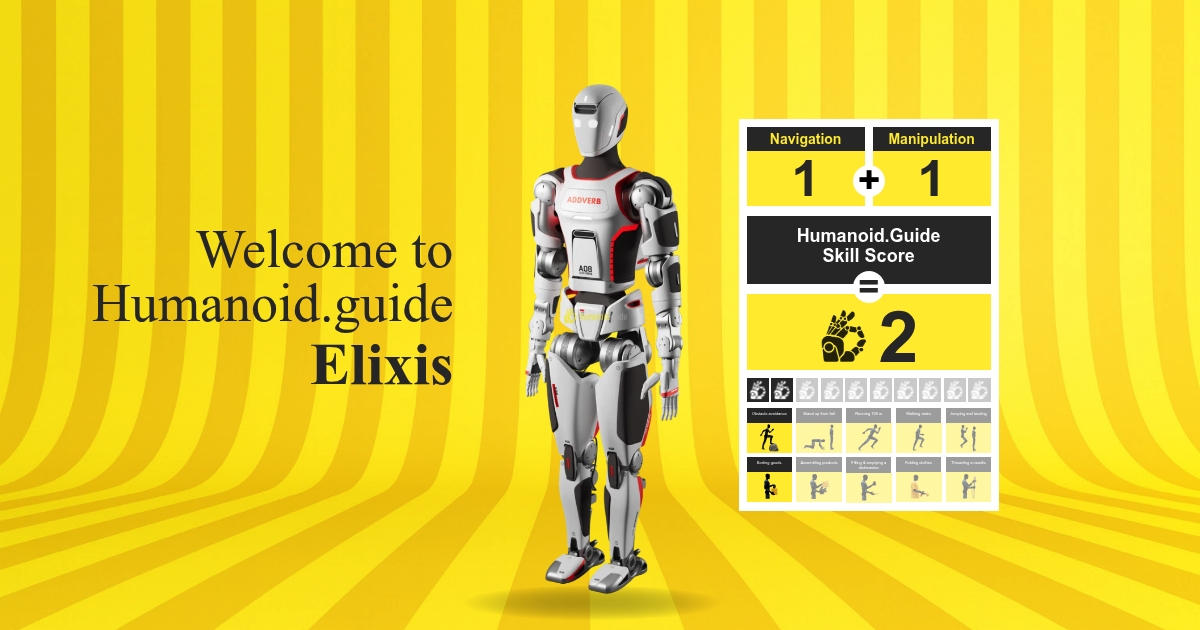
Elixis is a 175 cm, 75 kg humanoid designed by Addverb Technologies for industrial assistance in logistics, warehouses, retail, manufacturing, and healthcare settings. Its overall score of 2 out of 10 places it at an early stage of demonstrated humanoid capability, with navigation rated 1 out of 5 and manipulation rated 1 out of 5. The platform combines a biped body with 41 total degrees of freedom and two five finger hands, giving it a human shaped format intended for work around existing facilities and people. It uses high speed BLDC actuators, planetary gearboxes, an Intel Core i7 control unit, and NVIDIA Jetson Orin computing. Four stereo depth cameras support environmental perception, while 3D SLAM and multimodal sensor fusion contribute to its AI enabled control stack. Elixis has a stated maximum speed of 3.6 km/h, a 10 kg strength rating, and up to one hour of runtime per charge. Compliant control and layered safety hardware support close operation around human workers.
Elixis centers its practical task profile on two identified capabilities, obstacle avoidance and sorting goods. Obstacle avoidance is supported by stereo depth vision, 3D SLAM, and sensor fusion, which help the robot perceive its surroundings during facility operations. Sorting goods aligns with its five finger hands and industrial assistance role, enabling the platform to handle and organize items within relevant workflows. Its compliant control architecture is intended to keep interactions measured around people, while the two layer safety system uses six STM32 safety microcontrollers for monitoring. This combination positions Elixis for structured indoor work where perception, item handling, and safety must operate together.
Elixis is listed as a prototype and is offered with a stated price of 50,000 USD through an inquiry process. Developed by Addverb Technologies in India, it represents an Indian contribution to the emerging field of general purpose industrial humanoids. The platform’s emphasis on human centered assistance reflects a model in which robots support workplace operations alongside people. Its combination of Intel and NVIDIA computing, vision sensors, safety controllers, and human shaped hardware illustrates how industrial robotics is moving toward adaptable systems for facilities designed around human workers. At its current early stage score, Elixis highlights the continuing progression from prototype platforms toward practical workplace tools.