
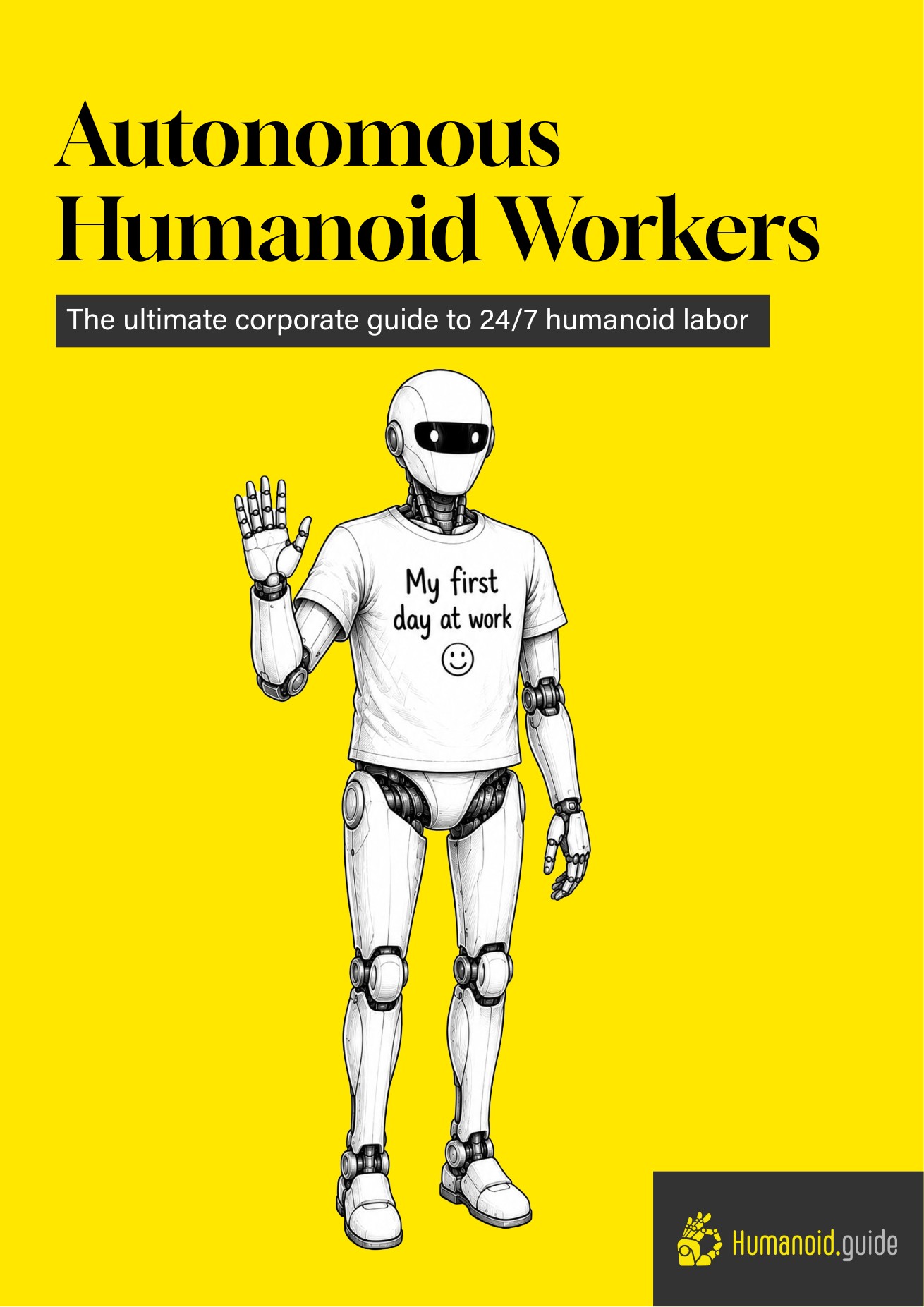
Corporate Preparation for Autonomous 24/7 Humanoid Workers
A board-level roadmap for the 2026–2031 transition. The robots are ready. The question is whether your organization is.
The first report written for the people who sign the purchase order
Roughly 13,000 humanoid robots shipped in 2025. Twelve commercial platforms are on the market. Payback periods have moved from vendor slides into CFO spreadsheets. And still, most pilots stall – not because the robots cannot do the work, but because the enterprise around them was never asked to be ready.
This report is the preparation manual: what a 24/7 humanoid worker actually is, what it costs over five years, what it does to your workforce, which standards apply and which do not yet exist, and a dated five-year plan with owners, budgets and gates.
- 130+ pages · ~36,000 words
- 11 chapters + Executive Summary
- 16 figures · 24 tables
- 251 sources, primary where they exist
- Five-year TCO and payback model
- Second Edition · updated September 2026
of Industry 4.0 adopters stuck in pilot purgatory – the constraint is readiness, not robots
modeled hourly cost of a $100,000 humanoid at 16 h/day – against $46.30 for US manufacturing labor
of 2025 humanoid volume shipped by Chinese manufacturers
of the preparation budget we recommend moving off hardware and into integration, data and people
Get the free preview
A chapter-by-chapter walkthrough of what the report covers, plus every page at a glance. Delivered by email.
Six chairs at the table – one plan
Humanoid deployment is not an engineering project with a business sponsor. It is a board decision with an engineering component. Every chapter closes with what each role has to own.
Boards and CEOs
Why 2026–2027 is the decision window, what first-mover advantage actually consists of, and the governance framework to put in place before the first purchase order.
CFOs
A five-year TCO model, six payback scenarios, Section 179 treatment, RaaS versus purchase, and the J-curve cash flows to budget for.
CHROs
What the WEF data actually says about robotics and jobs, union positions in four jurisdictions, and a five-phase reskilling program with owners and metrics.
CIOs and CTOs
Three integration architecture patterns, why the first robot-to-ERP integration takes hours but the security review takes months, and the IT/OT stack to build before fleet scale.
COOs and plant leadership
Floors, aisles, charging ratios, network latency, digital-twin validation and the maintenance economics of bipedal machines.
Legal, risk and compliance
ISO 10218:2025, the EU Machinery Regulation, the rescheduled AI Act, the Cyber Resilience Act, OSHA’s General Duty Clause – and the liability vacuum in between.
Preparation is the differentiator, not procurement.
Hardware capability is already sufficient for structured industrial work. What separates leaders from laggards is whether the enterprise around the robot – IT/OT, facilities, workforce, contracts – is ready to receive it. That readiness takes years to build, and none of it can be retrofitted to a fleet already on the floor.
Five overlapping phases, 2026–2031
Each phase comes with deliverables, an investment level as a share of IT budget, KPIs and the gate that must be cleared before the next one starts. Pilots begin in Month 6 while assessment is still running; BMW and Figure ran the whole sequence in eleven months.
Assessment & Foundation
Task audit, governance, vendor RFPs. Months 1–12.
Pilot & Validation
Single-task pilot, IT/OT integration, workforce engagement. Months 6–18.
Scale & Integration
Fleet expansion, cross-site rollout, reskilling at scale. Months 12–30.
Optimize & Automate
Continuous improvement, advanced tasks, supplier consolidation. Months 24–42.
Transform & Lead
Standard-setting, next-horizon planning. Months 36–60.
Eleven chapters and an Executive Summary
- 00
Executive Summary
The argument a board needs to hear in one sitting, and the recommendations split by role.
- 01
The 2026 Inflection Point: From Tech Demos to Labor Throughput
Shipments, platforms, production capacity, the China–US divergence, the sub-$30K price threshold and the actuator bottleneck.
- 02
The Anatomy of a 24/7 Autonomous Worker
Platforms, VLA foundation models, dexterous hands, and the battery architecture decision that moves a facility’s capital need by more than half.
- 03
The Economic Case: TCO, ROI, and Labor Economics
A five-year cost model, labor costs by jurisdiction, six payback scenarios, tax treatment and the insurance shift.
- 04
Strategic Imperatives for the C-Suite and Board
Governance framework, first-mover versus fast-follower, the productivity J-curve, and a six-dimension vendor scorecard.
- 05
Operational Readiness: Facilities, Infrastructure, and Integration
Why pilots stall, three integration patterns, floors and networks, digital twins and maintenance economics.
- 06
Workforce Transition and Human-Robot Collaboration
Displacement and creation dynamics, union positions in four jurisdictions, a five-phase reskilling framework.
- 07
Safety, Regulatory Compliance, and Certification
ISO 10218:2025, humanoid-specific drafts, EU and US regimes, a six-hazard risk matrix and battery-swap safety.
- 08
Cybersecurity, Liability, and Risk Management
Wormable exploits, training-data backdoors, CRA obligations, liability frameworks and insurance.
- 09
Industry Vertical Playbook
Automotive, logistics, electronics, healthcare, retail, hospitality, agriculture and construction – ranked by readiness.
- 10
The 5-Year Corporate Preparation Roadmap (2026–2031)
Five phases with deliverables, KPIs, budgets, a year-by-year action plan per stakeholder, and the BMW case.
- 11
Conclusion: First-Mover Advantage in the Age of Autonomous Labor
The convergence window, five success factors, and what changes for those who wait.
16 figures. 24 tables. One model.
Five-year TCO of a $100,000 enterprise humanoid – and the 47% that lands after the purchase order.
Months to payback across three labor scenarios, by unit price.
Robot capital saved per 100 workstations by hot-swap batteries versus docking.
Net jobs by 2030: robots and autonomous systems are the largest net job displacer in the WEF dataset.
The liability vacuum between today’s industrial standards and the first humanoid-specific ones.
The vendor scorecard: six dimensions, explicit weights, evidence required, common failure modes.
Two licences. One-time purchase.
- Full 130+ page report (PDF)
- All 11 chapters, 16 figures, 24 tables
- Single-user license
- Free updates throughout the 2026 cycle
- Email support
- Everything in Single User
- Unlimited internal users at one organization
- Right to quote in board papers and internal strategy documents
- Priority email support
- Optional 60-minute briefing call
Single User License · Terms · Enterprise License · Terms
By purchasing, you agree to the terms of the license you select. Questions? human@humanoid.guide
Frequently asked questions
Who is the report written for?
Boards, C-suites and the functional leaders who will own a humanoid deployment – CEO, CFO, CHRO, CIO/CTO, COO and legal/compliance. It assumes no robotics background. Engineers will find the technical chapters useful, but the report is written for the people who have to approve, fund and staff the program.
How is this different from the Humanoid Robot Market Report 2026?
The Market Report describes the industry – manufacturers, applications, demand and geopolitics. This report describes what your organization has to do about it: a cost model, a workforce plan, a compliance map and a five-year roadmap with owners and gates.
Are the cost figures real deployment data?
The five-year TCO, the hourly cost and the payback scenarios are humanoid.guide’s own model, built on published prices, BLS labor-cost data and stated assumptions (16 hours a day, 350 days a year, five years). Every assumption is printed so a CFO can change it. Where a figure is a vendor’s claim rather than a verified number, the text says so.
What is the methodology?
Every factual claim carries a numbered source – 251 in total – with primary sources preferred: company releases and filings, standards bodies, regulators, peer-reviewed papers and the major research houses. The September 2026 edition was re-verified claim by claim against those sources before release.
Will the report be updated?
Yes. Buyers receive free updates throughout the 2026 cycle. Standards and regulation in this space move quickly – the EU AI Act timeline changed in July 2026, for example – and the report is revised when they do.
Can I get a sample or preview?
Yes – the free preview above gives a chapter-by-chapter walkthrough and every page at a glance. Enterprise buyers can also request a briefing call before purchase.
Do you offer custom research or briefings?
Yes. Board briefings, readiness assessments and custom research are available – get in touch to discuss scope.
Waiting is itself a decision with a price
Defer to 2028–2029 and vendor capacity is committed, integration rates have risen, union positions have hardened into contract language, and the data moat has widened from months to years. The preparation takes years. The decision takes a meeting.
Buy full report · from $590