Southwest Airlines updates flight policy with humanoid robot ban
Southwest Airlines has updated its flight rules with a humanoid robot ban, according to a Grants Pass Tribune report published May 17. The policy bars humanoid and animal-like robots from both passenger cabins and cargo compartments, turning what had been an unusual edge case into a formal operating rule for a major US carrier.
What the humanoid robot ban covers
The report says the restriction was quietly added to Southwest’s safety and baggage guidance. It applies not only to the cabin, but also to checked baggage and cargo operations, and it covers the machines regardless of their size or intended purpose. That makes the policy broader than a simple carry-on rule.
At the same time, the article says Southwest has not prohibited all robotic devices. Smaller consumer electronics and compact robotic toys may still qualify under standard carry-on guidelines if they comply with existing battery restrictions. The dividing line, according to the report, is whether a machine is designed to imitate human or animal appearance, movement, or behavior in a realistic or interactive way.
A passenger incident exposed a policy gap
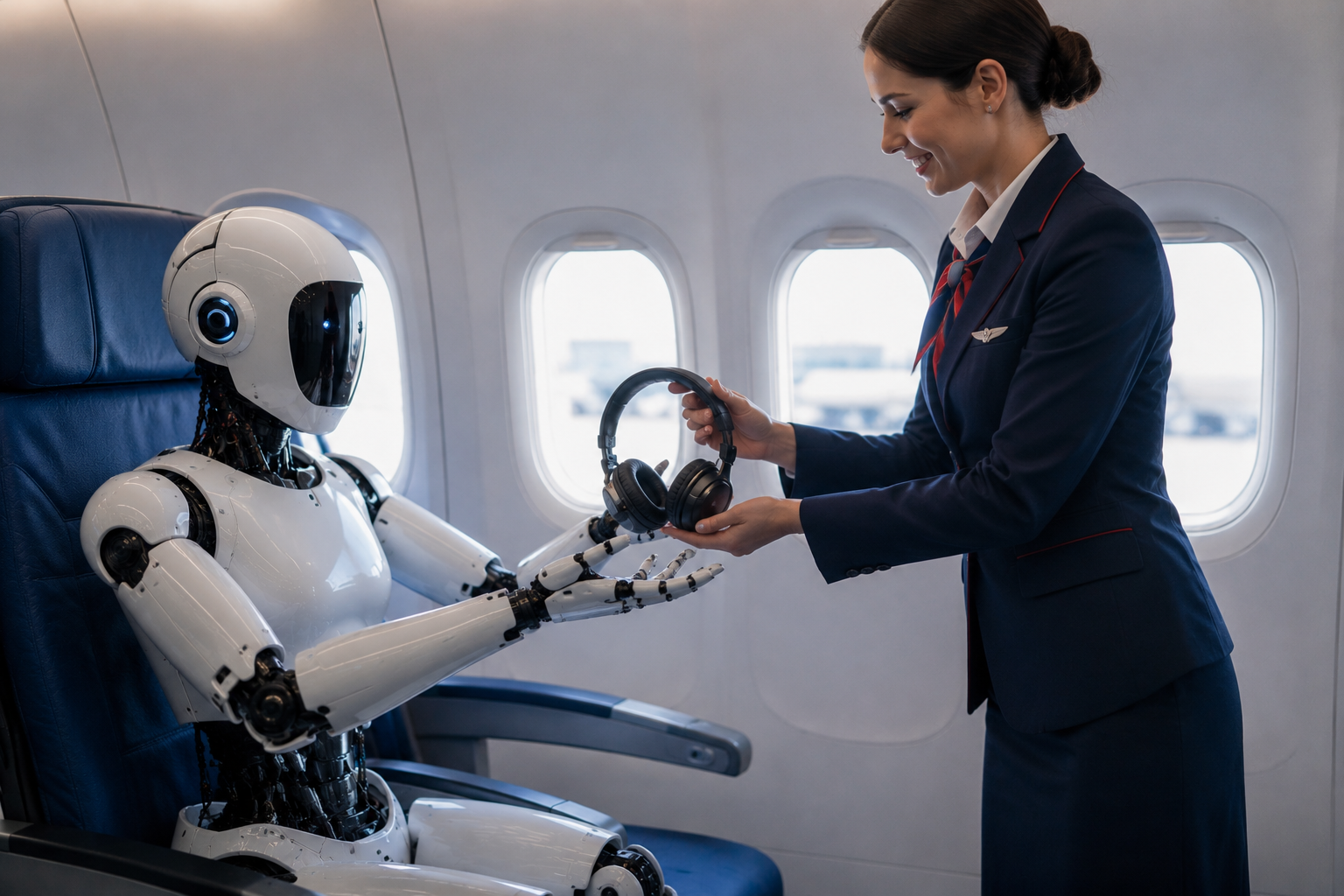
The article links the policy change to a recent onboard incident involving a humanoid robot passenger. According to the Grants Pass Tribune, a Dallas robotics entrepreneur purchased a seat for a human-like robot named Stewie on a Southwest flight from Las Vegas to Dallas. Images and videos of the machine seated beside passengers reportedly spread quickly on social media and turned the flight into a widely discussed aviation story.
That episode appears to have exposed a classification problem for airline staff. As the article describes it, crews had to decide whether the machine should be treated as cargo, electronics equipment, hazardous material, or a passenger occupying a purchased seat. For airlines built around human-centered operating rules, that ambiguity affects screening, boarding, seat assignment, emergency evacuation, and staff discretion at the gate.
Battery safety is central to the restriction
Southwest’s concerns appear to be rooted mainly in lithium-ion battery risk. The source notes that modern humanoid robots can contain battery systems large enough to power motors, sensors, cameras, processors, and onboard AI software at the same time. In an aircraft environment, that raises the possibility of thermal runaway, which aviation safety experts have long treated as a serious source of heat, smoke, and fire.
The airline case is more complicated than a standard consumer device because humanoid systems combine stored energy with moving mechanical parts. The report points out that concealed battery packs and internal actuators may be difficult for crews to assess quickly during screening or boarding. It also notes wider concerns that transportation operators will have to address, including passenger reactions, privacy issues tied to onboard cameras, and the behavior of AI-driven machines in confined public spaces.
Implications for humanoid robot logistics
According to the article, this may be one of the first publicly known blanket restrictions by a major US airline aimed specifically at lifelike robots. For developers, operators, and event organizers, the humanoid robot ban matters because commercial flights are often the simplest way to move machines to conventions, trade shows, sporting events, retail promotions, and other public demonstrations. If similar policies spread, logistics planning for humanoid deployments could shift toward ground freight or specialized cargo handling.
The broader industry issue is that humanoid robots are starting to move outside laboratories and warehouses into everyday venues, while transport rules still treat them as exceptions. The Grants Pass Tribune reports that AI-powered machines are becoming more visible in hospitality, customer service, healthcare assistance, and home companionship, which means travel, storage, and safety classification will become harder to ignore. Whether airlines create shared standards or continue to handle these machines carrier by carrier remains unclear, but Southwest’s policy suggests that humanoid transport is now an operational question, not a theoretical one.
Source: grantspasstribune.com