Welcome, StarBot Flex!
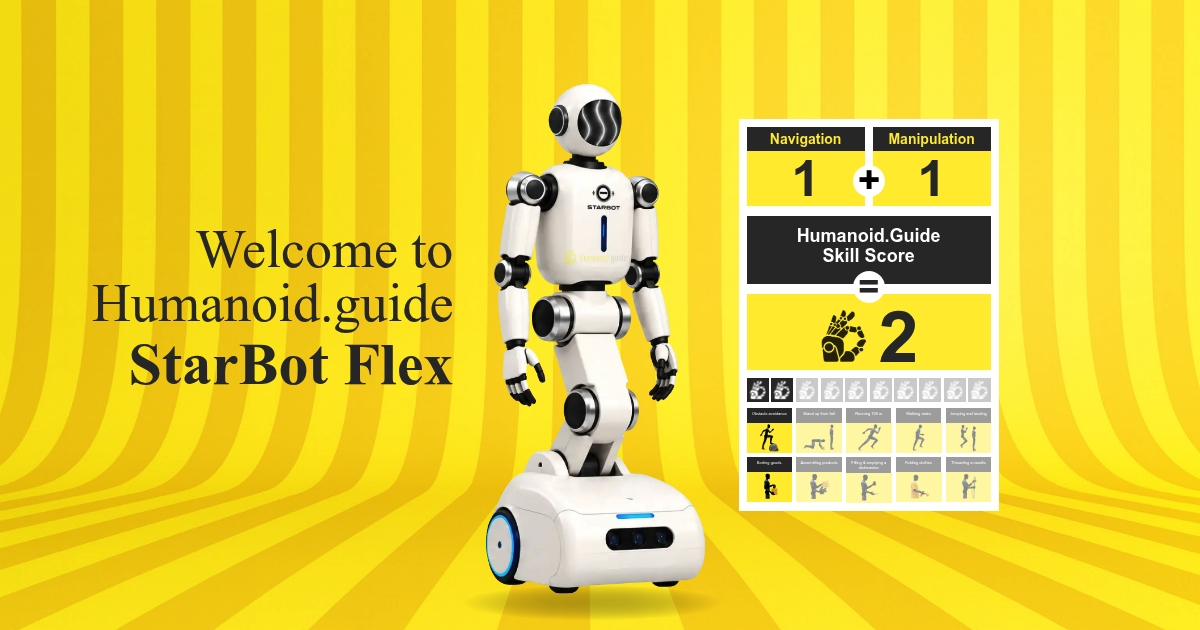
StarBot Flex is a foldable wheeled humanoid designed for service environments such as restaurants, hotels and retail stores. Developed by StarBot in Santa Barbara, California, it combines an adult sized upper body with a wheeled base rather than legs. It stands 175 centimeters tall, weighs 50 kilograms and has a listed maximum speed of 4 kilometers per hour. Its listed runtime is six hours per charge. The folding design supports transport and storage, making its physical format relevant to businesses with limited space. Electric motors power the robot, and its hands have five fingers each. Flex has an overall Humanoid Guide Skill Score of 2 out of 10, placing it in the early stage category. Navigation and manipulation are each rated 1 out of 5. Its confirmed capabilities include obstacle avoidance and sorting goods. Together, these specifications describe a preliminary service platform intended for practical indoor settings, rather than a mature general purpose humanoid.
Obstacle avoidance and sorting goods define Flex’s current capability profile. Its wheeled locomotion suits flat indoor floors, while obstacle avoidance is relevant to movement through service spaces where furniture and other objects shape accessible routes. Sorting goods provides a concrete manipulation capability for evaluating the robot in restaurant, hospitality or retail settings. The navigation rating of 1 out of 5 and manipulation rating of 1 out of 5 indicate preliminary performance in both categories. These ratings are assessment tiers, not counts of movements or tasks. For a business considering Flex, a useful evaluation would center on how consistently it avoids obstacles and sorts the specific goods involved in a proposed workflow.
Flex is listed as a prototype, with an advertised price of 25,000 US dollars and an option to inquire about pricing. StarBot plans to test individual workflows at customer sites before full deployment, giving businesses a way to assess suitability within their own premises. The platform builds on the company’s restaurant tested Nova robot and extends its focus on service robotics into a foldable humanoid format. Planned safety measures include an emergency stop, speed limiting and sensing, with confirmation tied to each deployment. Its broader significance lies in this combination of wheeled mobility, humanoid manipulation and site specific trials. Its early stage score makes practical evaluation more relevant than expectations of broad autonomy.