Southwest humanoid robot ban follows viral passenger flights
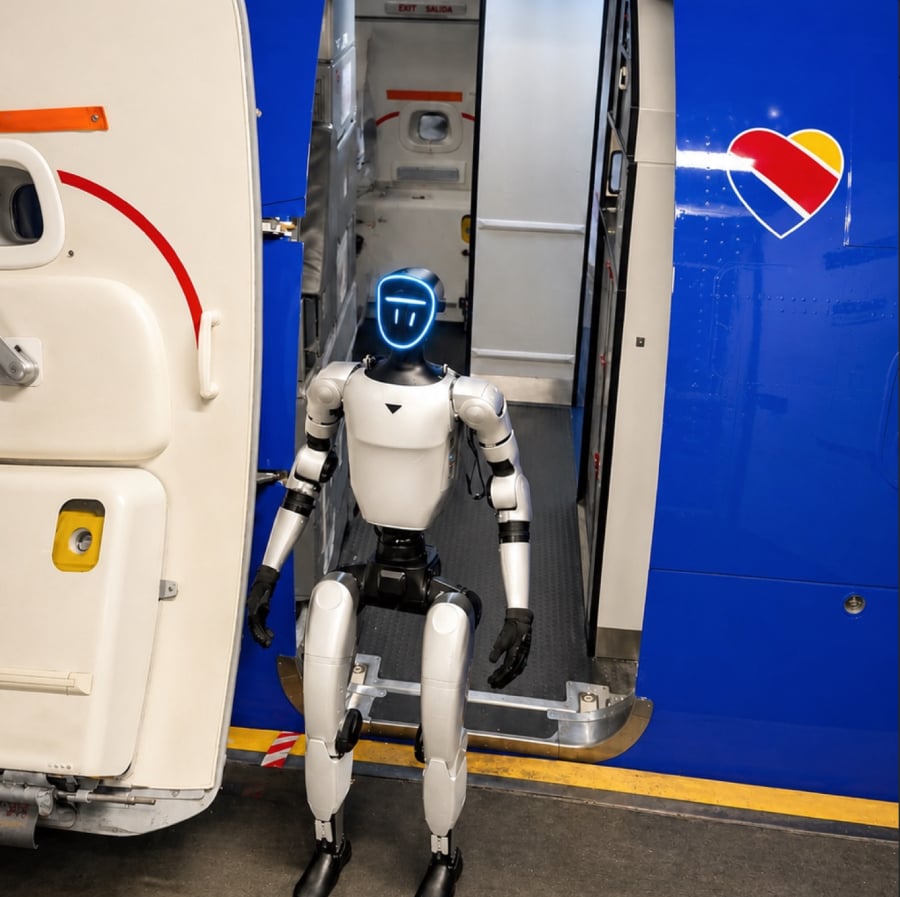
Southwest Airlines has introduced a Southwest humanoid robot ban, barring human-like and animal-like robots from passenger cabins and checked luggage after two high-profile passenger flights involving event robots. The policy turns a novelty travel episode into a practical transport issue for humanoid operators, focusing attention on lithium-ion battery safety, seat use, and how airlines classify machines that can move through public spaces under their own power.
Southwest humanoid robot ban centers on batteries
Southwest framed the change as a safety measure tied to the batteries used in sophisticated robotics. According to eWeek, the airline said its primary concern is the size of lithium-ion batteries used to power the robots and the risk those batteries pose during flight.
The airline also moved to narrow the definition of what is covered. Southwest defines a human-like robot as one designed to resemble or imitate a human in appearance, movement, or behavior, and an animal-like robot in parallel terms. The restriction applies both to the passenger cabin and to checked baggage, removing the ambiguity that flight crews faced in the earlier cases.
The wording is broad rather than model-specific. Instead of creating a special rule for one robot or one route, Southwest set a category rule that staff can apply before boarding and in the cabin. That matters because the earlier flights appear to have forced crews to make real-time judgments about whether a robot was occupying a passenger seat or traveling as an oversized carry-on item.
Flights that prompted the rule
The most visible case involved Aaron Mehdizadeh, founder of The Robot Studio in North Dallas, who bought a standard passenger seat on a flight from Las Vegas to Dallas Love Field for Stewie, a 3.5-foot humanoid robot used for events. To clear TSA security, Mehdizadeh equipped the robot with a smaller battery. Stewie then walked through the terminal and boarded the aircraft under its own power.
That trip illustrated why humanoids are treated differently from most consumer electronics. Stewie was not boxed, checked, or simply carried to the gate, but moving visibly through the airport as an active machine. The source says the robot drew stares and photos from onlookers, turning a routine boarding process into a public demonstration.
Once onboard, the operational problem became clearer. Because Stewie was technically classified as a carry-on item, it was not supposed to occupy a seat, even though a seat had been purchased for it. The crew disconnected the robot’s battery and moved it to a window position so the flight could continue.
A second incident followed on April 30, when Eily Ben-Abraham of Elite Event Robotics brought a robot named Bebop on a Southwest flight from Oakland to San Diego. That flight was delayed for nearly an hour after the crew saw the robot seated next to an aisle, which conflicted with airline rules for large carry-on items, and raised concerns about the power source. Together, the two trips pushed an unusual edge case into a formal policy question.
What the change means for robot operators
Mehdizadeh publicly disputed Southwest’s battery rationale, saying the modified power source used for Stewie was essentially a laptop battery. Even so, the disagreement points to a broader gap between aviation procedures and the needs of companies transporting humanoids for events and public appearances. A walking robot can look like a passenger, but airline procedures may still treat it as baggage.
For companies using humanoids as event platforms, the restriction is less about onboard autonomy than about transport procedure. The source describes both Stewie and Bebop as event robots, and both cases ran into ordinary airline rules once they reached the cabin environment. That makes travel policy a real deployment variable for firms moving humanoids between cities for commercial use.
What happens next is still unclear. eWeek noted that the incidents raise the possibility that other airlines could adopt similar restrictions as lifelike robots become more common in public spaces. For the humanoid sector, the immediate lesson is that deployment planning now includes transport compliance, not just hardware capability and software behavior.
Source: eweek.com