Welcome, Kaleido 9!
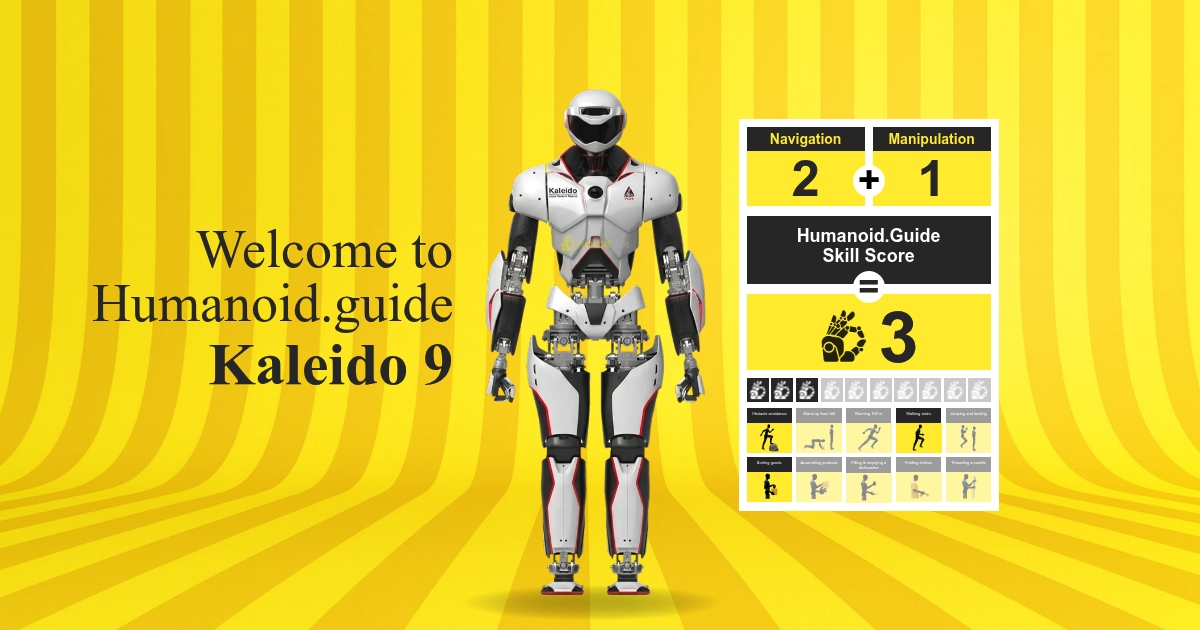
Kaleido 9 is a 190 centimetre humanoid robot from Kawasaki Robotics, created for disaster response and demanding industrial environments. The fully electric platform weighs 99 kilograms, has a stated payload strength of 30 kilograms, reaches speeds of up to 5 kilometres per hour, and operates for up to three hours per charge. Its magnesium alloy skeleton and 3D printed resin exterior panels combine structural support with a distinctive white humanoid form. Enhanced stereo cameras and LiDAR support three dimensional mapping, while Ethernet, WiFi, and VR headset teleoperation provide multiple operational connections. Kaleido 9 is rated 3 out of 10 on the Humanoid.Guide Skill Score, placing it in a developing stage. Its Navigation rating is 2 out of 5 and its Manipulation rating is 1 out of 5, reflecting an early capability profile focused on core mobility and whole body work rather than broad general purpose performance. Reinforced waist and leg joints support improved balance recovery for demanding physical settings.
Kaleido 9’s confirmed capabilities include walking stairs and sorting goods. Stair walking is particularly relevant to disaster sites, factories, warehouses, and other facilities where elevated access routes remain essential for human workers. Its tall 190 centimetre frame and robust body structure suit environments designed around human scale infrastructure. Sorting goods connects the platform to material handling tasks where objects must be identified, moved, and organized within industrial workflows. These capabilities fit Kawasaki Robotics’ focus on combining humanoid form factors with practical physical work. The Navigation rating of 2 out of 5 indicates an emerging mobility foundation, while the Manipulation rating of 1 out of 5 highlights that sorting work is an early area of applied handling capability. Together, these functions establish a platform for structured physical tasks in complex built environments.
Kaleido 9 is currently listed as a prototype. Kawasaki Heavy Industries unveiled the ninth generation Kaleido humanoid at the 2025 International Robot Exhibition in Tokyo, representing nearly a decade of dedicated Kaleido development beginning in 2015. The project also draws on Kawasaki’s longer robotics history, including its role in producing Japan’s first domestically built industrial robot in 1969. Kaleido 9 matters because it connects humanoid research with an established industrial robotics company and its existing mobile robot ecosystem. Its combination of electric actuation, remote VR operation, stereo vision, LiDAR, and industrial design points toward deployment concepts where human operators and robotic systems can collaborate in hazardous or physically demanding locations.