NVIDIA demonstrates SONIC controller on Unitree G1 humanoid
NVIDIA researchers have demonstrated SONIC, a humanoid control framework intended to drive running, jumping, grasping and other whole body motions through a single learned policy, according to Interesting Engineering. The system was tested in simulation and on a Unitree G1 humanoid, where the researchers reported a 99.2 percent success rate across 123 real world motion sequences.
The central claim is scale. Rather than training separate controllers for separate skills, SONIC uses motion tracking as the base task and trains one policy on more than 100 million motion frames. Those frames were derived from about 700 hours of motion capture data, with the largest model reaching 42 million parameters.
Key facts
- Training data: more than 100 million motion frames from about 700 hours of motion capture data
- Largest model: 42 million parameters
- Training compute: as many as 128 GPUs and about 21,000 GPU hours
- Hardware test: Unitree G1 humanoid
- Reported real world result: 99.2 percent success across 123 motion sequences
A shared token space for humanoid motion
SONIC’s architecture uses what the researchers call a universal token space. Specialized encoders handle robot motion, human motion and hybrid commands, then convert those inputs into a shared quantized representation that feeds a common robot control decoder.
That design lets the same control policy connect several input types to whole body control. The source describes VR teleoperation, video, text commands, music driven motion generation and vision language action models as supported routes into the controller. Video can come from prerecorded clips or live webcam streams, while text prompts can specify actions such as walking or kicking.
For humanoid developers, the useful part of the claim is not a single acrobatic behavior. It is the attempt to make locomotion, manipulation and expressive motion use the same low level action representation. Many humanoid stacks still separate walking control from arm and hand behavior, which complicates full body tasks that require coordinated contacts.
Real world tests show a small simulation gap
The reported hardware result is unusually concrete for this type of control work. SONIC achieved 99.2 percent success across 123 real world motion sequences on the Unitree G1 humanoid, compared with 100 percent in simulation. The source does not describe the full distribution of those sequences, so the result should be read as a reported benchmark rather than a broad field deployment claim.
The framework also includes a real time kinematic motion planner that generates short motion segments between keyframes. It can replan continuously as commands change, allowing the robot to adjust direction, speed and movement style without retraining the policy.
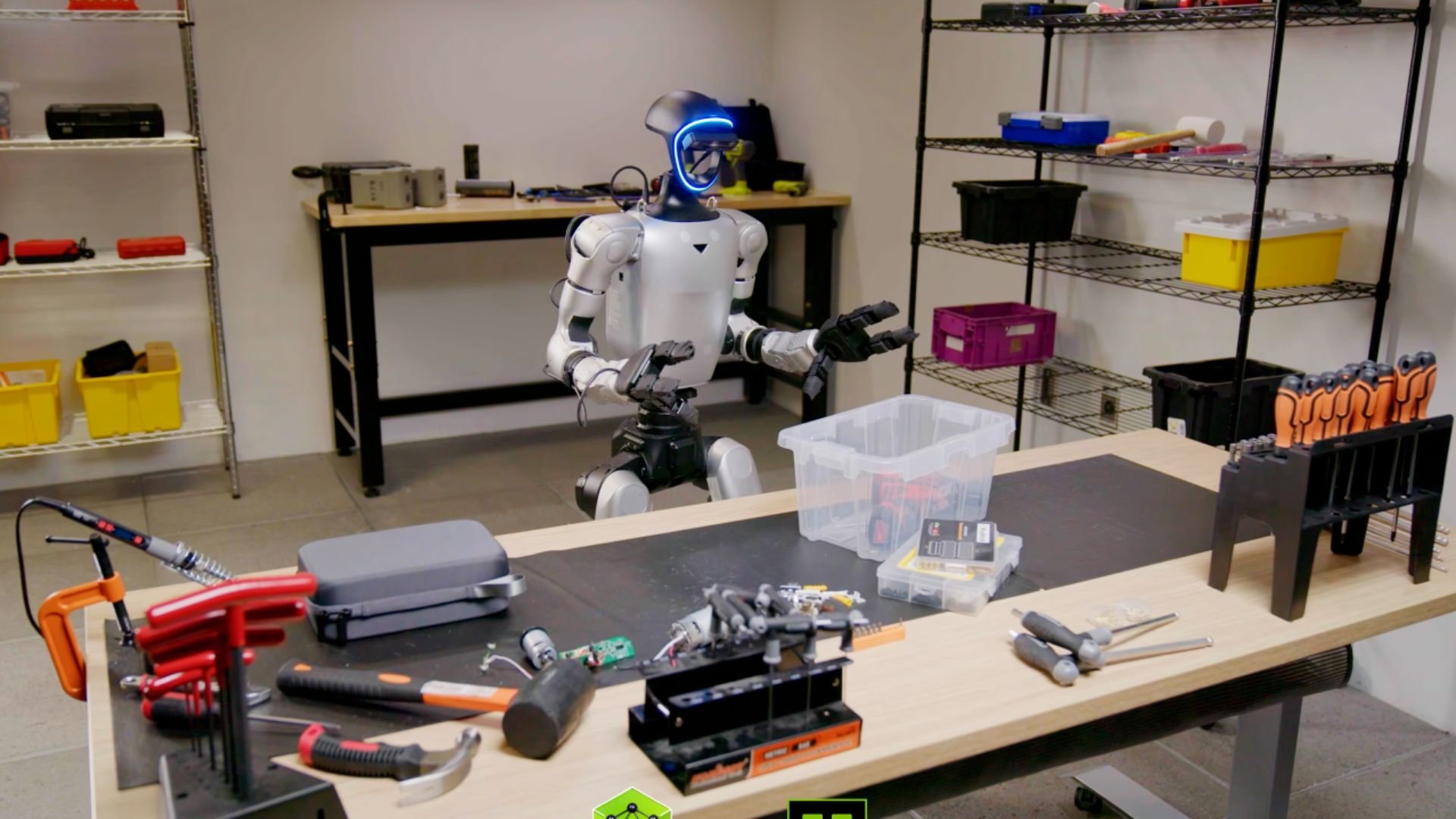
NVIDIA’s researchers also connected SONIC to a vision language action model through the shared token interface. Across five whole body tasks, the system averaged 75 percent success, including object pickup, opening a trash can with a foot pedal and coordinating hand and foot motion to move a soda can into the bin.
The researchers said SONIC could provide a foundation for adding higher level perception and reasoning to humanoid autonomy. The immediate evidence is narrower: a scaled motion tracking controller, trained with substantial data and compute, running diverse motions on a commercial humanoid platform with reported hardware results close to simulation.
Source: interestingengineering.com