Welcome, Dex2/5!
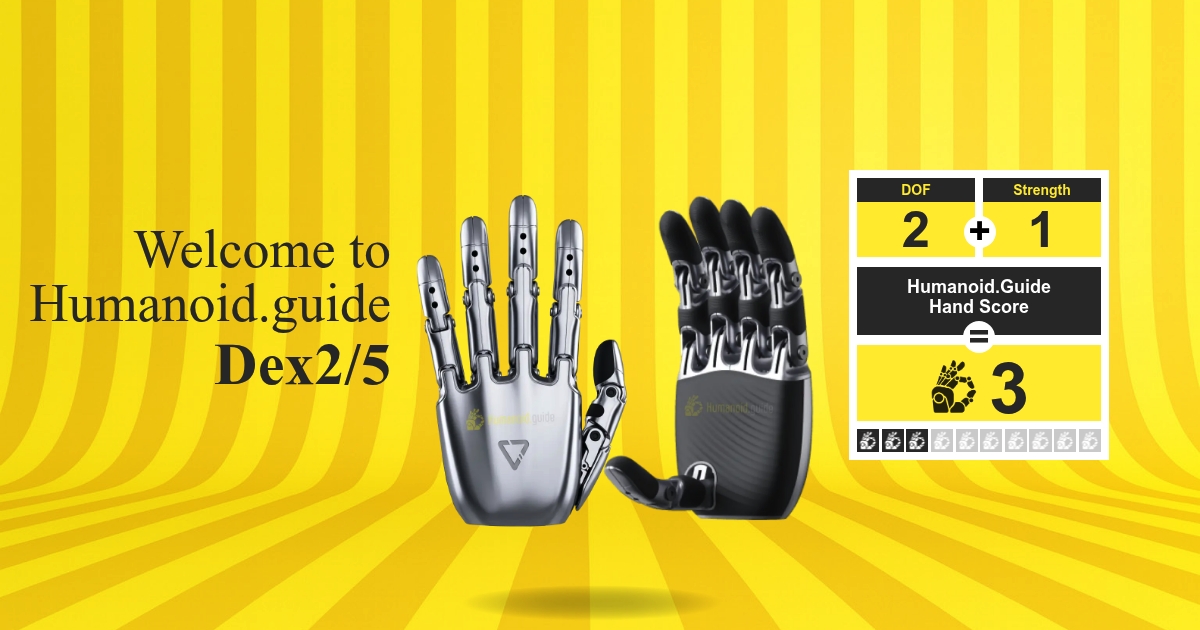
Dex2/5 is a lightweight robotic hand from Unitree Robotics, designed for the company’s G1 and R1 humanoids. Its five finger layout uses a compact mechanical architecture with two electric actuators, gearing, and tendon transmission. One motor serves the thumb, while the other moves the remaining four fingers together. This arrangement prioritizes mechanical simplicity rather than independent actuation of every finger. The hand weighs 365 grams and measures 151 × 70 × 63 millimeters, giving it a compact physical format for integration into a humanoid platform. Its overall Hand Score is 3 out of 10, placing it in the developing category rather than among mature or leading systems. The component ratings are 2 out of 5 for Degrees of Freedom and 1 out of 5 for Strength. These are comparative tier ratings, not physical measurements or joint counts. Together, they position Dex2/5 as an accessible hand with a restrained performance profile, whose principal design emphasis is simplicity, low mass, and affordability.
The technical ratings distinguish two separate evaluation priorities: dexterity and grip strength. Dex2/5’s Degrees of Freedom rating of 2 out of 5 places that dimension below the upper tiers, while its Strength rating of 1 out of 5 puts strength in a lower tier. Neither rating should be read as a literal specification, and the combined score does not establish suitability for a particular task. For application planning, these ratings are best treated as an initial comparison framework rather than a substitute for testing. Relevant evaluation questions include the required object range, the precision a task demands, and the forces involved. Those requirements should guide selection rather than the overall score alone.
Dex2/5 is listed as in production, with an advertised price of 800 USD and an option to inquire about pricing. Its manufacturer, Unitree Robotics, is based in Hangzhou, China, and develops both quadruped and humanoid robots. The hand’s intended association with Unitree’s G1 and R1 platforms places it within the company’s broader humanoid hardware offering, rather than presenting it as an isolated component. Its broader significance lies in the emphasis on a compact, lightweight, and comparatively simple hand architecture at an accessible listed price. The developing overall rating remains an important counterbalance to that positioning: affordability and integration context are relevant purchasing considerations, but they are distinct from high dexterity or strength ratings.