Figure AI humanoids demonstrate 24-hour sorting in livestream
Figure AI humanoids spent more than 24 hours sorting packages at the company’s San Jose headquarters this week, in a livestream that drew more than 3 million views on X. The run offered a public test of whether humanoid robots can sustain repetitive warehouse work across a full shift, then continue through handoffs between multiple units.
Figure AI humanoids in a 24-hour warehouse test
According to Business Insider, Figure AI CEO Brett Adcock began the livestream on Wednesday to show that the robots could complete an eight-hour stretch of autonomous labor. By Thursday morning, Adcock said, the humanoids had sorted more than 30,000 packages with “zero failures,” extending well past the original target.
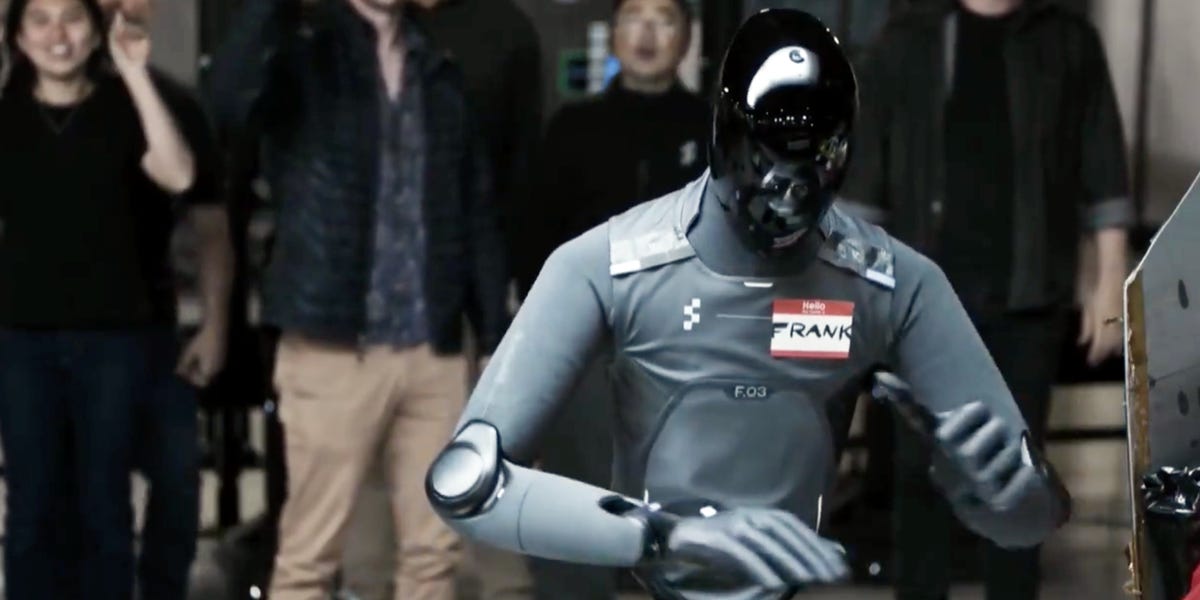
The setup was simple but revealing. One robot picked up small packages and placed them on a conveyor belt with the barcode facing down, while two other humanoids waited on chargers in the background and were ready to take over when the working unit needed power. The company continued the broadcast past the 24-hour mark, and by Thursday evening the robots had logged 30 hours of continuous work.
What the livestream showed
The demonstration focused on a narrow warehouse task rather than a full logistics workflow. Investor Jesse Coors-Blankenship told Business Insider that the conveyor was a large loop and that the same packages cycled through repeatedly, framing the exercise as a reliability test rather than a realistic throughput benchmark for a busy fulfillment center.
Adcock said Figure AI humanoids are fully autonomous and decide what to do from camera input, countering online speculation that a remote human operator was assisting the task. He added that when a robot gets stuck, its AI model triggers an automatic reset, and that a robot with a software or hardware issue can autonomously leave for maintenance while another robot takes over.
Commercial readiness remains the open question
The livestream gave Figure AI humanoids a widely viewed proof point in a crowded market that includes Tesla, Agility Robotics, and Unitree. Figure AI, which Business Insider described as valued near $40 billion, is using these demonstrations to convince customers and investors that general-purpose humanoids can handle long stretches of repetitive work in warehouses, factories, and eventually homes.
Competition in that market is already forcing comparisons. When asked about the livestream at an event in San Francisco, Agility Robotics cofounder Jonathan Hurst replied, “Congratulations. We did that two years ago,” referring to Digit deployments with customers including Amazon, Schaeffler Group, and GXO.
At the same time, the coverage made clear that duration alone does not settle the question of deployment readiness. Roboticist Ayanna Howard, dean of Ohio State University’s College of Engineering, called the run impressive because it appeared to continue for so long without a failure, but said the machines still looked more like a “science project” than systems ready for real-world logistics operations.
Howard pointed to visible accuracy issues during the livestream, including packages placed on the belt with the barcode facing the wrong way and one package being knocked off the conveyor. She also noted that the robot was handling only one small part of package sorting, not the broader range of perception, manipulation, and exception handling required in an actual logistics center.
Why the demo matters for warehouse humanoids
The public response to the stream showed how much attention now surrounds warehouse humanoids, even when the task itself is monotonous. Viewers nicknamed the three robots Bob, Frank, and Gary, and the feed accumulated more than 1.5 million views in its first eight hours before passing 3 million by the 24-hour point.
For the industry, the more important shift is that humanoid companies are moving beyond short edited videos and toward uptime claims, repeated task execution, and visible battery and maintenance handoffs. The next benchmarks will be customer-site deployments, broader task coverage, and independent evidence that humanoids can maintain similar performance outside controlled demonstrations.
Source: businessinsider.com