Hyundai Workers Strike Over Atlas Humanoid Deployment
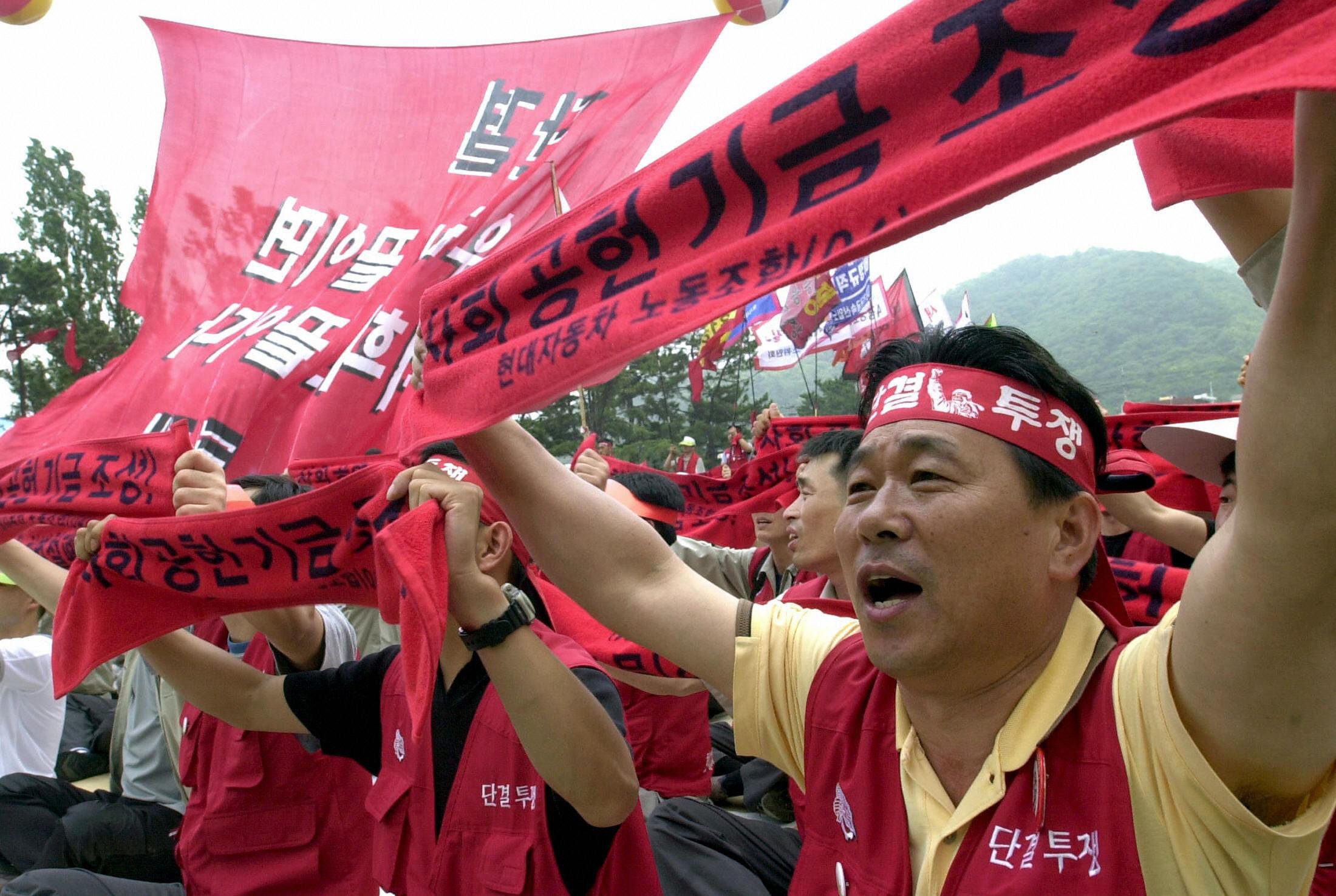
Thirty five thousand workers at Hyundai’s Ulsan complex began four hour partial strikes on July 20, according to TechTimes, in a labor action centered on Boston Dynamics’ Atlas humanoid before the robot has entered any Korean Hyundai plant.
The walkout is tied to a broader wage dispute, but the sharper robotics issue is consent. The Korean Metal Workers’ Union wants contract language requiring union approval before any humanoid robot deployment in Hyundai’s Korean factories. TechTimes, citing multiple sources that referenced the Wall Street Journal, described the stoppage as the first in the auto industry directly triggered by humanoid robots.
The timing is unusually pointed. Hyundai Motor Group reached the contractual close of full ownership of Boston Dynamics the same day, after SoftBank exercised a put option covering its remaining roughly 10 percent stake. The transaction was valued at about $325 million, implying a Boston Dynamics valuation of roughly $3.3 billion.
Atlas is still outside Korea
Hyundai has not assigned Atlas to any Korean factory task, according to the source. The confirmed deployment is at Hyundai Motor Group Metaplant America near Savannah, Georgia, beginning in 2028. Atlas is slated to start with parts sequencing, then expand to component assembly roles by 2030.
That absence is the union’s leverage. Once humanoids are operating inside a plant, bargaining usually moves toward mitigation, retraining and severance. The KMWU is trying to negotiate the terms of entry before a deployment creates operational precedent.
Hyundai has said workers can move into higher value roles such as training, supervising and maintaining robots. The union is not accepting that as sufficient protection. Its package of demands includes converting hourly production roles to fixed salaries, raising retirement age from 60 to 65, and giving workers a formal right to approve or refuse humanoid deployments.
The robot at the center of the dispute
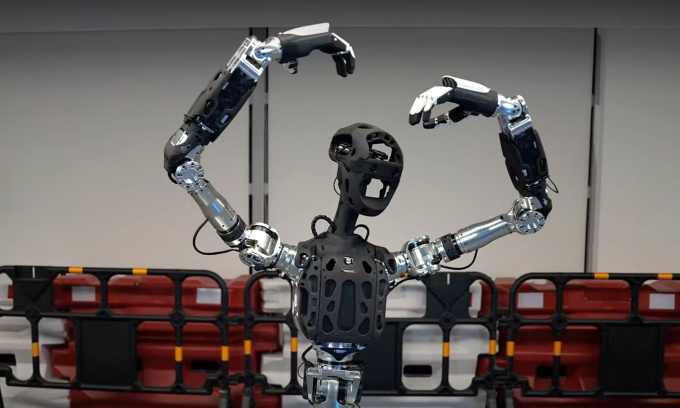
The Atlas involved here is Boston Dynamics’ fifth generation electric humanoid, not the retired hydraulic platform known for public demonstrations. TechTimes says the production Atlas is 6.2 feet tall, weighs 198 pounds and has 56 degrees of freedom, including 360 degree joint rotation at the hips, waist, neck and extremities.
The source lists a 50 kilogram instant lift capacity, 30 kilogram continuous lift capacity and 2.3 meter reach, allowing the robot to work around existing assembly lines without major physical reconfiguration. Dual hot swappable batteries are described as providing about four hours of runtime per pack, with autonomous three minute battery swaps for continuous operation through a shift.
The article also emphasizes the training method. Atlas uses reinforcement learning, with human motion capture data adapted to the robot’s joint geometry and trained through large scale simulation. TechTimes reports that new industrial tasks can be trained in about 24 hours and that an internal test policy trained on a 50 kilogram load adapted without retraining to heavier loads.
Those claims still need to be separated from broad commercial proof. The source says all 2026 Atlas units are committed to Hyundai facilities and Google DeepMind, with no arms length commercial customers until 2027. For factory operators, the labor dispute may be as useful a signal as the demo footage: workers are treating the platform as credible before it has arrived on their line.
Wages, production losses and a standards gap
The union represents more than 39,000 employees, with more than 34,000 authorizing industrial action. Earlier partial strikes from July 13 to July 15, when workers left two hours early each day, disrupted about 5,000 vehicles and represented roughly 200 billion won, about $145 million, in potential revenue losses, according to the source.
The wage terms are specific. Workers are seeking a performance bonus equal to 30 percent of Hyundai’s consolidated net profit. Management has offered an 89,000 won, about $64, increase in basic monthly pay, a performance bonus worth 350 percent of base salary plus 10 million won, about $7,200, and 15 company shares per worker.
Hyundai has said it will not compensate workers for wages lost during strike days, and management warned that stoppages cause “irreversible production losses.” The union has indicated it could extend the action or escalate to a full strike if automation demands remain unresolved.
The safety backdrop is thin. TechTimes reports that no safety standard specifically governs humanoid robots in mixed human and robot factory environments. OSHA has no regulations for this scenario, and ISO 25785-1, a standard for dynamically stable walking robots, is still under development with expected publication in 2026 or 2027 at the earliest.
Hyundai plans to deploy more than 25,000 Atlas robots across Hyundai and Kia factories globally, according to the source, absorbing most of a 30,000 unit annual production target by 2028. If the KMWU wins prior approval rights over Atlas humanoid deployment in Korea, other industrial unions will have a concrete bargaining model. If it fails, Hyundai will have a clearer path to introduce humanoids on management’s timetable once the robots are ready for Korean plants.
Source: techtimes.com