Leaderdrive harmonic reducers surge as humanoid demand lifts shares
Leaderdrive harmonic reducers are moving into the spotlight as rising humanoid robot demand lifts the valuation of a key Chinese motion component supplier. Shares of Leader Harmonious Drive Systems, known as Leaderdrive, have climbed 40% over the past year, helping founder Zuo Yuyu and his brother Zuo Jing reach billionaire status as investors look beyond robot makers to the companies supplying their joints.
Leaderdrive harmonic reducers and the humanoid market
Founded in 2011 by Zuo Yuyu, Leaderdrive focuses on affordable robot components and has become China’s largest manufacturer of harmonic reducers. These precision gear systems function as joints in robotic arms and humanoid machines, making them a central part of the motion stack for many robot designs.
According to J.P. Morgan, the company holds between 30% and 40% of China’s harmonic reducer market. As VnExpress International reports, its domestic customers include humanoid robot companies such as Agibot and UBTech Robotics, placing Leaderdrive in a part of the supply chain that is directly exposed to rising humanoid development activity.
That matters because the current humanoid race is no longer centered only on complete robots and public demos. Suppliers of reducers, vision systems, and other subsystems are increasingly becoming a visible proxy for how much production activity is building behind the scenes.
Financial growth tracks humanoid robot demand
Leaderdrive’s 2025 results show how quickly that demand is translating into financial performance. The company said net profit more than doubled year on year to 124.4 million yuan, while revenue rose 47% to 570.7 million yuan, citing expansion in both industrial robotics and humanoid robot markets.
Share performance has followed. Based on last Thursday’s closing price of 203.8 yuan, chairman Zuo Yuyu, 56, and vice chairman Zuo Jing, 61, who each hold a 17% stake, are worth about US$1 billion apiece, according to Forbes.
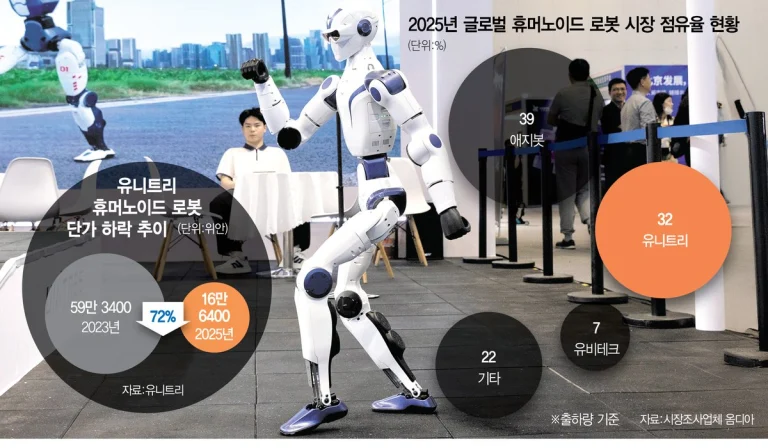
The wider market backdrop is also shifting fast. Research firm Omdia said global humanoid robot shipments rose nearly 480% in 2025 to 13,318 units, and projected that figure would reach 2.6 million units by 2035. Even if forecasts at that horizon remain uncertain, they help explain why component makers tied to actuation and motion control are attracting more attention from investors.
Supply chain momentum is broadening in China
Zuo Yuyu, a physics graduate of Nanjing University, began his career in 1999 at Hengjia Metal in Suzhou and later shifted into robotics in 2003, working on harmonic reducers before formally establishing Leaderdrive. In a 2020 interview with Shanghai Securities News, he said the company’s early years were shaped by the fact that key technologies were dominated by Japanese firms, and that progress came through “a process of constant trial and error.”
Leaderdrive went public on Shanghai’s STAR Market in 2020 and raised around 1.1 billion yuan in its initial public offering. Zuo Jing joined the company in 2014 as general manager, adding to the family leadership behind a business that now sits at an important point in China’s humanoid robotics supply chain.
The source also places the brothers among a broader group of Chinese founders benefiting from the robotics supply chain boom. It names Gpixel Changchun Microelectronics founder Wang Xinyang and Orbbec founder Howard Huang as other entrepreneurs whose companies are tied to sensors and 3D vision systems used in robotics.
The immediate story is about wealth creation, but the deeper signal is industrial. Public markets are beginning to value humanoid robotics through the companies that supply joints and other enabling components, not only through the robot brands that appear in demos. Whether shipment forecasts materialize at the projected pace remains unclear, but supplier performance is becoming an increasingly important indicator of where humanoid production is starting to scale.
Source: e.vnexpress.net