TrendForce maps US and China humanoid supply chain split
TrendForce has published a humanoid supply chain analysis that frames the US and China contest around two different strengths: intelligence platforms in the US and component scale in China. According to the GlobeNewswire release, the firm sees the global humanoid robot industry entering a phase of commercial trials, where control of key parts and a durable business model are becoming central competitive tests.
The analysis is useful less as a forecast of individual winners than as a map of where component leverage sits. TrendForce also introduces a Component Supply Chain Influence Index, or CSCII, to compare regional influence across humanoid robot component layers. The public release does not disclose the underlying scores, which TrendForce says are available by contacting the firm.
AI stack versus manufacturing depth
TrendForce argues that the US advantage in humanoid robotics is concentrated in the AI ecosystem. It points to NVIDIA platforms including Cosmos, Isaac Lab and GR00T, Google DeepMind’s Gemini Robotics, and OpenAI’s role in embodied AI model development through investment and research. In TrendForce’s view, US firms are building around large models, simulation environments, robotics platforms and AI chips.
The release links that software strategy to specific humanoid companies. Tesla’s Optimus Gen 3 is described as continuing real world validation on factory floors, with future production focused on improving generalization across work environments. TrendForce also says Figure AI is working with large enterprises to train models on factory data, Boston Dynamics is combining motion control experience with AI, and Apptronik is feeding real world deployment data into the Gemini Robotics training pipeline.
China, by contrast, is presented as a scale and supply chain story. TrendForce says localized servo motors, reducers and lithium batteries are helping Chinese humanoid developers lower costs and shorten development cycles. Unitree and Agibot are named as representative companies, with Unitree cited for high value products and fast iteration across quadruped and humanoid robots.
The sharpest production claim in the release concerns Agibot. TrendForce says Agibot increased production first to 5,000 units after about a year, then to 10,000 units in just three months. The release does not break down models, delivery status or end customer mix, so the figure should be read as TrendForce’s reported production scaling metric rather than a verified installed base.
CSCII gives a regional component view
TrendForce’s CSCII is explicitly not a single directly verifiable statistic. The firm describes it as a composite indicator that uses expert judgment across five dimensions: industry scale position, technology barriers and substitutability, humanoid robot application penetration, production capacity and expansion momentum, and policy or geopolitical supply resilience.
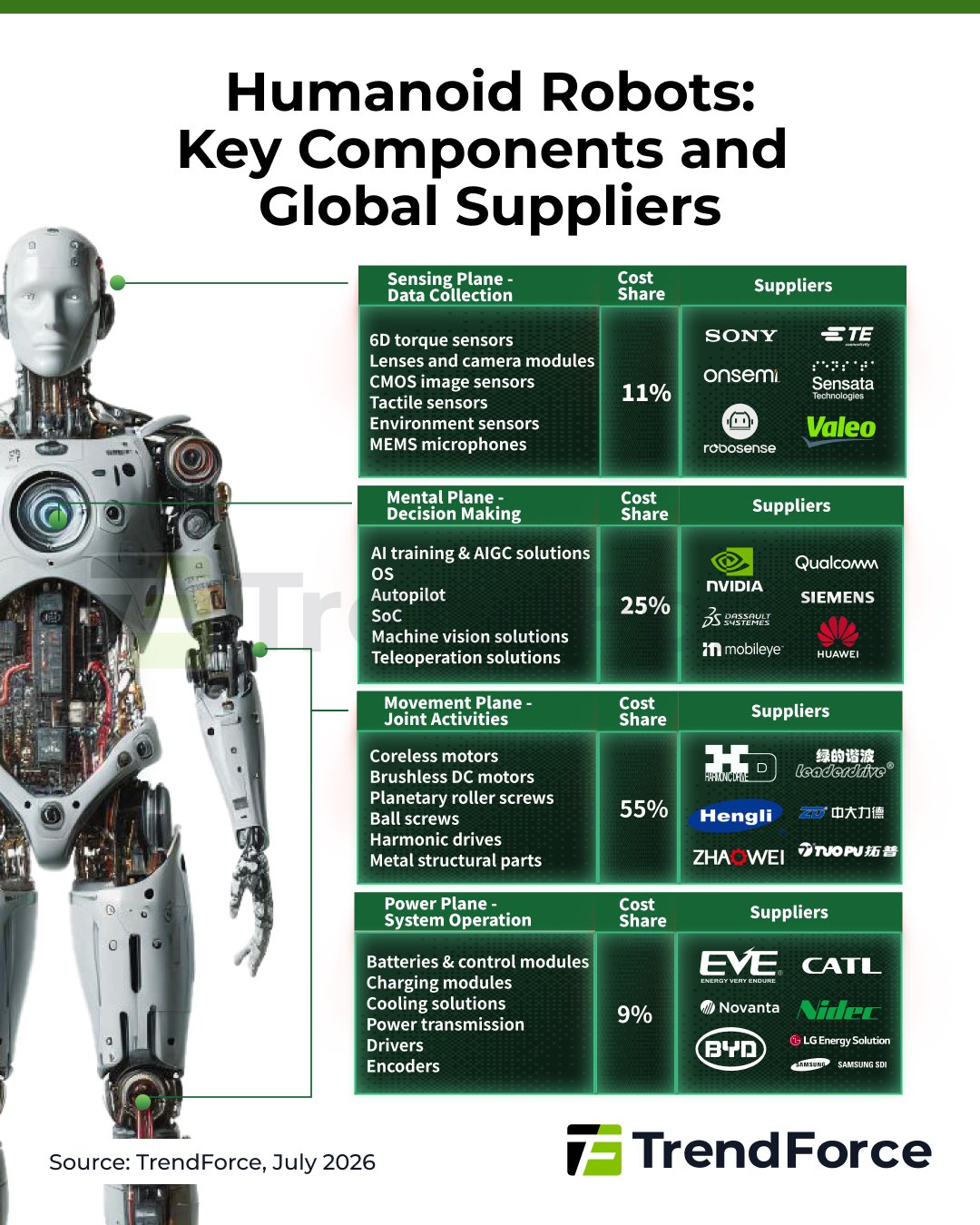
Using that framework, TrendForce rates China as having the most comprehensive presence across four planes: Power, Mental, Movement and Sensing. China leads the Power Plane and is rated Strong in both the Mental and Movement Planes, according to the release. The stated basis is manufacturing scale and broad component coverage.
The US receives its strongest rating in the Mental Plane, where TrendForce says NVIDIA and Qualcomm hold a near monopoly in AI chips and computing platforms. Europe is rated Strong in Sensing and Movement, with emphasis on precision manufacturing and a specific mention of German suppliers’ edge in encoders. Japan is described as leading in Movement through mechanical transmission, while South Korea is rated Strong in Power, supported by battery investments from LG and Samsung.
For humanoid operators and procurement teams, the most practical implication is supplier risk. If TrendForce’s framework is directionally right, humanoid developers will not compete only on whole robot demos. They will compete on access to actuators, reducers, batteries, compute platforms, encoders, simulation systems and training data, all under different regional constraints.
TrendForce’s final point is a sober one: the humanoid market is unlikely to be captured by a single player. The firm expects multiple companies to coexist because commercial use cases and user needs vary. The more immediate question is which vendors can connect deployment scale, data collection and profitability without depending on a component stack they cannot control.
Source: globenewswire.com