Welcome, Isaac 1!
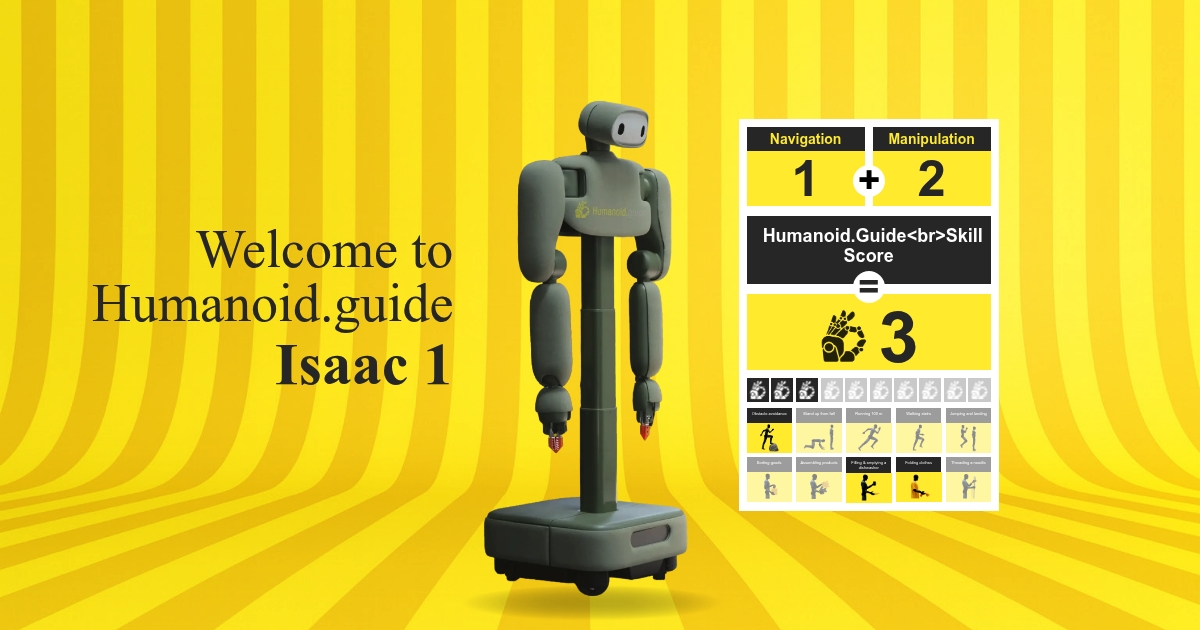
Isaac 1 is a humanoid home robot from Weave Robotics, Inc., designed in San Francisco for everyday domestic work. It uses a wheeled platform rather than legs, pairing stable indoor mobility with an upper body built for household manipulation. The robot stands up to 160 centimeters tall, weighs 40 kilograms, carries up to 10 kilograms, and runs for about 8 hours per charge. Its frame combines a solid inner structure with soft, swappable fabric outer shells, giving it a friendlier presence in living spaces while helping it fit naturally into bedrooms, laundry rooms, and kitchens. Isaac 1 has 21 degrees of freedom overall and two finger gripping claws for handling common objects around the home. Its Humanoid Guide skill score of 3 places it in a developing stage, with navigation rated 1 out of 5 and manipulation rated 2 out of 5. Safe human interaction, Wi Fi connectivity, and a compact, home oriented form factor position it as a practical domestic assistant rather than an industrial machine.
Its current use case centers on chores that benefit from repeated handling and simple object organization. Isaac 1 can fold clothes, giving it a clear role in laundry workflows where garments need to be picked up, aligned, and placed neatly. It is also listed for sorting goods, which points to basic classification and placement tasks across household items such as clothing, kitchenware, or daily essentials. In the kitchen, Isaac 1 supports filling and emptying a dishwasher, a task that combines reaching, grasping, and careful placement in a structured environment. Together, these capabilities show a robot aimed at routine maintenance rather than broad general labor. The emphasis is on dependable assistance with repetitive home tasks that reduce daily workload and keep living spaces organized.
Isaac 1 is offered on a pre order basis at 7,999 USD, signaling an early commercial push into the consumer robotics market. That matters because most humanoid development still targets factories, warehouses, or research labs, while Isaac 1 is positioned directly for the home. By prioritizing safety with humans, a soft exterior, and a wheeled architecture, Weave Robotics is making a case for a more approachable domestic robot that can live alongside families instead of operating behind barriers. As a United States built system focused on everyday chores, Isaac 1 contributes to a broader shift in robotics toward useful, service oriented machines for ordinary environments. Its significance lies less in spectacle and more in testing whether home robotics can become a realistic product category.