EngineAI opens URKL humanoid combat league in Shenzhen
EngineAI has opened the first tournament phase of the Ultimate Robot Knockout Legend in Shenzhen, putting 32 teams into a full size humanoid combat format that the organizer describes as the world’s first free combat league for full size humanoid robots.
The event is entertainment first, but it is also a rare common platform test. All teams compete with EngineAI’s T800 humanoid, supplied to participants free of charge, according to Trending Topics. The first phase runs from July to August, with finals scheduled for November and December. The winning team is set to receive a gold championship belt worth 10 million yuan (roughly $1.4 million).
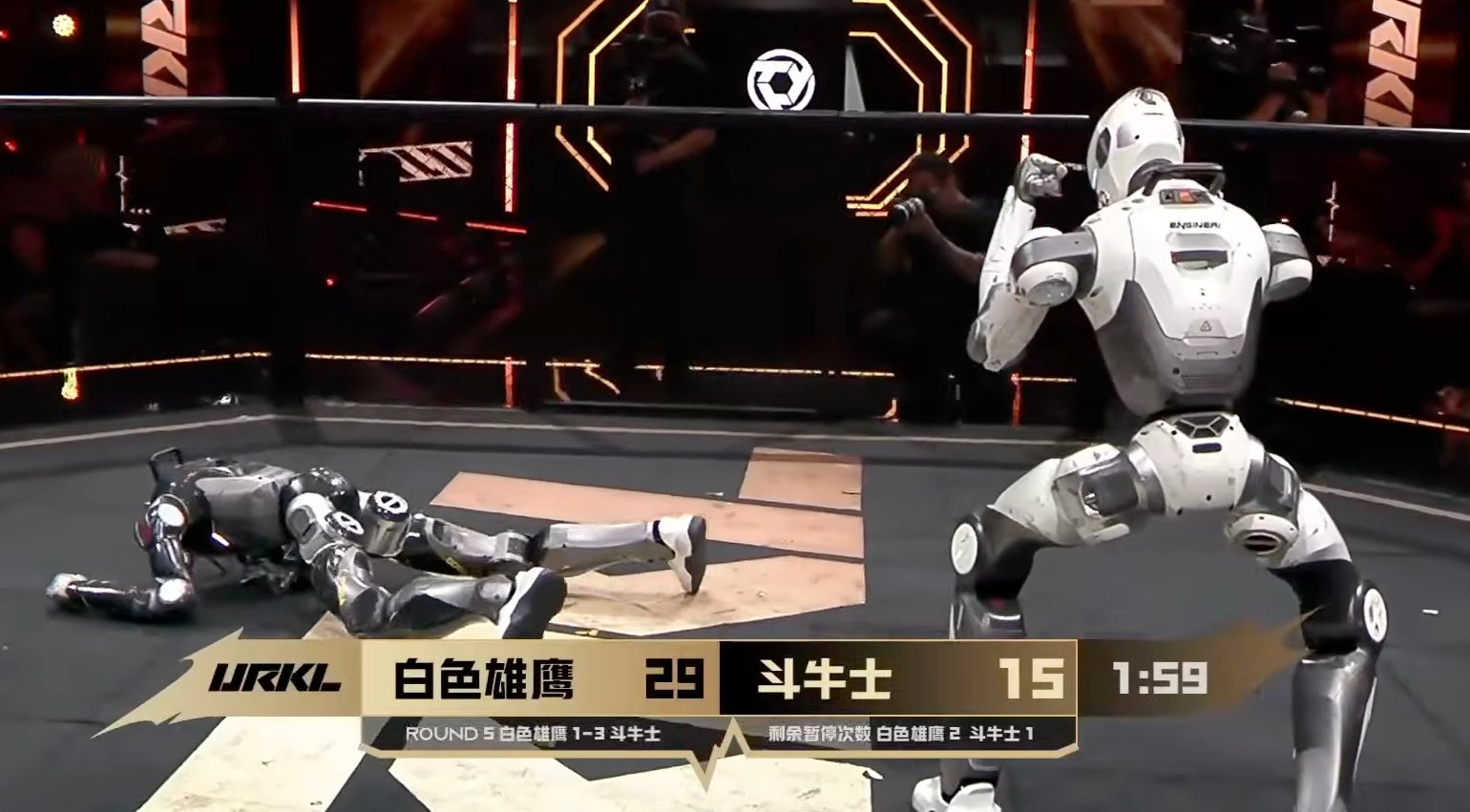
The opening night also produced a blunt durability signal. In one bout, a robot named White Eagle kicked the head assembly of another robot, Matador, loose from its socket. The damaged machine continued moving and attempting strikes before the head came off entirely after a fall.
A common T800 platform
Key facts
- Robot: EngineAI T800
- Height: about 173 cm
- Weight: 75 to 85 kg
- Joints: 29 movable joints
- Joint torque: up to 450 newton meters
- Perception: 360 degree radar
- Operation: active cooling for up to four hours of continuous high intensity use
- Unit price: about $40,500
EngineAI says the T800 uses aviation grade aluminum alloy panels, a modular solid state battery architecture and an active cooling system intended for sustained operation under high loads. Those details make the URKL more technically relevant than a typical stage appearance, though the league format still rewards a narrow type of performance.
Useful stress test, narrow incentive
Chinese industry experts cited in the report frame combat as a demanding test of motion control, dynamic balance and impact resistance. Tian Feng, former dean of SenseTime’s Intelligence Industry Research Institute, argues that real world testing under these conditions could shorten iteration cycles for components such as reducers, lead screws and hand mechanisms.
The limitation is equally clear. Combat bouts emphasize short bursts, collisions and recovery after falls. Industrial and household humanoids need different optimization targets, including lower cost, repeatability, safe physical interaction and mundane tasks such as care, rehabilitation or logistics support.
The URKL is part of a wider Chinese push to raise the public profile of humanoid robotics. The Chinese Institute of Electronics projects China’s humanoid robot market to reach 870 billion yuan (about $121 billion) by 2030.
Source: trendingtopics.eu