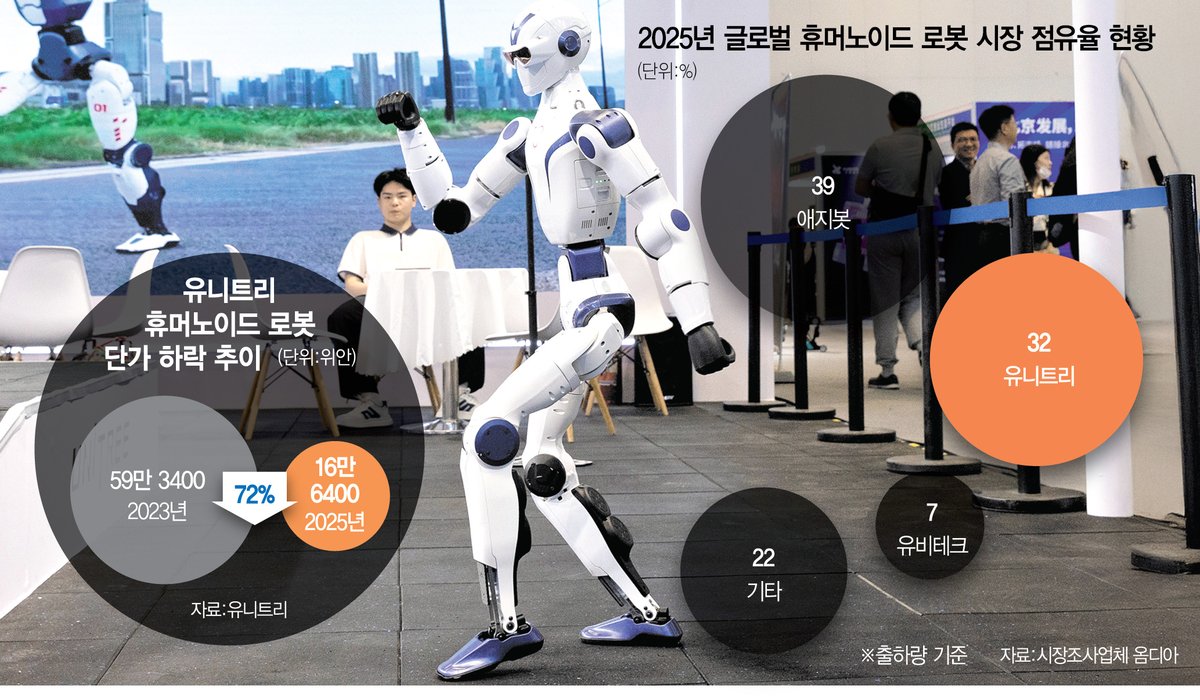
China humanoid prices plunge as Unitree cites 72% drop
China humanoid prices are falling sharply in the crowded performance robot segment, with Seoul Economic Daily reporting that heavily discounted bipedal models are now selling at levels far below last year’s averages.
Noetix’s Xiaobumi, described in the report as the top selling humanoid robot on JD.com, is currently priced at 9,118 yuan (about $1,270) after government subsidies and platform discounts. That is roughly 10% below its 9,998 yuan list price. Unitree’s entry level R1 is selling for 29,349 yuan (about $4,090), down from its launch price last year of 39,999 yuan (about $5,570).
The discounts coincide with China’s 618 Shopping Festival, but the reported price compression looks broader than a seasonal promotion. Unitree said in a recent IPO filing that the unit price of its humanoid robots fell 72%, from 593,400 yuan in 2023 (about $82,600) to 166,400 yuan last year (about $23,200).
Performance robots are taking the hardest hit
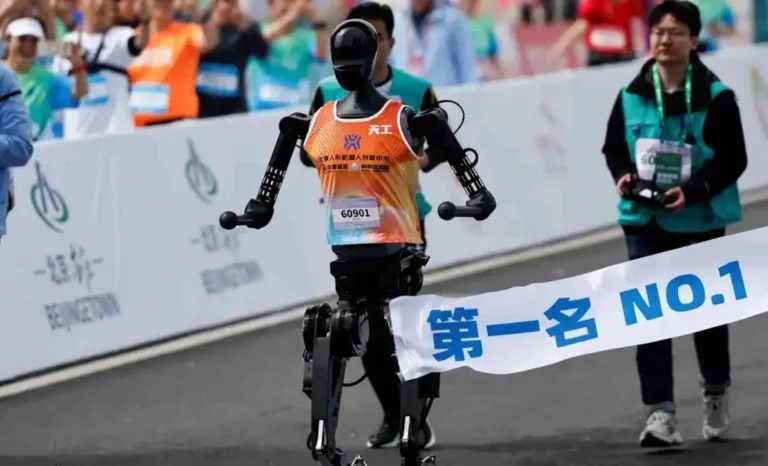
The deepest cuts appear concentrated in bipedal robots used for shows, demonstrations and rentals rather than factory work. According to The Beijing News, cited by Seoul Economic Daily, the daily rental rate for a 100,000 yuan humanoid robot (about $13,900) reached 25,000 yuan (about $3,480) early last year, then fell to 2,199 yuan (about $306) by early this year. Some secondhand platform transactions are reportedly happening below 1,000 yuan (about $140).
The technical explanation is straightforward. The report says many bipedal robots still face short battery life and stability limitations, which restricts their use in industrial settings. Entertainment and performance work is less demanding because machines can repeat preset motions.
Cai Bingzhen, director of Chinese consulting firm GGII, told Caijing that robots used in entertainment and performance fields only need to repeat preset movements, so the technical entry barrier is relatively low. He said many companies are competing fiercely for market share and shipment volume.
TSMC chairman C.C. Wei was blunter in March, according to the article, saying Chinese robots were “useless, just jumping and running around for show.” That comment is broad and dismissive, but it captures a real divide in the market: choreography is not the same as useful autonomous labor.
Unitree and Agibot dominate shipments
Seoul Economic Daily reports that China has as many as 150 humanoid robot companies. Shipment volume, however, is already concentrated. Agibot and Unitree together accounted for about 71% of total humanoid robot shipments last year, while many smaller companies are taking relatively small orders, often from universities and research institutions.
Industrial automation pricing offers a useful contrast. GGII put the overall price decline for industrial robots last year at about 13%, while some manufacturers have raised prices this year because of higher component, raw material and logistics costs. Inovance Technology raised robot sales prices by 5 to 15%, and AUBO raised robotic arm prices by 5 to 8%, according to the report.
For humanoid developers, the pricing data undercuts the idea that all unit shipments carry the same commercial weight. Yao Maoqing, vice president of Agibot, said that after mass production succeeds, the key metric will be how well robots are actually used at industrial sites, not simple sales price.
Source: en.sedaily.com