RLWRLD unveils RLDX-1 humanoid model for dexterous manipulation
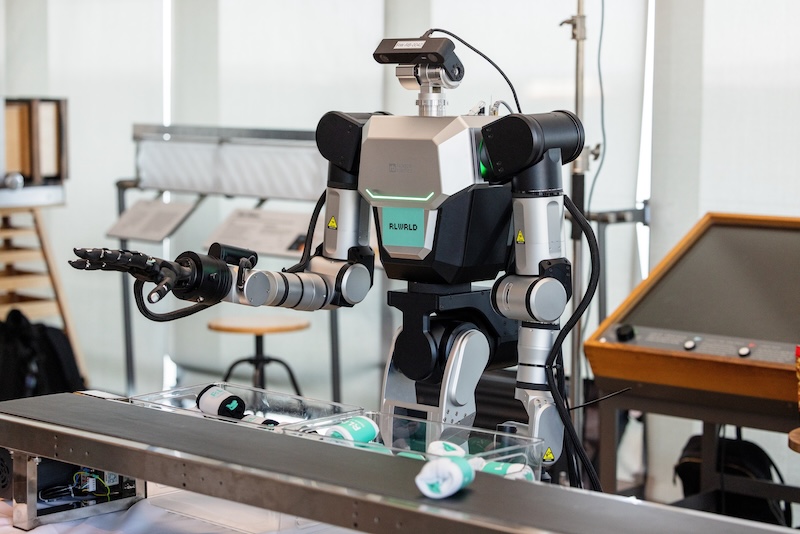
RLWRLD has unveiled the RLDX-1 humanoid model at its Dexterity Night in SF event, presenting it as a foundation model for contact-rich tasks such as grasping, pouring and tool use. For humanoid robotics programs, the announcement matters because it targets dexterity, a capability that often determines whether a general-purpose platform can handle real work rather than staged pick-and-place demos.
RLDX-1 humanoid model targets dexterity
According to roboticsandautomationnews.com, RLWRLD built the model on Nvidia’s robotics stack, including Isaac GR00T, Isaac Lab, Isaac Sim and cuRobo, with Hopper GPUs used for training and Jetson AGX Thor used for inference. At the launch event, RLWRLD chief executive Junghee Ryu argued that ‘Robot AI so far has been stuck on seeing and talking,’ framing hand control and physical interaction as the next practical constraint for humanoid deployment.
RLWRLD said the core of the system is a Multi-Stream Action Transformer architecture. Rather than combining all inputs at the outset, the design keeps vision, language, action, tactile and memory signals in separate streams before fusing them through joint attention, an approach the company says is better suited to tasks where weight, force and contact conditions change during execution, such as pouring from a pot into a cup.
Benchmarks focus on humanoid and contact-rich tasks
RLWRLD used the RLDX-1 humanoid model to present three headline benchmark results. On the GR-1 Tabletop benchmark, which the source describes as humanoid-specific, the company said RLDX-1 outperformed Nvidia Isaac GR00T N1.6 by 10.7 percentage points. On RoboCasa Kitchen, RLWRLD reported a score of 70.6 and said it was the first Vision-Language-Action model to break the 70-point mark on that benchmark.
The company also reported a 70.8 percent success rate in a coffee-pouring evaluation on WIRobotics’ Allex humanoid, which it said was roughly double competing models. Those figures were presented by RLWRLD at its event, and the source article does not indicate independent replication, but the tests themselves are notable because they emphasize long-horizon manipulation and changing contact conditions, two areas where humanoid systems still face difficulty even when locomotion is relatively mature.
Cross-embodiment strategy and ecosystem support
RLWRLD also emphasized that the same model backbone runs across multiple embodiments, including WIRobotics’ Allex humanoid, Franka Research 3 and the OpenArm platform. That matters for the humanoid market because many hardware companies are trying to avoid software stacks that are locked to a single robot design, especially while hand design, sensor configuration and actuation strategies remain unsettled across the sector.
The company used the event to highlight a broader partner network around dexterous manipulation. Nvidia’s Amit Goel, head of robotics ecosystem and edge AI product, called RLWRLD ‘one of the core partners in the physical AI ecosystem we are building at Nvidia,’ while executives from Enactic, Origami Robotics and Proception AI joined a panel discussion on embodiment-agnostic models, industrial data access and emerging standards around robotics foundation models.
What comes next for dexterous humanoid AI
Beyond the launch, RLWRLD said it is working on a ‘4D+ world model’ that would predict and generate contact, torque and robot state over time, extending beyond vision, language and action alone. The source also said the company has backing from SK Telecom, LG Electronics, CJ Logistics, Lotte, KDDI, ANA Holdings, Mitsui Chemicals and Shimadzu Corporation, and is already running benchmark, proof-of-concept and Robotics Transformation projects with more than ten enterprise partners.
RLWRLD plans additional RLDX-1 events in Japan and Korea in the coming weeks. For the humanoid industry, the central question now is whether this emphasis on dexterity can translate from benchmark settings and controlled demonstrations into production environments, where variable objects, wear, latency and safety constraints usually define the real boundary between a promising model and a deployable system.
Source: roboticsandautomationnews.com