On 17 August 2026, Unitree Robotics introduced a new humanoid with a short video and a short caption:
“Unitree New Robot Preview: ‘Superman’ — Breaking the Limits of Humanity. Standing high jump 2 m, top speed 12.66 m/s (0.85 m leg length). Surpassing the standing high jump and running speed records of all humans around the world. This new machine has only been in development for a little over three months, with significant room for further improvement in the coming months.”
Unitree Robotics — the whole of the official recordThat post is, as far as we can find, the whole of the official record. There is no press release and no product page for Superman on Unitree’s site.
We wanted to see how the two numbers stack up against the human records they’re being measured against. Looking them up turned out to be more interesting than we expected.
The sprint
| Peak speed | How it was measured | |
|---|---|---|
| Usain Bolt | 12.42 m/s (44.72 km/h) |
Averaged across the 60–80 m segment of his 9.58 s world record, Berlin 2009 — electronically timed in competition |
| Unitree Superman | 12.66 m/s (45.6 km/h) |
Manufacturer-stated peak; distance, surface and method not specified |
The gap is 0.24 m/s, or about 1.9 per cent. Run them side by side for three seconds and Superman finishes roughly 70 cm ahead — less than a third of a Bolt stride.
≈ 1.9 per cent
less than a third of a Bolt stride
the number in brackets
The two figures also describe slightly different things. Bolt’s is a speed held across a measured 20-metre window inside a full 100 m race. Superman’s is a peak, and we don’t know for how long it holds.
What impressed us most isn’t in the headline. Superman reaches that speed on 0.85 m legs, noticeably shorter than a 1.95 m sprinter’s. A shorter leg means a shorter stride, and matching human velocity with a shorter stride means turning the legs over considerably faster. The cadence required is arguably the harder engineering problem, and it’s the number Unitree chose to include in brackets.
Which human record does the jump compare to?
This is where it got genuinely interesting. We went looking for “the human standing high jump record” and found four different answers, because there are four different disciplines.
| Discipline | What’s measured | Human record |
|---|---|---|
| Standing jump onto a platform | Height the feet land at, from a standing start | 1.70 m Christopher Spell (USA), 2021 |
| Standing high jump (bar clearance) | Body clears a bar, no run-up | 1.90 m Rune Almén (SWE) |
| Olympic standing high jump | Same event, held 1900–1912 | 1.65 m Ray Ewry (USA), 1900 |
| High jump, with run-up | Fosbury flop bar clearance | 2.45 m Javier Sotomayor (CUB), 1993 |
Sotomayor’s 2.45 m is the most famous of these, but it’s measuring something quite different: it uses a run-up, and the Fosbury flop is specifically a technique for routing the body over the bar while the centre of mass passes almost underneath it. The bar height isn’t the height the athlete rose.
In Unitree’s footage, Superman’s feet clear the 200 cm mark on the measuring board — the whole machine passes above it. That makes the platform jump the closest like-for-like comparison: 2.00 m against 1.70 m, both from standing.
Which means the jump, not the sprint, is the more decisive of the two claims. The speed record is edged past by under two per cent. The jump clears its comparable human record by 30 centimetres.
What we can and can’t see
The jump demo is unusually legible for promotional footage: a locked-off camera, a graduated board in frame, an engineer alongside for scale, no cuts through the jump. It’s close to self-documenting.
The speed claim has no equivalent. There’s no timing system, no stated distance, no visible measurement. Neither figure has been independently verified — both were published on social media rather than through any testing body, and Unitree says the machine still has “significant room for further improvement.”
Superman was shown on Monday 17 August. Unitree lists on Shanghai’s STAR Market two days later, on Wednesday 19 August, raising 6.1 billion yuan, with the retail tranche oversubscribed more than 8,000 times.
The number we keep coming back to
Not 12.66, and not 2.00.
That’s how long it took to go from a new machine to record-adjacent athletic performance. Not long ago, a bipedal robot that could run at all was a multi-year programme at a national lab. What changed is the pipeline underneath: high-power-density actuators built in-house, and locomotion policies trained in simulation and transferred to hardware. Once that exists, a new body can be brought up quickly. Superman suggests dynamic legged locomotion is becoming an engineering problem rather than a research one.
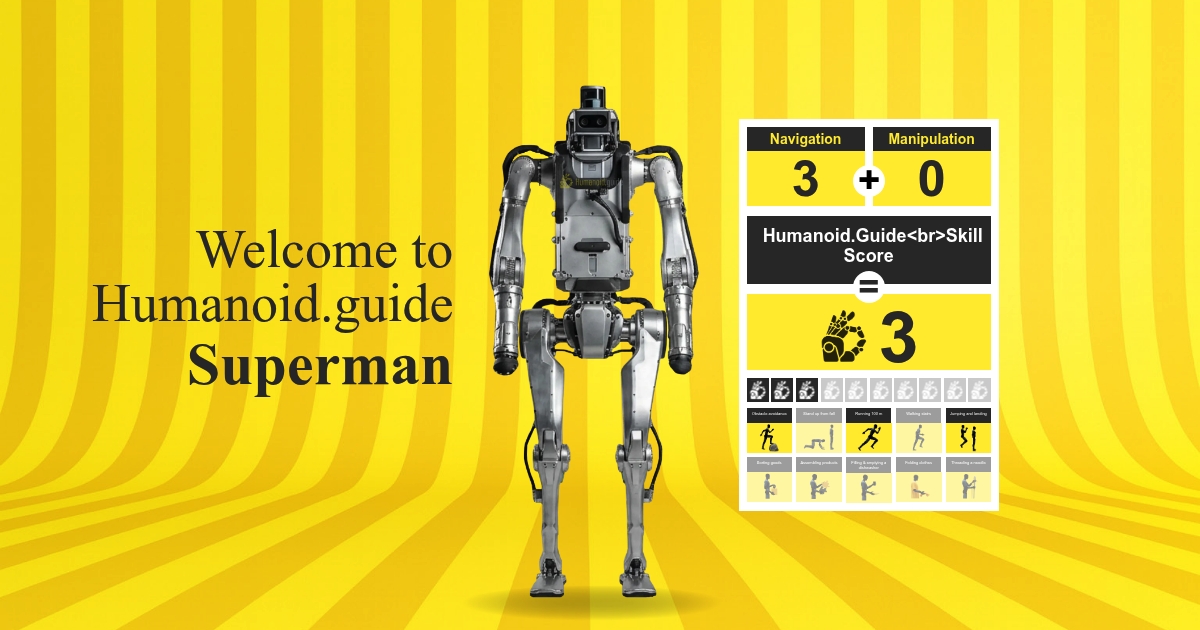
Manipulation hasn’t made that transition, and Superman is honest about it. The machine has 20 degrees of freedom in total — a single pair of genuinely dexterous hands can account for more than that on its own. Superman spends its budget below the waist. On our scoring it rates 3 out of 5 for navigation and 0 out of 5 for manipulation: a mobility demonstrator, by design.
That’s a fair snapshot of where the field is in 2026. Robots are becoming remarkable at moving through the world faster than they’re becoming useful once they arrive. The work that would make a humanoid economically valuable — hands, contact-rich tasks, recovering when a grip slips — is slower and much less photogenic. Athletic demonstrations are what raise the capital that funds it. Worth knowing which of the two you’re looking at.
We just watched a robot outrun Usain Bolt. It still has no hands to speak of.
The platform
Superman is a humanoid research platform from Unitree Robotics, built to explore fast, dynamic movement in a compact human-scale body. Standing 170 cm tall and weighing 45 kg, it combines 20 total degrees of freedom with in-house permanent-magnet motors, planetary reduction, and quasi-direct-drive architecture to emphasise responsive lower-body control. Its listed top speed reaches 45.6 km/h, while standard walking speed is 5 km/h, and its runtime per charge is 1.5 hours. The machine uses an NVIDIA compute stack, supports Bluetooth 5.2, Ethernet, and Wi-Fi 6, and works with the Unitree SDK plus ROS 2 support for development. Superman carries a Humanoid Guide skill score of 3, which places it in the developing tier, with navigation rated 3 out of 5 and manipulation rated 0 out of 5. The structure pairs aluminium alloy with carbon fibre to keep the body light, and Unitree marks it as safe with humans. This makes Superman a focused mobility demonstrator for labs and engineering teams interested in agile humanoid motion rather than advanced hand work.
Its capability profile highlights obstacle avoidance as the clearest operational strength, aligning with its mid-tier navigation rating and making it relevant for structured indoor movement, routing tests, and dynamic path planning research. The listed application set also includes sorting goods, filing and emptying a dishwasher, and ironing and folding — target scenarios for the platform rather than tasks this prototype performs today, given its 0 out of 5 manipulation rating. Those scenarios connect Superman to logistics, back-office support, and household task development, where coordinated movement, scene awareness, and repeatable task sequencing matter as much as raw speed. In practical evaluation, these use cases position the robot as a platform for benchmarking perception, navigation, and task orchestration across mixed environments, from warehouse aisles to domestic layouts, while giving developers a way to study how fast locomotion can support broader humanoid work cycles.
Superman is currently a prototype, which places it squarely in the experimental phase rather than full commercial deployment. The robot comes from Unitree Robotics in China and is aimed at research and technology demonstration, not mass field rollout. That status is important, because it frames Superman as a statement of engineering direction: Unitree is pushing humanoid development toward extreme mobility, lightweight design, and rapid iteration. The reveal in August 2026 underscored how quickly the company can bring a new platform together, and it added strategic visibility during a consequential moment in the business. In the wider humanoid landscape, Superman matters because it expands the performance ceiling for compact humanoids and gives universities, robotics teams, and advanced developers a concrete platform around which to test high-speed body control, software integration, and future task expansion.
Sources: Unitree Robotics’ own post; IPO figures as reported by Reuters. Both performance figures are the company’s own and have not been independently verified.