Welcome, Nadia!
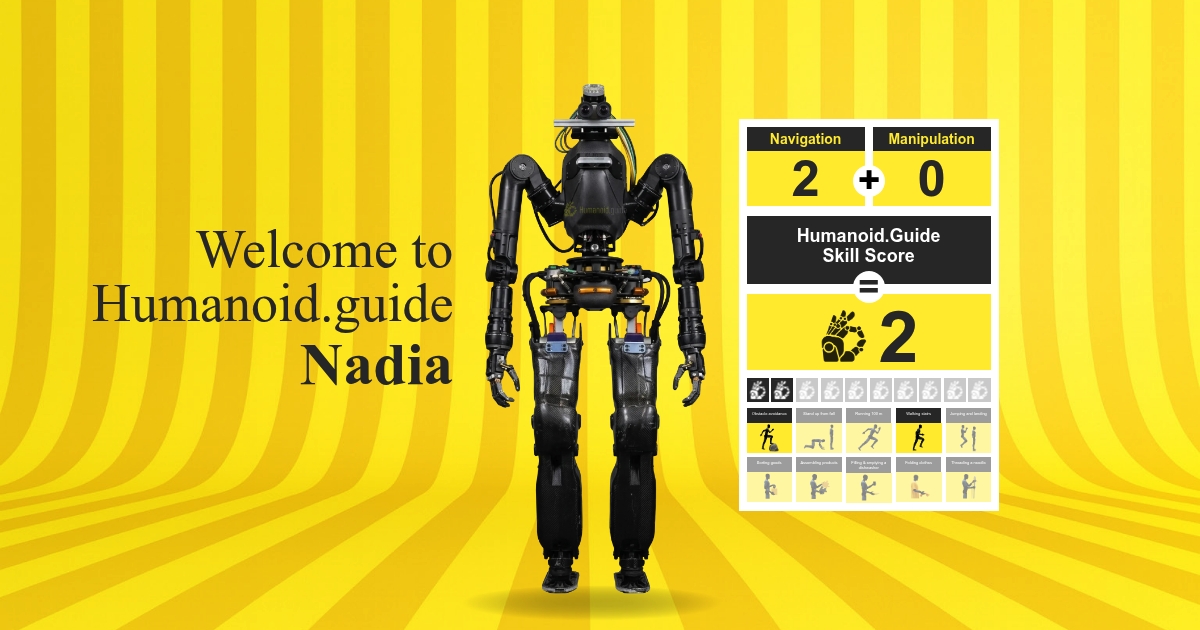
Nadia is a 190 cm, 100 kg research humanoid developed by IHMC, the Florida Institute for Human and Machine Cognition, with Boardwalk Robotics and other partners. Its hybrid actuation combines Moog hydraulic Integrated Smart Actuators in the legs and spine with electric motors at the hip and spine yaw joints and in the arms. This architecture integrates hydraulic and electric actuation across the body and pairs it with 29 total degrees of freedom and two finger grippers. Carbon fiber composite shell structures form the exterior, while planetary drives serve hip and spine yaw motion and cycloidal drives serve the arms. Nadia reaches a maximum speed of 3.5 kilometres per hour and is rated for 12 kg strength. Control uses IHMC whole body control software alongside CAN bus communications inside the actuators, EtherCAT, and tethered connectivity. Its operating system is IHMC in house open source robotics software for coordinated full body research. The black humanoid is designed for supervised operation rather than direct safe collaboration with people.
Nadia has a navigation rating of 2 out of 5 and a manipulation rating of 0 out of 5, placing its Humanoid Guide Skill Score at 2 out of 10. This is an early stage research profile that emphasizes foundational mobility rather than broad autonomous manipulation. Its demonstrated capability set includes walking stairs, a whole body locomotion task that requires coordinated leg, torso, and balance control across changing elevations. It also includes sorting goods, connecting its grippers, arm motion, and positioning to a practical material handling activity. Together, these capabilities establish Nadia as a humanoid platform for investigating how hybrid hydraulic and electric systems can execute structured movement and basic object handling under supervised control.
Nadia is listed as a prototype and is available through price inquiry, with a stated price of 700 000 USD. It represents a collaboration led by IHMC, the Florida Institute for Human and Machine Cognition, and Boardwalk Robotics, bringing together research expertise and specialized humanoid engineering. The platform design pairs hydraulic leg and spine actuation with electric arm and yaw actuation in a single biped system. Its name honors gymnast Nadia Comăneci, connecting the project to extensive humanlike range of motion. As a United States research humanoid, Nadia contributes to continuing work on whole body control, actuator integration, and biped robot design. Its prototype status positions it as a platform for technical development and evaluation, rather than a finished general purpose worker.