Welcome, KUAVO 5 W!
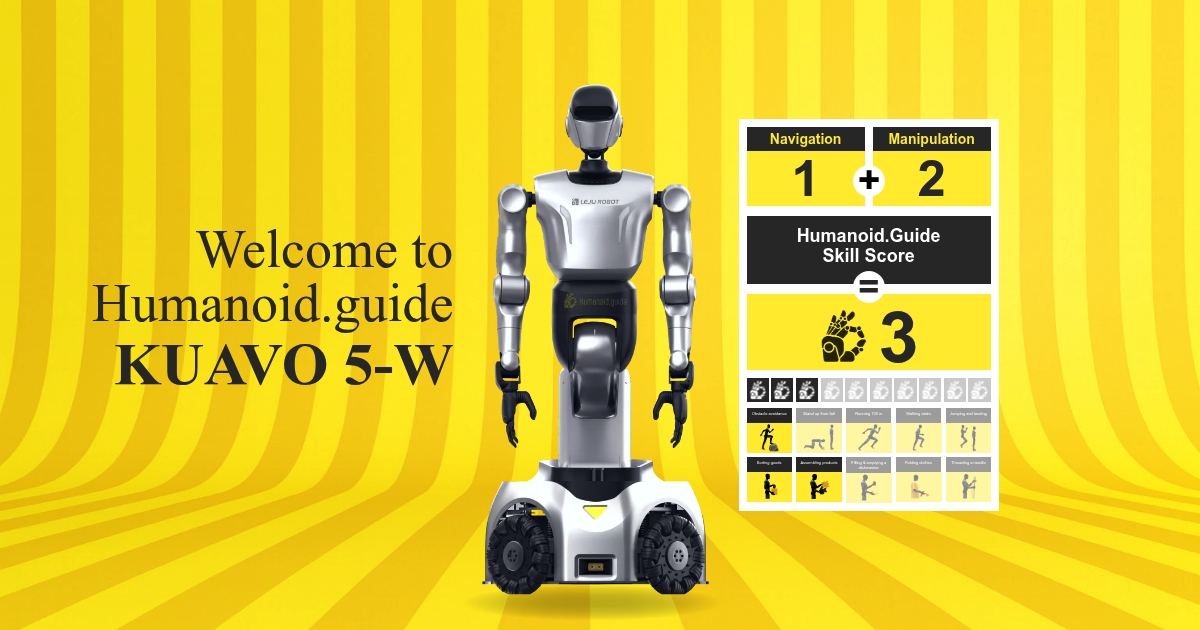
KUAVO 5 W is a wheeled humanoid built by Leju Robotics for industrial and service environments where stable mobile manipulation matters. Its 40 degree of freedom body combines a dexterous upper torso, five finger hands, and an omnidirectional wheeled base that can translate in any direction and rotate in place. At 200 centimetres tall and 156 kilograms, it is designed to reach shelves, bins, and work surfaces across a broad vertical range. A rotating waist extends its working envelope while the base remains positioned for a task. The platform lists a maximum speed of 5 kilometres per hour, 20 kilogram strength, and up to six hours of runtime per charge. Four depth cameras, 3D SLAM navigation, Bluetooth, and Wi Fi support operation in structured sites. With a Humanoid Guide Skill Score of 3 out of 10, KUAVO 5 W is a developing platform. Its navigation rating is 1 out of 5 and its manipulation rating is 2 out of 5, indicating early capability tiers for autonomous mobility and object work.
In practical workflows, KUAVO 5 W is positioned for sorting goods and assembling products. The wheeled base supports sustained movement between stations, while the upper body can handle tasks at different heights and orientations. Its 12 hand degrees of freedom and 40 overall degrees of freedom provide the mechanical range for industrial handling sequences, and integrated joint modules deliver up to 500 newton metres of peak torque. An industrial grade computer with an NVIDIA edge module provides 100 to 2070 TOPS, depending on configuration. The system is ROS compatible and uses OpenHarmony based KaihongOS within the KUAVO family. Integration with Huawei Pangu and Doubao large models adds an AI layer for task interaction and skill learning. These elements support repeatable workflows in manufacturing, logistics, service, research, and data collection centres.
KUAVO 5 W is in production and represents a commercial option from Shenzhen based Leju Robotics, a Chinese humanoid developer. The platform sits alongside the legged KUAVO 5, giving organizations a choice between wheeled mobility and a walking form factor. Its shared industrial and service orientation is reinforced by EMC testing, although no collaborative safety certification is published. The use of planetary reducers, aluminium alloy, and steel reflects a machine engineered for deployment rather than a purely laboratory concept. By combining a full sized humanoid upper body with a mobile base, it illustrates an important route toward practical automation in sites built around human workspaces. The model also reflects the growing importance of Chinese robotics suppliers, edge AI compute, ROS integration, and large language model enabled interfaces in commercial humanoid development.