Welcome, Kengo!
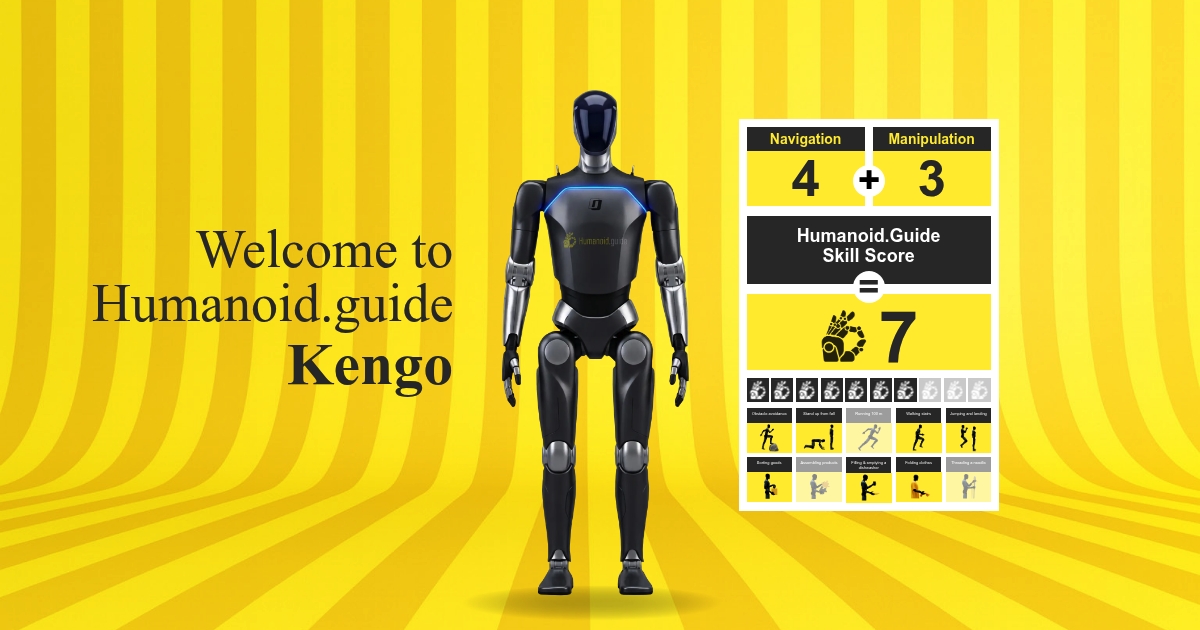
Kengo is a bipedal humanoid robot built for real world work across factories, commercial spaces, and home settings. It stands 170 cm tall, weighs 65 kg, and combines 32 total degrees of freedom with 12 in the hands, giving it a balanced profile for mobility and practical handling. Humanoid Guide gives it a total score of 7, placing it in the capable tier, with a stronger 4 out of 5 rating for navigation and a 3 out of 5 rating for manipulation. Kengo is designed around two core actuator modules used across the whole joint system, paired with harmonic style reducers and lightweight aluminum alloy structure with composite covers. Each joint can deliver more than 130 newton meters of torque, and the robot is built to tolerate repeated falls and impacts. It supports Ethernet and Wi Fi connectivity, runs on Linux with a ROS based stack and a proprietary software layer, and integrates an embodied AI brain with high performance motion control for whole body movement.
In operation, Kengo focuses on practical mobility and household or workplace assistance rather than stunt behavior. Its navigation profile includes obstacle avoidance, the ability to navigate 100 m routes, and walking stairs, which supports movement through busy interiors and mixed layouts. Recovery is also part of its working capability, with stand up from fall listed among its present skills. On the manipulation side, it is aimed at structured service and logistics tasks such as sorting goods, filling and emptying a dishwasher, and folding clothes. These abilities fit the robot’s mid tier manipulation rating and stronger navigation rating, showing a machine meant to move reliably through real environments while handling useful daily tasks. The result is a humanoid positioned for repeatable work instead of one off demonstrations.
Kengo is listed as a prototype and is not currently available for purchase. Galaxea Dynamics introduced it on June 2, 2026 as the company’s first self developed bipedal humanoid, marking an important step beyond its earlier wheeled and desktop systems. The Beijing company was founded by alumni from Tsinghua and Stanford and has grown quickly, reaching unicorn status in China after raising significant capital. Kengo matters because it reflects a push toward scalable humanoid manufacturing, with a simplified actuator strategy intended to lower production complexity and support larger volumes. Galaxea also presents the robot as part of a broader full stack platform that spans hardware, motion control, and embodied AI. Combined with reported enterprise orders and letters of intent across the company’s lineup, Kengo represents a serious commercial attempt to move humanoids from showcase moments into sustained deployment.