1X details Neo robot hands ahead of consumer humanoid launch
1X is putting Neo robot hands at the center of its pitch for a home humanoid that is scheduled to ship later this year. In a June 1 report, Forbes said the latest hand design for Neo will ship with 22 degrees of actuated freedom, a distinction that matters because active control, not just mechanical range, determines how well a humanoid can grasp, release and rest in natural poses.
Why Neo robot hands matter
According to 1X head of product and design Dar Sleeper, the industry often compresses hand capability into a single degree-of-freedom number, even when some of those joints are passive or only powered in one direction. Sleeper argued that Neo’s design actively actuates every available degree of freedom, including opening motions that are often handled by springs in other robot hands.
That difference affects more than grasp strength. Forbes reports that passive opening can leave a system without closed-loop feedback on finger position, which limits control when the hand returns to an open state and makes it harder to hold a relaxed, human-like posture. For humanoids intended to work around people, that matters for manipulation performance and for how natural the robot appears in shared spaces.
1X also said the shipping hands are not the same units seen in earlier Neo videos. The faster, more dexterous version shown to Forbes had not yet been fitted to the robot at the time of the interview, which means the hardware claim is ahead of a full public demonstration on the production system.
Tendon drive, weight and noise
The hand design sits within a broader mechanical approach that 1X says is aimed at home use. Neo uses a proprietary tendon-drive system in which high-torque-density motors pull flexible polymer tendons instead of driving joints through rigid gearboxes. The company says that architecture supports finer control in the hands while also reducing noise across the robot.
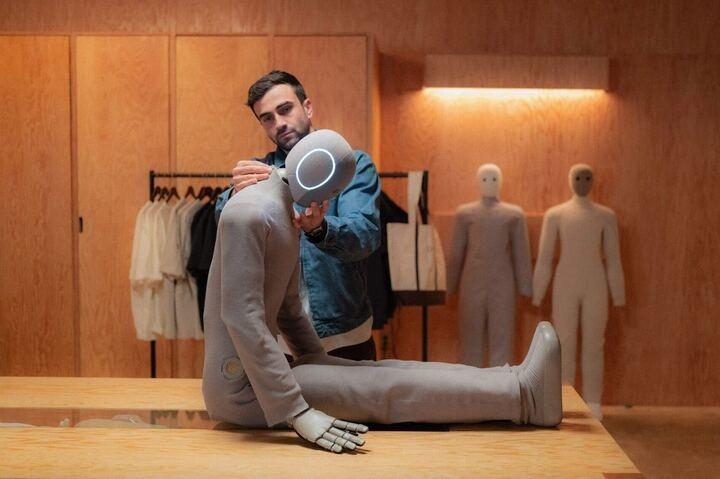
Sleeper told Forbes that Neo operates at 22 decibels. The same report contrasts that with harmonic drive-based humanoids, which it says can weigh 150 to 200 pounds and tend to be louder, stiffer and less back-drivable. 1X says Neo weighs 66 pounds and uses soft clothing and lower noise levels as part of a broader safety and comfort strategy for domestic environments.
Those choices highlight a familiar trade-off in humanoid design. Industrial robots often optimize for rigidity, payload and repeatability, while home robots need compliance, quiet operation and acceptable human factors. Neo’s hand claims matter partly because they suggest 1X is trying to pair fine manipulation with a mechanical package designed for close contact settings.
Manufacturing and the home-first strategy
1X’s argument on cost is tied to vertical integration. According to Forbes, the company manufactures the hands, actuators and related subsystems in-house in Hayward, California, including tendon system assembly, custom electronics, 1X motors, proprietary polymer molding and an integrated tactile sensing stack. Sleeper said that control over motor and tendon design has helped push bill-of-materials cost down.
The pricing described in the report is aggressive by current humanoid standards. 1X lists Neo at $20,000 to buy or $499 per month on subscription, and Forbes says the company’s entire first-year production capacity of 10,000 units sold out within five days of preorders opening. Those figures will draw attention because few humanoid companies have publicly discussed consumer pricing at that scale.
1X is also unusual in putting the home ahead of factories and warehouses. Sleeper’s case, as summarized by Forbes, is that homes generate more varied training data, tolerate mistakes better than production lines and may offer a faster route to mainstream adoption. At the same time, he acknowledged that complex chores such as fully autonomous laundry remain difficult, suggesting that Neo’s near-term value may come from many small cleanup and retrieval tasks rather than end-to-end household automation.
The next test is execution. 1X still has to show the final Neo robot hands on a shipping system, scale manufacturing beyond its sold-out first year and demonstrate that software can make practical use of the extra actuation. Even so, the report underscores where competition in humanoids is shifting, from locomotion alone to the harder question of whether robot hands can deliver useful, repeatable work in everyday settings.
Source: forbes.com