Welcome, KAIST!
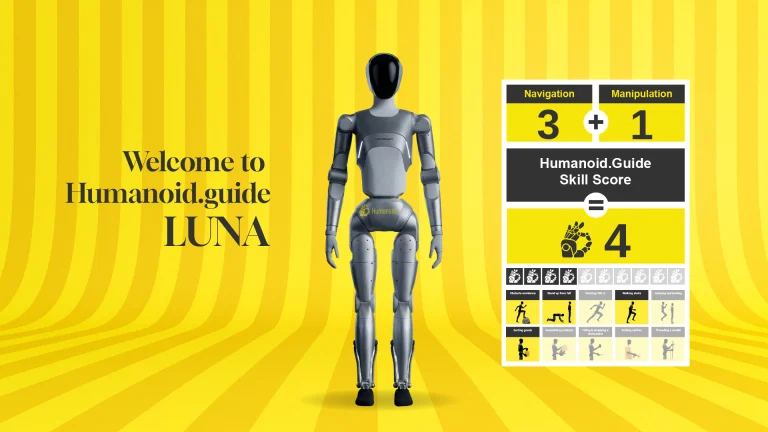
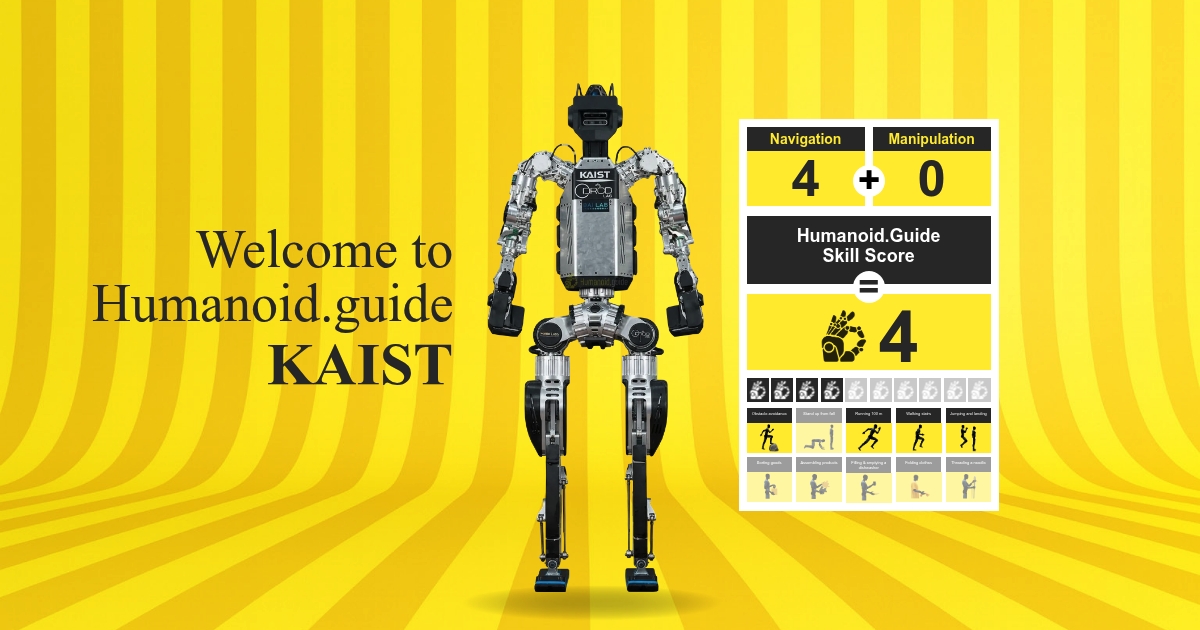
KAIST is a full size humanoid research prototype developed by the Dynamic Robot Control and Design Lab at KAIST in South Korea, with arms supplied by RAILAB. Standing 165 cm tall and weighing approximately 75 kg, it combines an adult sized body with hardware designed for dynamic locomotion research. Its demonstrated capabilities include obstacle avoidance, running 100 m, walking stairs, and jumping and landing. An overall Humanoid Guide Skill Score of 4 out of 10 places the platform in the developing category. Navigation is rated 4 out of 5, while manipulation is rated 0 out of 5, making mobility its clearest established strength. The robot has 25 overall degrees of freedom and uses internally developed quasi direct drive motors, motor drivers, and custom 3K compound planetary gearboxes. Reinforcement learning supports its control approach, alongside onboard vision. Its silver exterior houses a platform intended primarily for research, with a specified maximum speed of 12 km/h and a walking speed of 4 km/h.
The combination of obstacle avoidance, stair walking, running 100 m, and jumping and landing makes KAIST relevant to research on locomotion across different movement demands. Obstacle avoidance concerns navigating around physical barriers, while stair walking introduces repeated changes in elevation and foot placement. Running 100 m provides a concrete distance over which to examine sustained dynamic movement. Jumping and landing adds another control challenge, requiring coordinated body motion through takeoff and ground contact. Together, these capabilities provide distinct settings for studying how a humanoid manages motion and stability. The navigation rating reflects a stronger mobility profile than its overall developing score alone conveys, without establishing equivalent competence in manipulation or other physical tasks.
KAIST remains a prototype aimed at the research market, with a listed price of USD 150,000 and an inquiry route for prospective buyers. Development is led by KAIST’s Dynamic Robot Control and Design Lab, while RAILAB contributes the arms. This collaboration combines a university robotics research program with a separate arm development contribution. The team’s internal development of motors, drivers, and gearing is significant because it connects actuator engineering with whole robot control research within the same platform. For research organizations, KAIST offers a concrete example of a humanoid whose current strengths center on locomotion rather than manipulation. Its broader relevance lies in integrating custom hardware and reinforcement learning into an adult sized experimental robot.