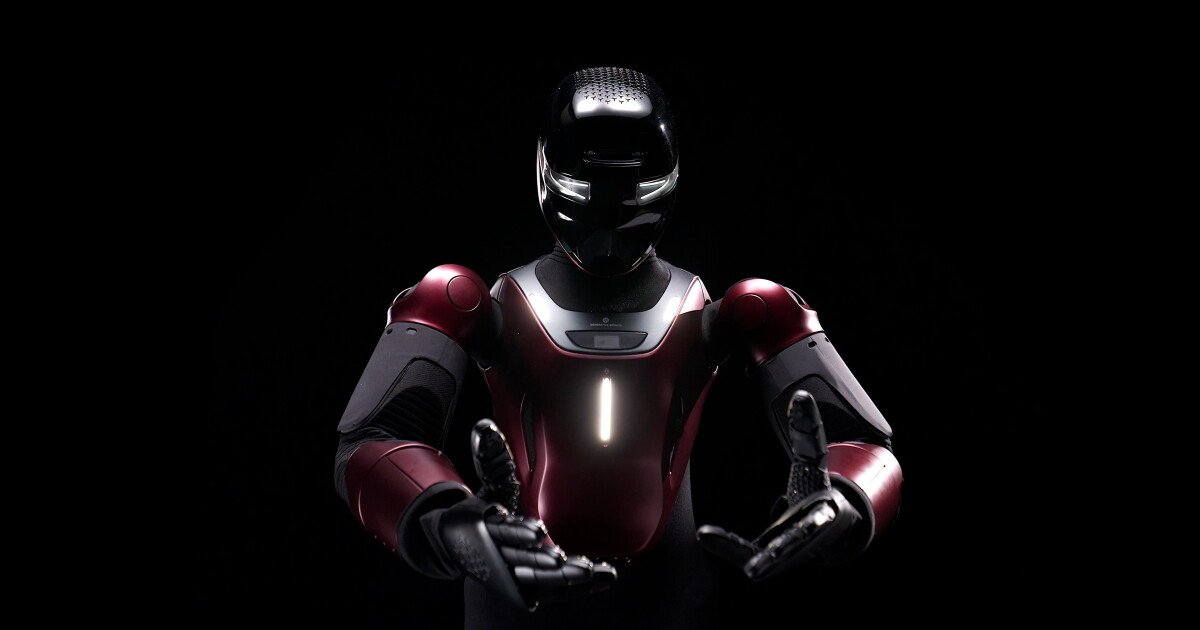
Generative Bionics details Gene.01 smart skin humanoid
Italian startup Generative Bionics has presented Gene.01, a humanoid robot platform wrapped in a smart skin designed to sense touch, temperature, proximity and force before and during contact with people, according to New Atlas.
The company says the sensor network runs from the robot’s torso to its limbs. Its safety pitch is aimed squarely at shared factory floors: the humanoid should detect a person approaching and adjust its movement before a collision occurs, then continue sensing force and contact if interaction is unavoidable.
The strongest claim here is not dexterity, but whole body pre contact sensing. For industrial humanoids, that is a concrete direction of travel, since many proposed applications place heavy electromechanical systems close to workers. The public detail is still thin on sensor range, latency, resolution, payload, battery life and safety certification, so the current claim should be read as a platform description rather than a validated factory safety case.
Teaching force through physical guidance
The Gene.01 smart skin is also presented as a training interface. Generative Bionics says a person can physically guide the robot’s arm to teach a task, including how much force to apply during manipulation.
That addresses a real problem in humanoid workcells. Video demonstration can show the shape of a motion, but it often does not capture the contact forces needed to hold an object without dropping it or damaging it. The source describes force sensing as part of the method for teaching grip behavior directly through the robot’s body.
Gene.01 grew out of research from the Italian Institute of Technology, recently published in Nature Machine Intelligence. Generative Bionics says it is the first industrial platform to apply that peer reviewed method to a fully functional humanoid covered in sensors. That first of its kind claim comes from the company.
A customizable industrial platform
Generative Bionics is positioning Gene.01 as a base for multiple specialized humanoids, not a single fixed product. Customization is described on three levels: task specific AI, exterior design adapted to the work environment, and interchangeable end effectors such as hands, grippers or feet.
The company also uses the term Physical AI for its design approach. In the source’s description, that means treating the robot’s body, mechanics and movement control as an integrated system, with hardware and motion behavior tuned together using factors such as ergonomics and walking stability.
Generative Bionics is pairing that robotics platform strategy with a European supply chain argument. It has formed a strategic alliance with German firm Synapticon to develop a European made chain of actuators, with final assembly, calibration and safety testing carried out in Europe.
The company has also raised a US$81 million seed round led by CDP Venture Capital, with AMD Ventures, Duferco, Eni Next, RoboIT and Tether participating. Its first real world application is a partnership with shipbuilder Fincantieri to develop a welding humanoid for use in shipyards.
Source: newatlas.com