Welcome, H2-D!
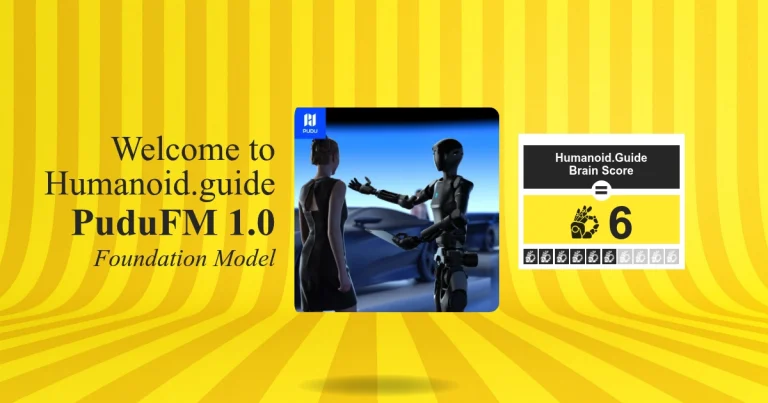
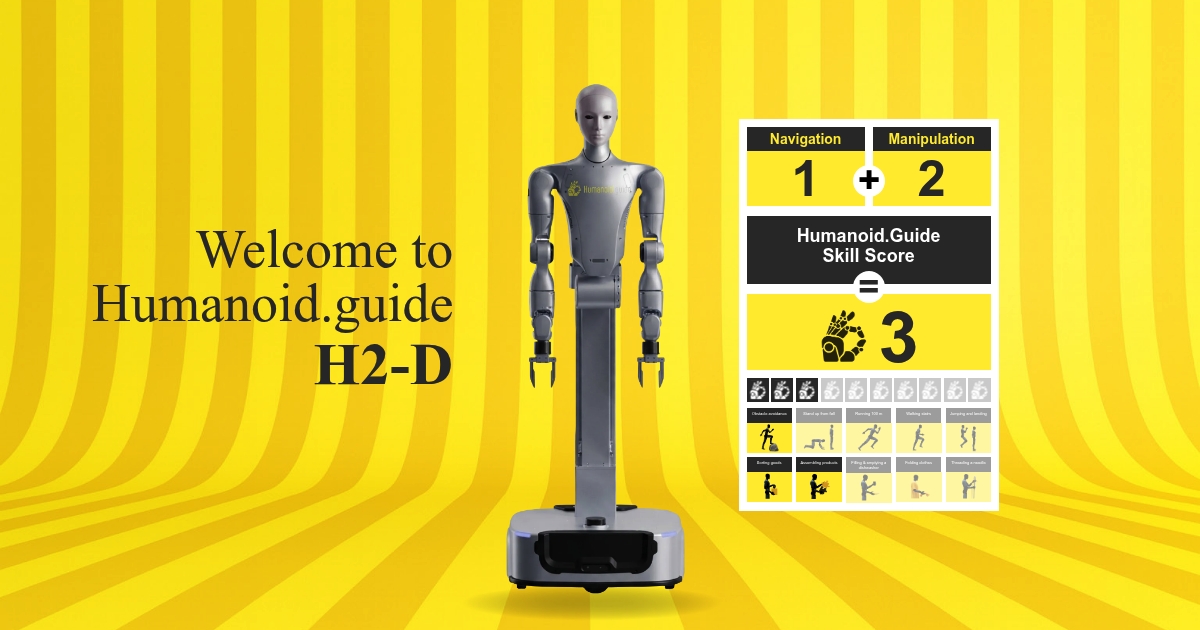
Unitree Robotics’ H2 D is a wheeled humanoid designed for research, training data collection and manipulation tasks. Rather than using legs, it combines a mobile base with a height adjustable column and two arms, each with seven degrees of freedom. Its listed height is 170 centimetres and its weight is 120 kilograms. The platform has a maximum speed of 5.4 kilometres per hour and a listed runtime of five hours per charge. A choice of hands gives developers flexibility when configuring the robot for different manipulation requirements. Its demonstrated capability set includes obstacle avoidance, sorting goods and assembling products. The overall Humanoid Guide Skill Score is 3 out of 10, placing it in the developing category rather than among mature general purpose systems. Navigation is rated 1 out of 5 and manipulation 2 out of 5. These ratings frame it as a platform for focused experimentation and application development, with stronger emphasis on manipulation than navigation within its current capability profile.
The sensing system combines a wide view binocular head camera, two HD wrist cameras and a depth camera. Collision and ultrasonic sensors supplement this visual hardware, supporting obstacle avoidance around the wheeled base. For sorting goods, the two arms and available hand options provide a platform for studying object handling and coordinated manipulation. Assembling products offers another application for research into positioning, interaction and repeatable task execution. The computing configuration includes an Intel Core i5 platform computer and an Intel Core i7 development computer, with an optional NVIDIA Thor module. A Linux based Unitree system, the Unitree SDK and ROS 2 support provide the software environment for developing and evaluating these applications.
H2 D is listed as in production, with a published price of USD 55,000. Its manufacturer, Unitree Robotics, is based in Hangzhou, China. The platform targets researchers, developers and teams collecting AI training data, alongside light service applications. Its broader significance lies in offering a humanoid upper body on a wheeled foundation, allowing development work to concentrate on manipulation and mobile positioning rather than legged locomotion. For prospective buyers, its developing skill score provides important context when setting project expectations. Safety also requires attention: collision and ultrasonic sensing are included, but the robot has no formal safety certification. Deployment planning should therefore account for the operating environment, human proximity and the specific sorting or assembly workflow being tested.