Welcome, PuduFM 1.0!
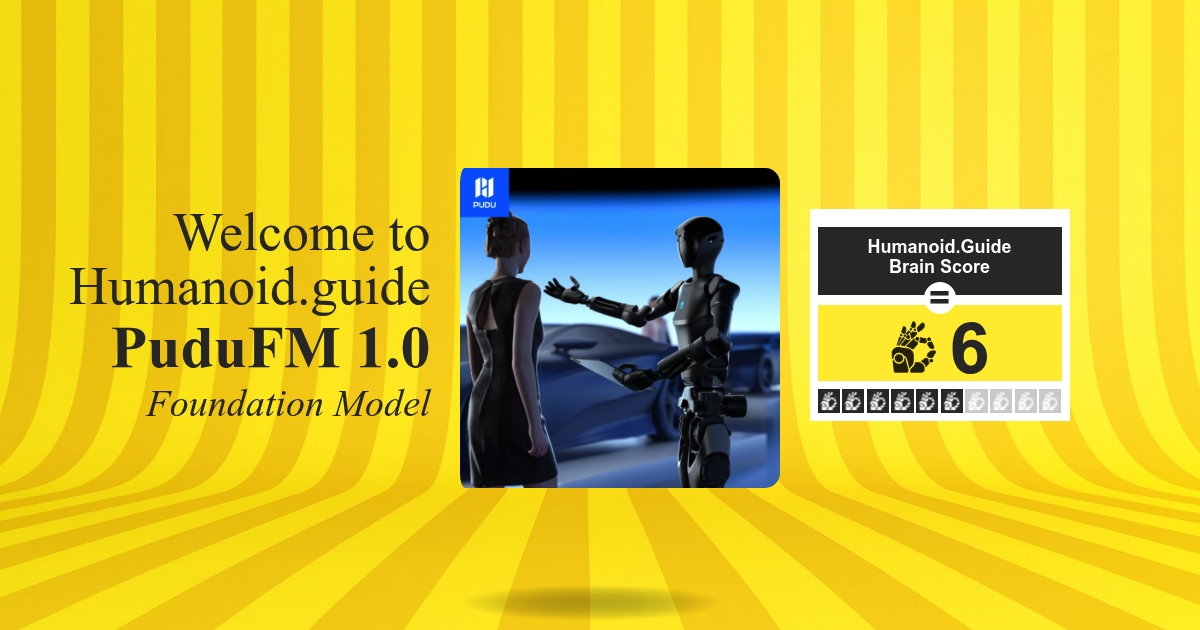
PuduFM 1.0 is an embodied AI foundation model from Pudu Robotics that centers on physical intuition and gives robots a shared cognitive system for acting in the real world. It combines movement planning and task execution inside one continuous decision loop, so navigation and manipulation are handled together rather than as separate stages. The model is built around two core layers, a Physical Intuition Model that reasons about object behavior and constraints, and a multimodal Vision Language Action system that turns that reasoning into action. This design shifts robots beyond simple object detection toward predicting outcomes, understanding contact and stability, and choosing actions with foresight. Pudu positions the system as a step toward general physical agents that can adapt across environments and tasks. With a Humanoid Guide Brain Score of 6, PuduFM 1.0 sits in the capable and mature range, reflecting a software stack that is already structured for practical deployment and ongoing improvement across multiple robot categories.
A major technical strength of PuduFM 1.0 is its training pipeline, which blends large scale real world deployment data with simulation and human feedback. Pudu states that the model learns from more than 130,000 deployed robots across over 80 countries, giving it a broad operational base that spans varied environments and usage patterns. Training in a high fidelity simulator supports faster iteration, while refinement with live human feedback helps align decisions with practical outcomes in the field. This makes the system relevant for robots that need to understand how objects behave, anticipate the results of contact, and coordinate movement with action in a single reasoning process. The same core intelligence can then be applied across delivery, cleaning, industrial, and humanoid platforms, supporting reuse of learned world knowledge instead of rebuilding autonomy for each machine from scratch.
PuduFM 1.0 is listed at zero dollars and is available on backorder, signaling that it is being positioned as a platform level intelligence offering rather than a conventional off the shelf consumer product. Its broader significance comes from the One Brain, Multiple Embodiments strategy, which aims to let many robot forms share a common and continuously improving model. That approach can shorten development cycles, spread learning across fleets, and create a stronger data flywheel as more robots operate in more places. By grounding progress in deployed systems rather than lab only demonstrations, Pudu is tying foundation model development to commercial robotics at scale. This matters for the wider market because it points toward software defined robotics, where improvements in world modeling and action policy can lift the usefulness of entire fleets across service, industrial, and humanoid domains.