China expands humanoid robot patent share to 60.8%
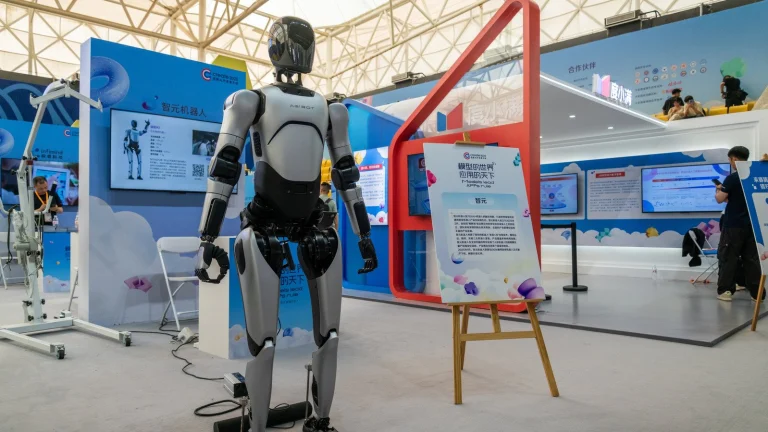
China accounted for 60.8 percent of humanoid robot patents across the world’s five major intellectual property offices in the first half of 2026, extending a lead that has become increasingly difficult for South Korean developers to ignore.
Data obtained by South Korean Rep. Lee Jeong-heon showed the US holding a 21.8 percent share and South Korea 4.6 percent, according to The Korea Herald. China’s share was 51.8 percent in 2024. Over the same period, the US share fell from 27.3 percent and South Korea’s declined from 6.3 percent.
Key facts
- China’s IP5 patent share: 60.8 percent
- US patent share: 21.8 percent
- South Korean patent share: 4.6 percent
- China’s robot foundation model share: 66.3 percent
Recent application figures favor China
China submitted 1,584 humanoid robot patent applications during the first half of 2026, compared with 113 from the US and 35 from South Korea. In 2025, the corresponding figures were 2,573 for China, 640 for the US and 97 for South Korea.
The office cautioned that recent counts are provisional because patent applications are normally published after an 18 month delay. The latest totals should therefore be treated as an incomplete view rather than a final accounting of filings.
China also held 66.3 percent of IP5 patents related to robot foundation models, which use data from multiple sources to help robots acquire new tasks without separate programming for every action. The US accounted for 14.1 percent and South Korea 8.8 percent.
Patent volume does not by itself establish technical superiority. Filing totals can reflect corporate strategy, public incentives and the breadth of claims as well as the quality of an invention. Separate capability assessments cited by the newspaper, however, point in the same direction.
Manipulation and interaction scores reverse Korea’s lead
The Korea Institute of S&T Evaluation and Planning used the US as a benchmark of 100 when assessing advanced autonomous manipulation. South Korea scored 85 and China 79 in 2022. By 2024, China’s score had increased to 90 while South Korea’s had fallen to 80.
Human robot interaction followed a similar pattern. South Korea led China by 85 to 84 in 2022, but China scored 90 against South Korea’s 80 in 2024.
Lee warned that weaker domestic capabilities and expanding foreign patent holdings could leave Korean robot manufacturers dependent on overseas technology and exposed to royalty costs. He called for an overhaul of national research investment and intellectual property strategy.
Industry sources cited China’s integrated component, robot assembly and AI software supply chain as part of its advantage. Korean manufacturers were described as facing gaps in domestic production of critical humanoid hardware, including complex joints and actuators, as well as shortages of physical task training data.
Hyundai Motor Group is drawing on its supplier network to localize components and working with technology companies including Nvidia on robot training data, according to the report. Whether those efforts produce defensible humanoid robot patents and stronger domestic component capacity will be a practical test of South Korea’s response.
Source: The Korea Herald