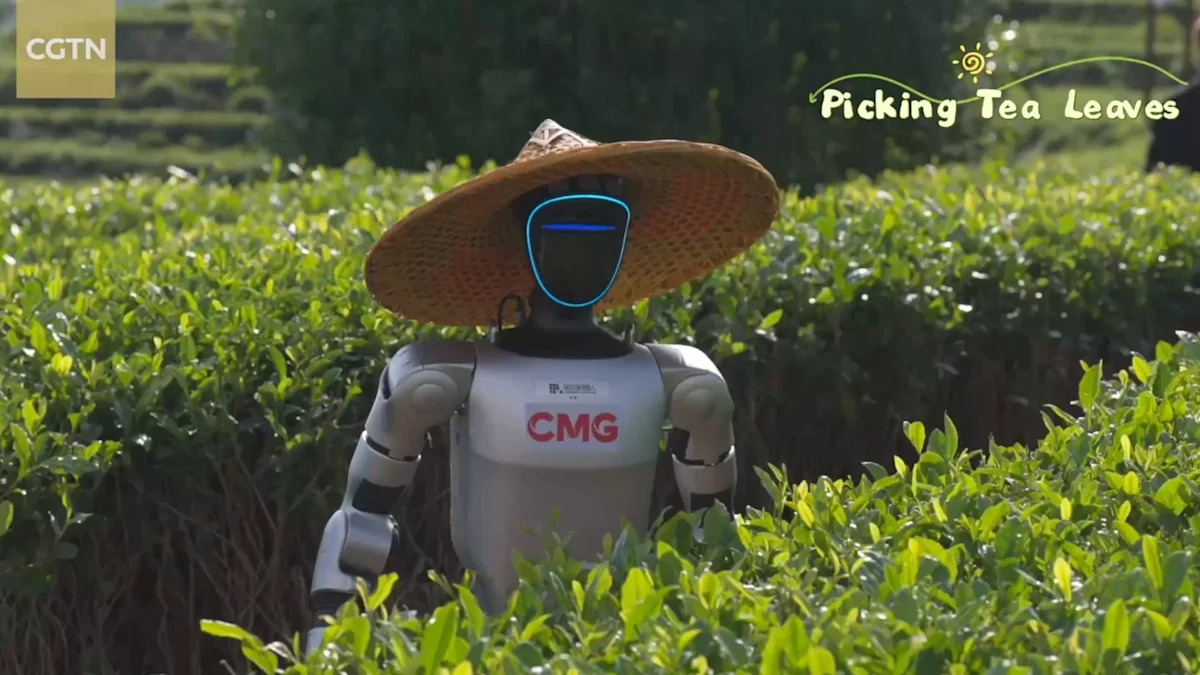
Tea farm humanoid robots tackle field trials ahead of 2026 games
Tea farm humanoid robots were put through live field trials in Fuding’s tea gardens in Fujian Province on May 10, taking on leaf picking, load carrying, and tea processing work in an agricultural setting rather than a lab. The trial matters because it tests whether humanoids can handle uneven terrain, variable crops, and delicate manipulation in the same workflow. It also serves as an early showcase for China’s 2026 World Humanoid Robot Games.
Tea farm humanoid robots move into real field work
According to the report published by tech.yahoo.com, citing China Daily, the robots were tested across several stages of white tea production rather than a single scripted demonstration. The tasks included identifying and picking leaves at different maturity stages, hauling loads across hilly ground, and assisting with sun drying and roasting. That combination pushes perception, locomotion, and dexterity together in a way that many indoor demos do not.
Agricultural work is especially difficult for humanoids because the environment does not conform to fixed dimensions or repeatable object placement. Tea leaves differ in size, ripeness, and position on the plant, while lighting changes throughout the day and the ground can shift underfoot. Those variables can disrupt machine vision and gripping accuracy at the same time that the robot has to maintain balance.
Why tea gardens are a meaningful benchmark
The source argues that tea gardens represent a tougher benchmark than standardized fulfillment centers because the job is not organized around uniform bins, shelves, or conveyor timing. Instead, the robot has to interpret plant conditions in place and decide how to grasp and move without damaging the crop. That makes the trial relevant to a broader question in humanoid robotics, whether systems can adapt to human workspaces that are irregular by design.
CGTN, as cited in the source text, said the Fujian test is intended to gather data for general purpose AI systems that need to operate in unstructured, human centered environments. For robotics teams, the value of that kind of trial is not only whether a task succeeds, but where it fails, such as missed picks, unstable footing, or poor hand placement. Real work trials can expose edge cases that remain hidden in carefully staged lab scenarios.
The tea setting also highlights the tension between speed and care. Harvesting and processing require contact with delicate materials, so raw force or simple repetitive motion is not enough. A humanoid that can move through a tea garden still has to show controlled manipulation to become useful in agricultural workflows.
2026 games will test more than athletic performance
The Fujian event is being framed as part of the buildup to the 2026 World Humanoid Robot Games. According to Global Times, as cited in the source article, the games will include 32 events split between athletic competition and real world scenario testing. Those scenario categories are expected to cover homes, hospitals, factories, and emergency response situations.
The source says this is a broader program than the 2025 Beijing games, which drew 280 teams and more than 500 robots from 16 countries. Adding agricultural challenges to that trajectory suggests organizers want humanoid evaluation to move beyond balance, speed, or entertainment oriented routines. It also reflects a growing emphasis on embodied AI performance in places where objects, surfaces, and human expectations vary continuously.
What the Fujian trial does not yet show is how the robots performed on throughput, error rates, or product quality, since the source provides no performance metrics. Even so, tea farm humanoid robots offer a useful signal about where evaluation is heading, toward field data from messy workplaces instead of only polished demonstrations. As more competitions and pilots adopt that approach, the gap between benchmark performance and deployable capability should become easier to measure.
Source: tech.yahoo.com