Welcome, Phoenix Gen 8!
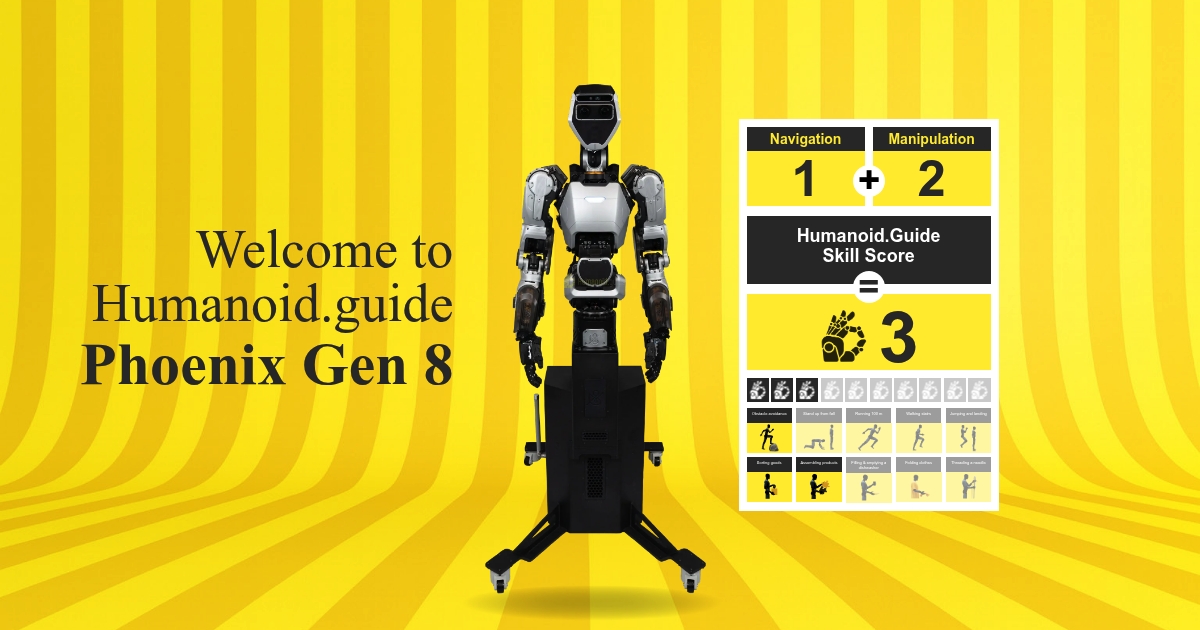
Phoenix Gen 8 is Sanctuary AI’s eighth generation general purpose humanoid, combining a humanlike upper body with a wheeled base. Developed in Vancouver, Canada, it prioritizes stable positioning and precise manipulation rather than bipedal movement. The robot stands 170 cm tall, weighs 70 kg, and has a listed lifting capacity of 25 kg. Its body uses electric actuators, while its hands employ miniaturized hydraulic valves. Each hand has five fingers and 21 degrees of freedom, supported by fine tactile sensing. Across the robot, the listed total is 58 degrees of freedom. Upgraded cameras provide a wider field of view and sharper imagery to support data collection for Sanctuary’s Carbon AI control system. Phoenix Gen 8 has an overall skill score of 3 out of 10, placing it in the developing category. Its navigation rating is 1 out of 5, while manipulation is rated 2 out of 5. These ratings distinguish its current development stage from its ambitious hardware design and general purpose positioning.
Obstacle avoidance, sorting goods, and assembling products define Phoenix Gen 8’s demonstrated capability set. Its wheeled base provides a stable platform for positioning the upper body during manipulation, while articulated hydraulic hands and tactile sensing support object interaction. Sorting goods is relevant to logistics workflows, where items must be separated and organized. Product assembly provides another setting for evaluating hand control and repeatability. The upgraded camera system adds visual information to these activities, complementing tactile feedback from the hands. Together, these systems support the collection of training examples for Carbon AI. The emphasis is on developing manipulation through physical tasks, with navigation remaining a comparatively limited part of the robot’s current skill profile.
Phoenix Gen 8 is listed as a prototype, with a displayed price of USD 150,000 and an inquiry process for prospective buyers. Sanctuary AI released this generation in December 2024, less than eight months after Gen 7. Its shift to wheels reflects customer feedback that earlier leg designs were too fragile to support a strong upper body. The platform’s broader significance lies in its role as a physical data collection system for robot AI development, alongside potential industrial and logistics applications. Listed runtime is four hours per charge, and connectivity includes Ethernet and WiFi. Its prototype status and developing skill score remain important context when considering deployment expectations.