Welcome, Vesoma 1!
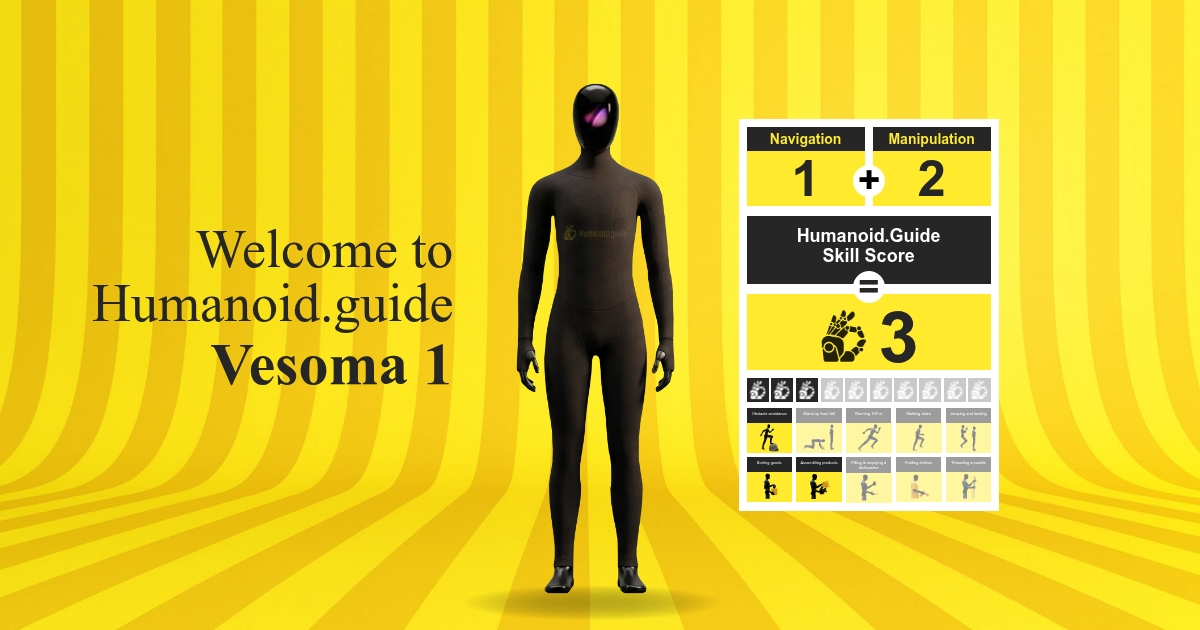
Vesoma 1 is a 170 cm, 75 kg humanoid robot designed for physical work in logistics, manufacturing, and warehouse environments. Developed by Vesoma, the machine combines a black and white form factor with 26 overall degrees of freedom, including 12 in its hands and ten fingers across two hands. Its listed top speed is 4 km/h, while its specified strength is 5 kg. The robot is intended to learn tasks through trial and error, a method Vesoma describes as Physical General Intelligence. Rather than relying exclusively on copied human demonstrations, it develops behaviors through direct interaction with physical conditions. This approach puts emphasis on adapting actions to its own body and the forces involved in real work. Vesoma 1 is rated 3 on the Humanoid.Guide Skill Score, placing it in a developing stage. Its navigation rating is 1 out of 5 and its manipulation rating is 2 out of 5, reflecting an early platform focused on building practical robotic competence.
Obstacle avoidance is one of Vesoma 1’s stated capabilities, supporting movement through active work areas where routes may contain people, equipment, containers, or other changing obstructions. The robot is also intended for sorting goods, a useful function for warehouse flows involving identification, handling, and placement of items into designated locations. Product assembly is another listed capability, positioning Vesoma 1 for repetitive industrial tasks that require physical interaction with components. These capabilities align with its logistics, manufacturing, and warehouse focus. The combination of basic navigation and developing manipulation creates a foundation for structured work environments where tasks can be repeated, evaluated, and refined through continued physical experience.
Vesoma 1 is currently listed as a prototype and is available through price inquiry, with a displayed reference price of 50 000 USD. Vesoma operates from Munich, Germany, and Limassol, Cyprus, and was founded by Nikolai Ensslen and Peter Skoromnyi in December 2025. The company has grown to more than 60 people across its two European hubs. The project is significant because it pursues a learning approach centered on direct physical experimentation, rather than depending solely on human demonstrations. This direction addresses the need for robots that can adapt their behavior to changing conditions in factories, warehouses, and other labor constrained settings.