Welcome, ROBO-T1!
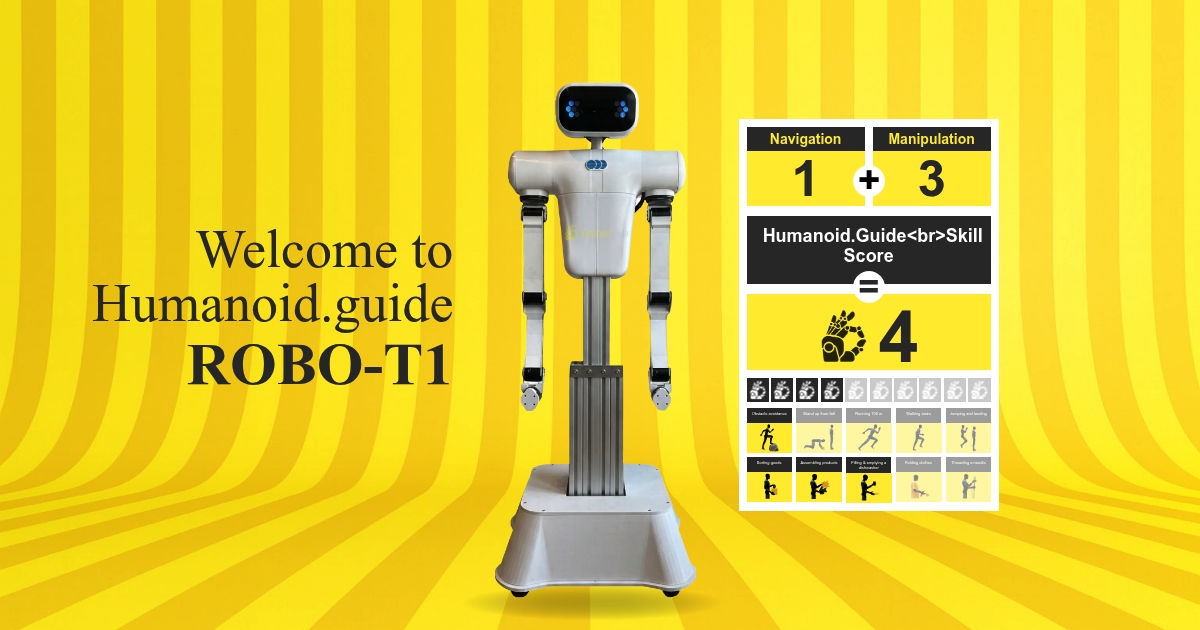
This 130 cm, 50 kg humanoid is designed for practical industrial automation, pairing a mobile form with two coordinated arms for work in factory settings and other structured workplaces. Each arm provides six degrees of freedom and uses a two finger gripping claw, while force sensing supports controlled handling across materials. Electric servo motors, harmonic drives, and an aluminum and composite structure form the mechanical platform. It connects through Ethernet and Wi Fi, reaches a maximum speed of 2 km/h, carries up to 5 kg, and provides up to four hours of runtime per charge. The system is intended to work safely alongside people and can be taught tasks through demonstrations rather than extensive conventional programming. Its score of 4 out of 10 positions it as a developing humanoid platform, with a navigation rating of 1 out of 5 and a stronger manipulation rating of 3 out of 5. Remote operator support and behavior learning from demonstrations help teams refine deployed workflows.
The platform supports obstacle avoidance while performing manipulation centered workflows. It can sort goods for material flow, assemble products where coordinated arm use is valuable, and fill and empty a dishwasher. These capabilities connect loading tasks with industrial handling requirements, emphasizing repeatable interaction with objects rather than fixed single purpose machinery. The bimanual arrangement enables one arm to stabilize or position an item while the other performs an action, supporting operations that require coordinated handling. Sorting can support kitting and order preparation, while product assembly aligns with manufacturing cells. Obstacle avoidance adds spatial awareness for operation in environments shared with equipment, materials, and personnel.
ROBO T1 is in production from Robo Robotics Inc., a United States manufacturer, and is listed at 12 000 USD with inquiries available for pricing engagement. The platform illustrates a practical route toward accessible humanoid automation, standardized hardware can let organizations teach a task, transfer a learned policy across units, and integrate robotic assistance into existing workflows. Its emphasis on supervised deployment and learning through demonstration addresses the operational challenge of introducing robots without demanding major line changes. Across manufacturing, logistics, healthcare, food production, packaging, quality inspection, and laboratory workflows, it represents an effort to turn bimanual humanoid hardware into a flexible workforce tool. The developing score reflects an emerging platform focused more strongly on manipulation than navigation.