Welcome, PHD Hand!
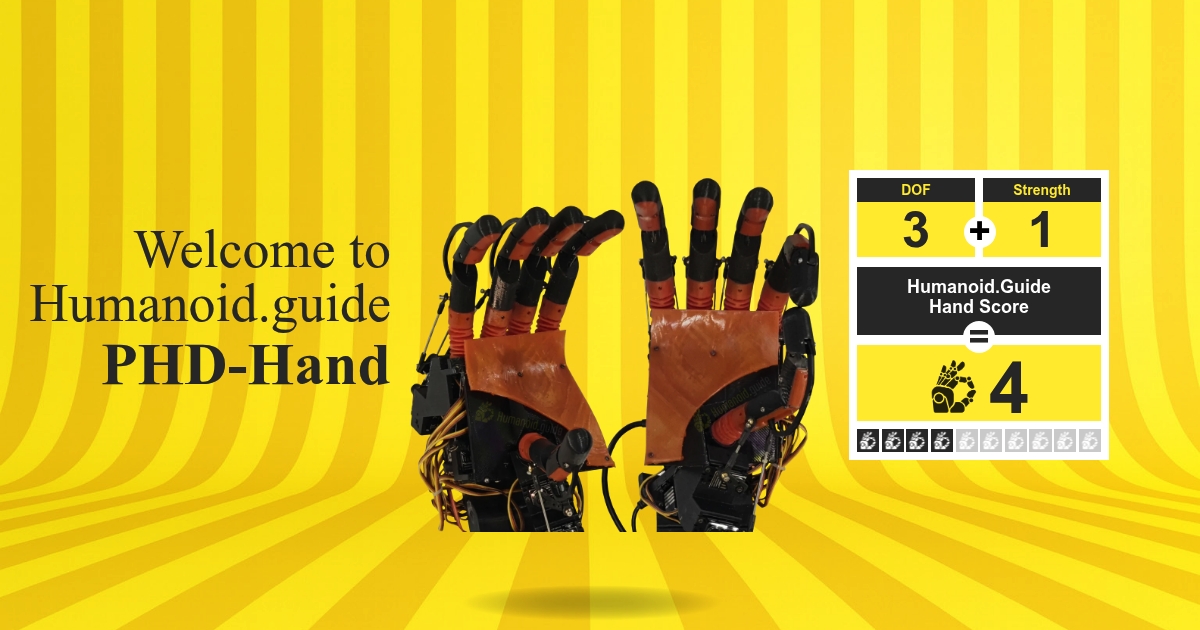
The Printable Humanoid Dexterous Hand, developed by researchers at the New Jersey Institute of Technology, is a prototype robotic hand built around an affordable, printable mechanical design. Its five fingers use linkages rather than tendons, with flexible hinges and thin stainless spring steel rods forming key parts of the mechanism. Miniature hobby servo motors sit outside the fingers and drive the linkages without gear trains. The main structural materials are PETG and TPU, making additive manufacturing central to its construction. Listed specifications include a weight of 0.5 kilograms and a size of 200 millimeters, placing the design near human hand scale. Its overall Humanoid Guide score is 4 out of 10, positioning it as a developing platform rather than a mature commercial benchmark. The category ratings are 3 out of 5 for degrees of freedom and 1 out of 5 for strength. These ratings distinguish its joint articulation profile from its comparatively low strength tier.
The evaluation separates two important aspects of robotic hand development: degrees of freedom and strength. A degrees of freedom rating of 3 out of 5 places this design in the middle tier for that category, while its strength rating of 1 out of 5 identifies force as a comparatively limited dimension. Neither score is a physical measurement or a count of joints. Together, they provide a useful framework for discussing the hand without equating articulation with powerful gripping. Its overall score of 4 out of 10 reinforces that distinction: this is a developing design whose assessment should preserve the difference between mechanical complexity, dexterity ratings, and strength ratings.
The hand is listed as a prototype with an indicated price of 300 USD. Its researchers plan to release the design files openly, making the intended distribution model relevant to academic laboratories, robotics education, and communities interested in printable hardware. Planned publication of files should not be confused with an already completed release. The broader significance lies in the project’s emphasis on accessible fabrication and a mechanical alternative to tendon driven construction. Using printable polymers, hobby servos, and steel rods places familiar components at the center of the design. The New Jersey Institute of Technology is the named developer, and the project website is https://phd-hand.github.io/.