Welcome, RayNex G3!
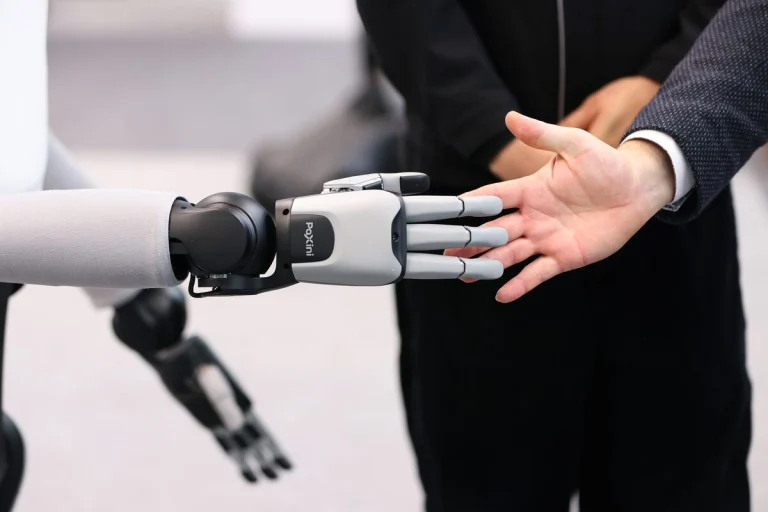
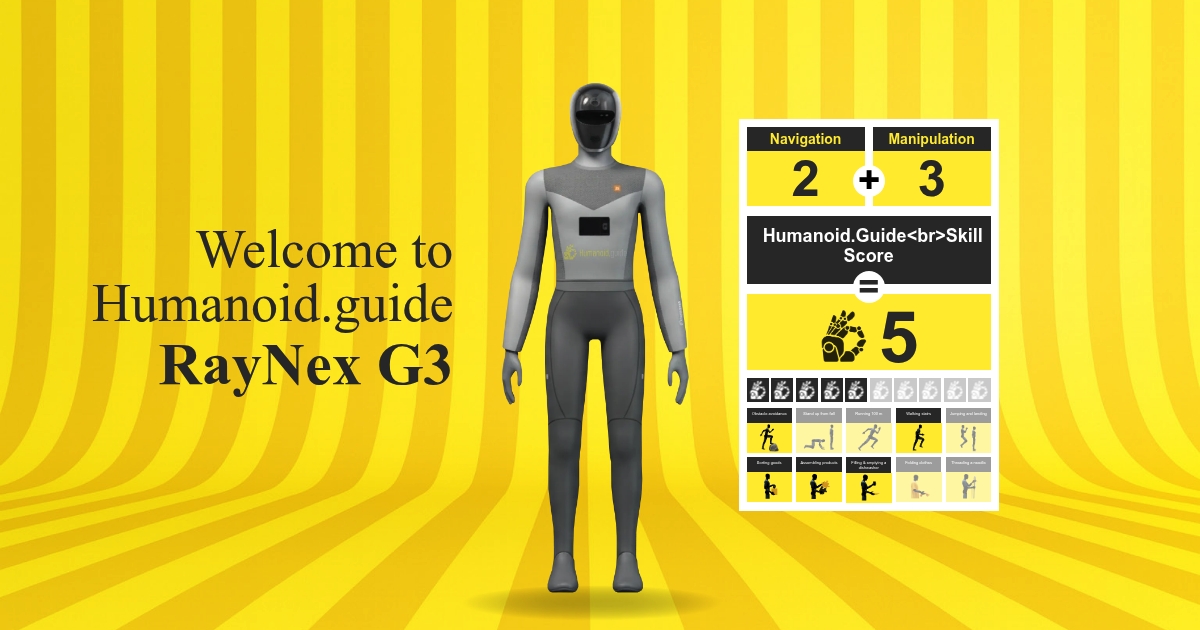
The RayNex G3 is an industrial humanoid designed for heavy payload work in manufacturing environments. At 173 centimeters tall and 60 kilograms, it combines a compact humanlike frame with a stated 100 kilogram deadlift capacity. NineRay uses hybrid linear and harmonic series elastic actuator joints, alongside frameless torque motors and harmonic plus linear drive systems, to support controlled force delivery and stable whole body motion. The platform includes 32 overall degrees of freedom and 12 degrees of freedom in its hands, with five fingers on each hand. RayBrain AI and RayBrain OS unite perception, planning, and control in NineRay’s proprietary architecture. A full body force control network draws on 44 precision sensor units to adapt movement dynamics while handling loads. The robot has a listed maximum speed of 6 kilometers per hour, a walking speed of 4, Ethernet and WiFi connectivity, and an eight hour runtime per charge. It is intended for industrial and manufacturing deployment.
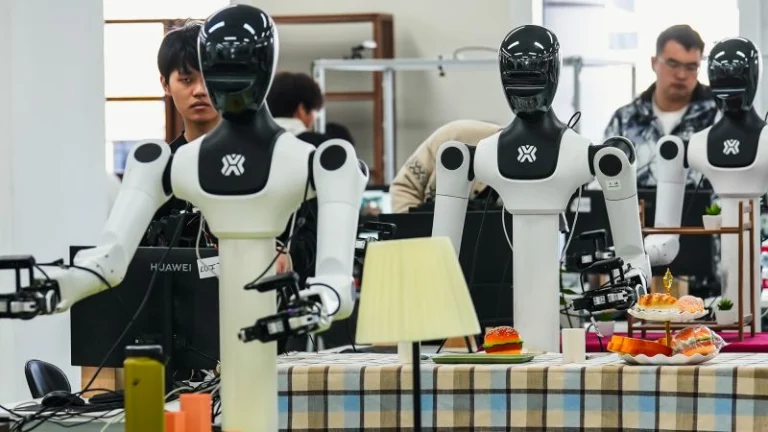
With a total skill score of 5 out of 10, the RayNex G3 occupies a developing stage of humanoid capability. Its navigation rating of 2 out of 5 indicates an early tier for mobile autonomy, while its manipulation rating of 3 out of 5 reflects developing whole body handling and task execution. The demonstrated capability set includes walking stairs, sorting goods, assembling products, and filling and emptying a dishwasher. These tasks suit structured workplaces where the robot can combine movement with two handed object handling. Its stated load capacities, including mobile handling of 80 kilograms and dual arm holds of 60, emphasize the platform’s focus on demanding industrial material movement.
RayNex G3 is listed as in production by NineRay, a Chinese manufacturer, and carries a listed price of 6,500 USD, with purchasing inquiries invited for application specific requirements. The system’s stated safe operation with humans supports its role in shared industrial settings. Its combination of substantial payload capacity, long duration operation, and proprietary control technology signals a push toward humanoids that can contribute to physical production work rather than only laboratory demonstrations. By pairing in house component engineering with a unified AI stack, NineRay positions the G3 as a platform for industrial automation development. Its availability reflects growing commercial interest in humanoid systems built for demanding factory tasks.