Welcome, Jupiter!
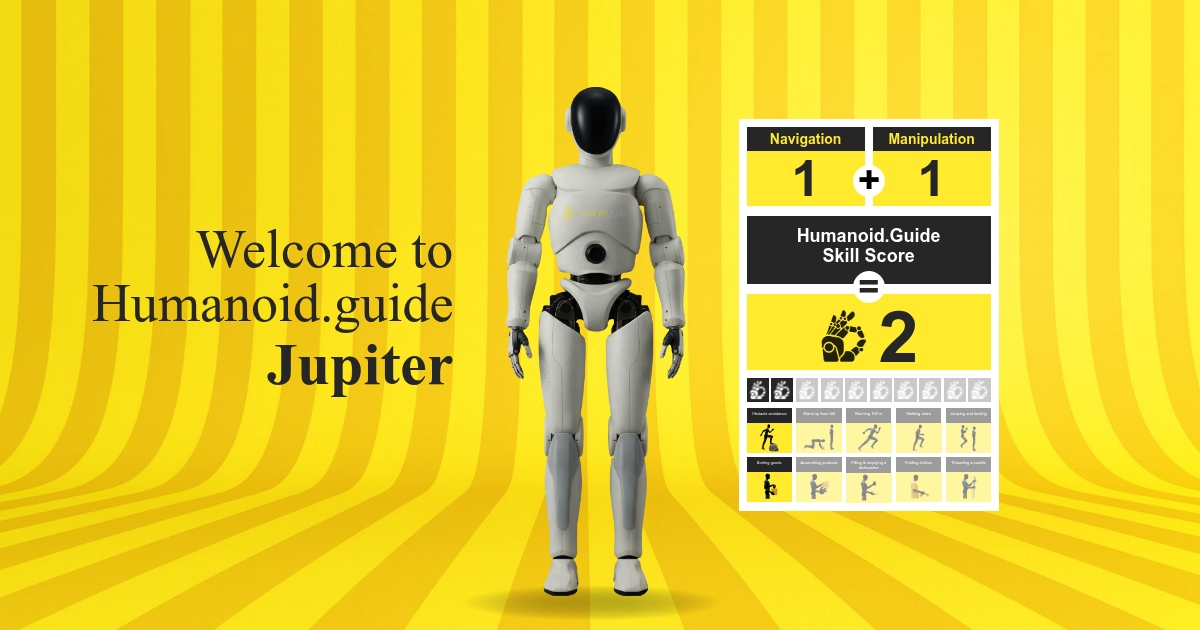
Jupiter is a 165 cm, 60 kg full size humanoid from Zeroth Robotics, designed for logistics, security patrols, research, training, and front of house service. Its 30 degrees of freedom, including 16 in its hands, support a human shaped form intended to operate in spaces built for people. The platform reaches a maximum speed of 3 km/h, carries a listed strength figure of 6 kg, and has a stated runtime of four hours per charge. Jupiter combines autonomous operation with teleoperation, enabling a remote operator to take control when situations demand direct judgment. A torso depth camera supports perception, while proprietary Zeroth actuators drive its motion. The robot has five fingers on each hand and is presented in white. Its total score of 2 out of 10 places it in the early stage category, with navigation rated 1 out of 5 and manipulation rated 1 out of 5. Jupiter is positioned as a supervised service robot and development platform rather than a mature general purpose worker.
Sorting goods is Jupiter’s identified capability, making it relevant to structured logistics environments where items need to be organized into designated categories or locations. This task suits a supervised deployment model, combining automated operation for repeatable steps with teleoperation when an operator needs to intervene. The robot’s full size form and articulated hands provide a familiar physical format for handling goods in facilities designed around human workers. Jupiter’s low navigation and manipulation tier ratings indicate that sorting use cases benefit from controlled environments, clear workflows, and human oversight. This positioning makes the platform useful for organizations evaluating humanoid labor concepts, testing service automation workflows, and collecting operational experience with remotely supported robotic systems. Its purpose is to bring sorting activity into a humanoid format while retaining direct human control when required.
Jupiter is listed in early production with limited release availability. Zeroth introduced the robot at CES 2026 during its entry into the United States market, positioning Jupiter as the largest model in its robot lineup alongside the smaller M1 home humanoid and W1 tracked service robot. The platform reflects an industry direction toward humanoids that can provide useful work before full autonomy is achieved. By combining autonomous functions with remote operation, Jupiter addresses the practical need for reliable human intervention in real workplaces. Its significance lies in supporting early adoption across front of house service, logistics, research, security, and training, where businesses can evaluate humanoid workflows without relying entirely on autonomous performance.