Welcome, CRAFT Hand!
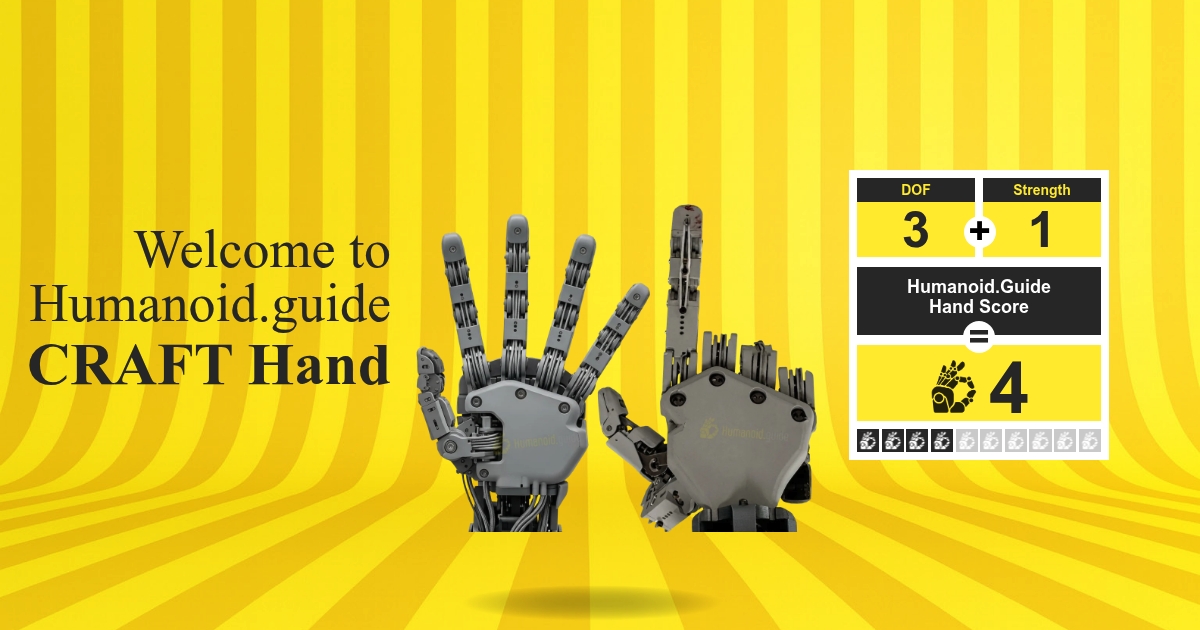
CRAFT Hand is an open source robotic hand developed by researchers at the University of Illinois Urbana Champaign and UC Irvine. Its design combines rigid structural links with soft joint material, creating a hybrid architecture rather than relying entirely on hard components or flexible construction. The five finger assembly uses tendon actuation, with 15 ROBOTIS Dynamixel servo motors positioned outside the fingers. Rolling contact joints form another distinctive part of the mechanical design. The listed hand dimensions are 200 × 95 × 40 mm, with a weight of 0.6 kg. Its structure uses 3D printed rigid links alongside compliant joint material, making material selection central to the design. Dedicated tactile sensors are not included, while position feedback comes from the Dynamixel motors. CRAFT Hand receives an overall score of 4 out of 10, placing it in the developing range. Its category ratings are 3 out of 5 for degrees of freedom and 1 out of 5 for strength, indicating a stronger relative assessment for articulation than for force.
The technical assessment separates articulation from strength, two distinct considerations when evaluating a robotic hand. CRAFT Hand’s degrees of freedom rating sits in the middle of the five point scale, while its strength rating occupies a lower tier. These ratings describe category performance rather than physical joint counts or measured lifting limits. For research planning, that distinction matters: mechanical complexity, available feedback and force requirements deserve separate evaluation rather than being collapsed into a single impression of dexterity. Its overall score signals a developing platform, not a mature benchmark across every dimension. A useful evaluation framework would therefore examine articulation, force requirements and sensing needs independently, with particular attention to the absence of dedicated tactile sensing.
CRAFT Hand is listed as a prototype, with a published parts cost of under $600 rather than a confirmed price for a finished commercial unit. The collaboration between the University of Illinois Urbana Champaign and UC Irvine places the project within academic robotics research. Shared resources include CAD designs, printing files, software and a simulation model, giving other researchers documentation for studying and reproducing the platform. This open source approach makes the project significant beyond its hardware specifications: it provides a common design that laboratories can inspect, modify and compare. Its affordability is best understood in terms of component costs, with assembly effort and research integration remaining separate considerations for anyone planning a build.