Welcome, Handroid!
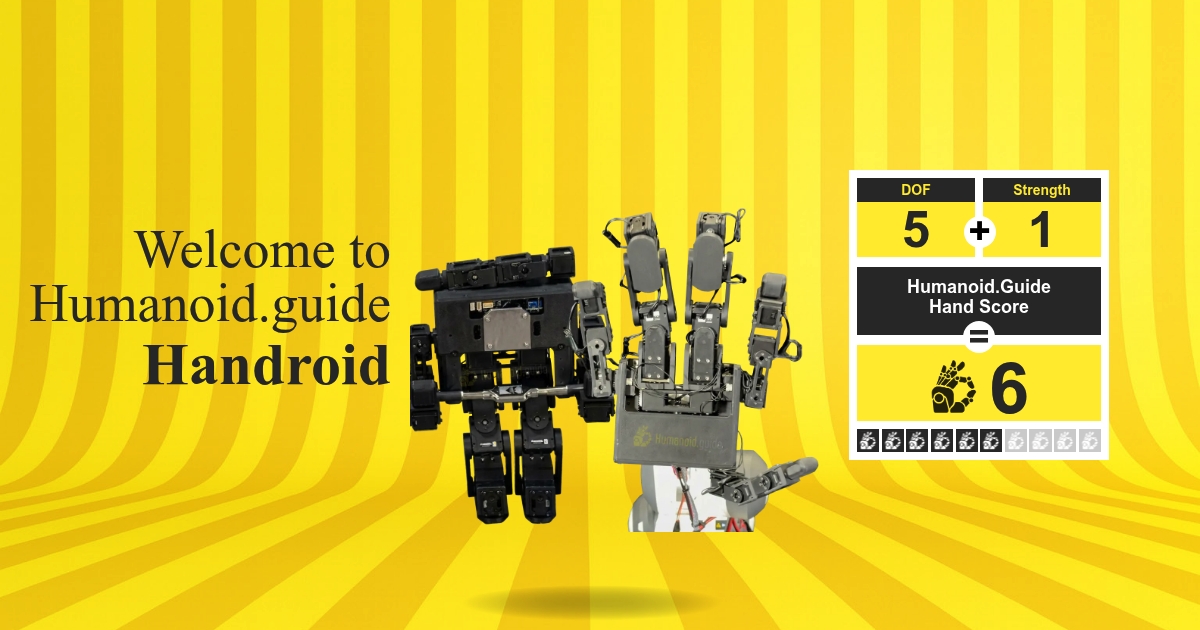
Handroid is a desktop robotic hand developed by researchers at UNC Chapel Hill and Stanford University. Its design combines a fully 3D printed plastic structure with compact modular actuators, creating a research platform centered on dexterity and adaptable mechanical design. It receives an overall Humanoid.Guide Hand Score of 6 out of 10, placing it in the capable range of the scoring system. The two component ratings reveal a distinct balance: Degrees of Freedom receives 5 out of 5, while Strength receives 1 out of 5. These ratings describe category performance rather than physical measurements or joint counts. The strongest aspect of its assessment is therefore its degrees of freedom rating, not its strength tier. The listed hardware includes five fingers, joint position feedback from its actuators, and an integrated control board for power, sensing, and status. With a listed weight of 2.05 kilograms, Handroid presents a compact research format whose technical identity emphasizes modular construction and articulated hand design.
The key technical distinction in Handroid’s assessment is the contrast between its top tier degrees of freedom rating and its lower strength rating. For researchers comparing robotic hands, these categories address different selection priorities and should remain separate. A high degrees of freedom score is not a statement of lifting capacity, and the overall score should not obscure the weaker strength tier. Likewise, the strength rating is not a force measurement and cannot be converted into a payload specification. Handroid is best evaluated through this category balance: a capable overall assessment with particularly strong recognition for degrees of freedom. Research planning should distinguish mechanical articulation requirements from grip force requirements rather than treating either score as a substitute for task specific testing.
Handroid is listed as a prototype, with a displayed price of 1,000 USD and an option to inquire about pricing. Its academic development connects UNC Chapel Hill and Stanford University, with C. Karen Liu and Shuran Song among the researchers named. The team shares design files and a parts list through the project, supporting access to the underlying hardware design rather than presenting only a finished commercial product. That openness is significant for laboratories assessing construction methods, component choices, and reproducibility. Its fully 3D printed structure and reused actuator modules provide a concrete basis for examining modular robotic hand architecture. Prototype availability remains an important distinction when considering procurement, research integration, and expectations for product maturity.