Welcome, Bolt!
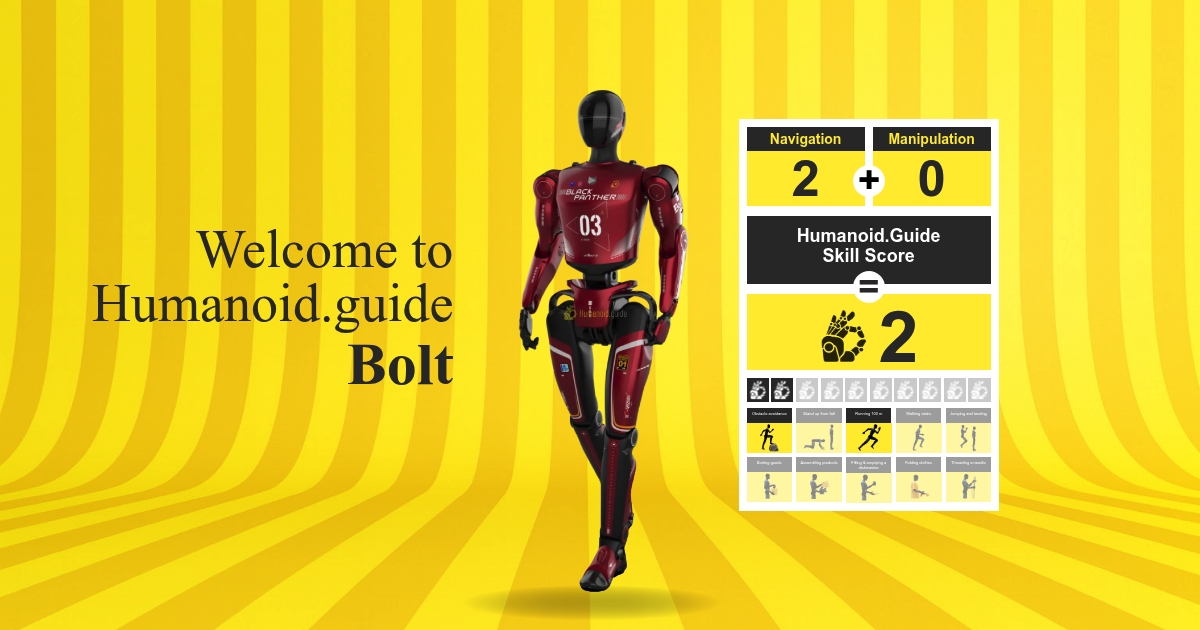
Bolt is a full size humanoid robot developed by MirrorMe Technology, a robotics company based in Beijing, China. Unveiled in February 2026 and named after sprinter Usain Bolt, it concentrates on fast locomotion rather than manipulation. The robot stands 175 cm tall, weighs 75 kg, and uses human proportions as a foundation for its mechanical design. Its red body incorporates high performance electric joint motors designed in house. MirrorMe reports a peak running speed above 11 meters per second, following its earlier achievement of exceeding 10 meters per second. Its listed capabilities include obstacle avoidance and running 100 m. Bolt has an overall skill score of 2 out of 10, placing its broader capability profile at an early stage despite its specialized speed performance. Navigation is rated 2 out of 5, while manipulation is rated 0 out of 5. Listed runtime is one hour per charge. As a high speed research robot, Bolt is intended for supervised use rather than unrestricted interaction with people.
Running 100 m gives Bolt a concrete locomotion task around which researchers can evaluate its performance. Its human scale dimensions make that task relevant to comparisons between robotic and human sprinting, while its reported peak speed highlights the demands placed on joint motors and body control. Peak speed should not be confused with an average speed across the full distance or a verified race time. Obstacle avoidance adds a separate navigation capability alongside straight running performance. Together, these capabilities support its positioning for locomotion research, sprint training applications, and technology demonstrations. Any use around athletes or observers requires supervision, consistent with its stated safety designation. Its navigation rating remains preliminary rather than indicating comprehensive mobility.
Bolt is listed as a prototype, with an advertised price of USD 100,000 and an inquiry option for prospective buyers. Its stated markets are research, sports training, including use as a sparring partner for sprinters, and technology demonstration. That positioning makes it a specialized research platform rather than a general purpose worker. Its broader significance lies in bringing high running speeds to a robot with dimensions close to those of an adult human. The contrast between its sprint performance and its overall score is important: excellence in a narrow physical task does not establish broad humanoid competence. For organizations considering Bolt, the relevant starting points are its prototype status, supervised operating requirements, and specific emphasis on running and obstacle avoidance.