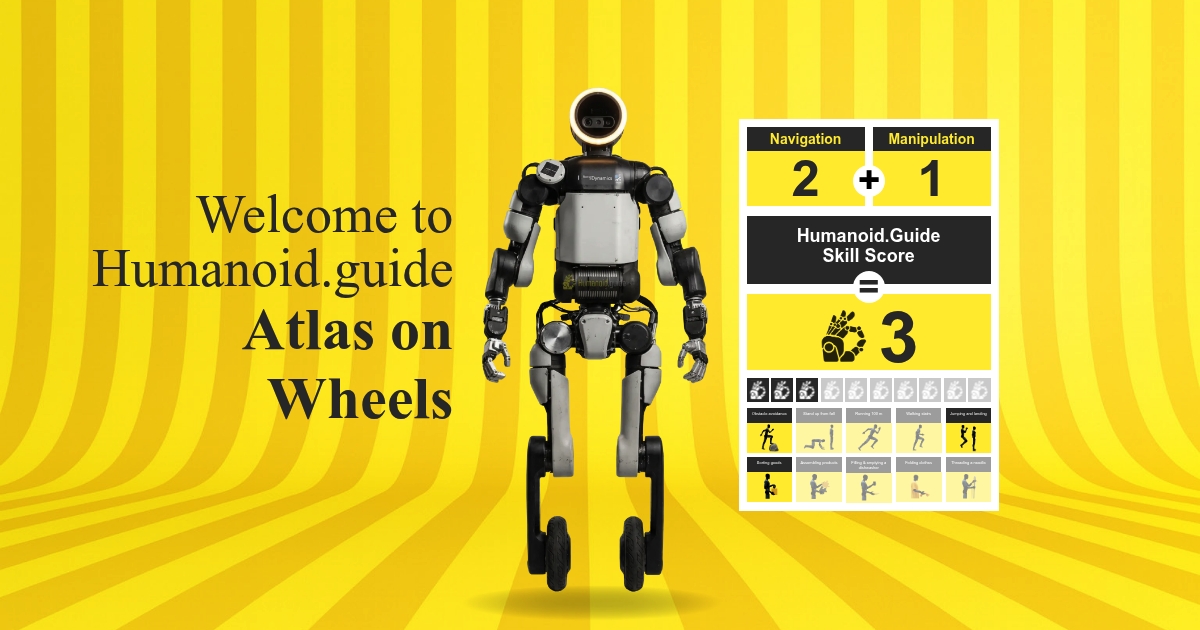
Welcome, Atlas on Wheels!
Atlas on Wheels is a wheeled humanoid research prototype from Boston Dynamics, designed to explore electric actuator performance through an unusual approach to locomotion. Instead of conventional feet, it uses scooter wheels fitted to its existing ankle motors, allowing the research team to investigate demanding motor behavior without building an entirely new robot. Its supported capabilities include obstacle avoidance, jumping and landing, and sorting goods. With an overall skill score of 3 out of 10, it remains a developing platform rather than a mature general purpose worker. Navigation is rated 2 out of 5, while manipulation is rated 1 out of 5, indicating a stronger emphasis on mobility than object handling within its current capability profile. The robot stands 190 centimeters tall, weighs 90 kilograms, and has a maximum speed of 12 kilometers per hour. Custom electric actuators power the platform, while its hands have three fingers each. Its black and white body retains the humanoid upper body configuration while replacing foot contact with rolling contact.
The combination of obstacle avoidance and jumping and landing makes Atlas on Wheels a distinctive platform for studying movement with wheels attached to articulated legs. Obstacle avoidance concerns navigation around physical obstructions, while jumping and landing introduces a separate challenge involving coordinated motion and controlled contact with the ground. These capabilities align with its research purpose of testing motors under demanding conditions. Sorting goods adds an object handling application to this mobility profile, although its manipulation rating remains at an early tier. A 360 degree camera view provides surrounding visual coverage, and connectivity through Boston Dynamics’ Orbit software links the platform to factory systems. Together, these features support research into the relationship between mobile navigation, actuator performance, and goods handling.
Atlas on Wheels is a prototype intended primarily for research, not an established commercial workforce product. Its price is presented as 200,000 USD, with an inquiry option for prospective buyers seeking further details. Boston Dynamics developed the wheeled configuration as an experimental version of Atlas, and the work helped inform the standard robot. Its broader significance lies in using an existing humanoid platform to investigate a different form of ground contact and the resulting demands on electric motors. Rather than treating wheels as a complete departure from humanoid design, this version places them within the robot’s existing articulated structure. The result is a focused research vehicle whose developing capability profile should be distinguished from expectations of broad industrial readiness.