Welcome, Alex!
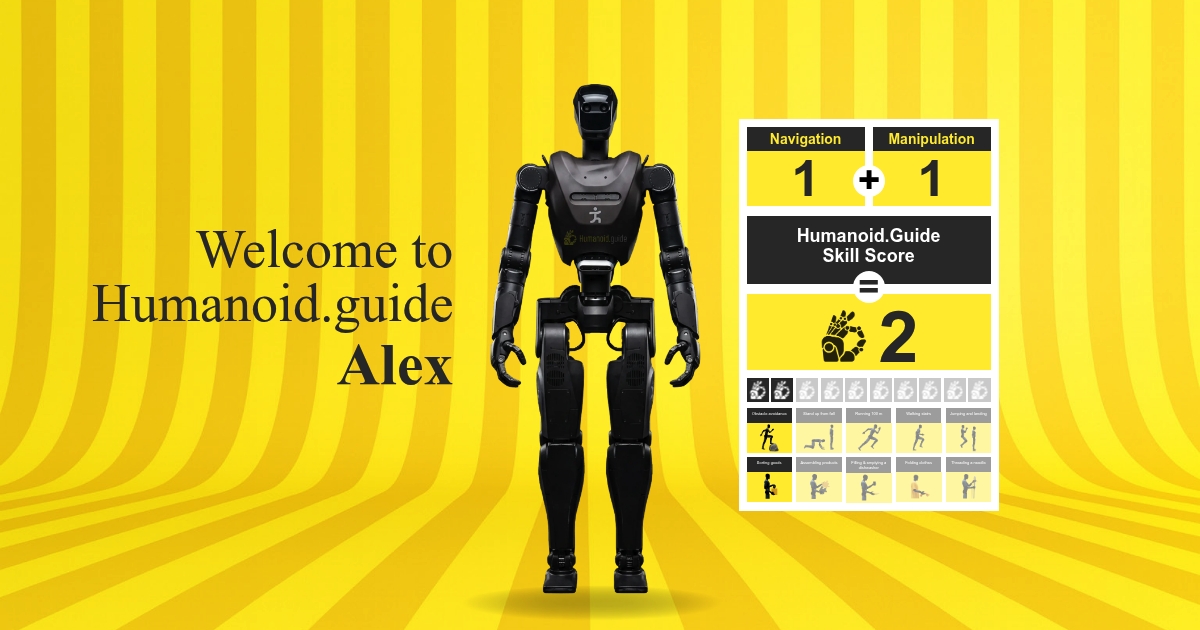
Alex is a fully electric humanoid research robot developed by IHMC, the Florida Institute for Human and Machine Cognition. Standing 175 cm tall and weighing 85 kg, it combines bipedal mobility, onboard power, stereo vision, wireless teleoperation, and five finger hands in a platform intended for demanding real world environments. Alex has 29 degrees of freedom overall and uses custom high power electric actuators with low friction transmissions. Its onboard computing runs IHMC whole body control and behavior software, supported by an open Alex software development kit. With a maximum speed of 3 km/h and a reported runtime of two hours per charge, Alex is built for supervised research and hazardous environment operations rather than public deployment. Its Humanoid.Guide Skill Score of 2 places it at an early stage, with navigation and manipulation each rated at 1 out of 5. The platform builds on IHMC’s earlier Nadia humanoid research, extending the institute’s long running work in dynamic locomotion, perception, and human shaped robotic systems.
Alex supports obstacle avoidance and sorting goods, two capabilities that connect its perception, motion control, and manipulation systems. Obstacle avoidance is particularly relevant to urban, industrial, and disaster settings where robots must move through changing spaces while maintaining stability and awareness of nearby objects. Sorting goods demonstrates a practical manipulation direction for its hands and arm systems, allowing the robot to identify, handle, and organize items under controlled supervision. Stereo vision provides environmental information for these tasks, while onboard computing and wireless control enable operators to monitor and guide operations without remaining physically tethered to the machine. These functions position Alex as a research platform for developing dependable whole body behavior in environments where conventional wheeled robots face mobility limitations.
Alex is listed as a prototype and is priced at 500,000 USD through inquiry. IHMC’s work is supported by United States government research organizations, including the Office of Naval Research and the Army Research Laboratory. This backing reflects the strategic importance of humanoid robots for defense, disaster response, and research involving dangerous or inaccessible sites. Alex represents an effort to move advanced humanoid robotics beyond laboratory demonstrations toward field relevant tasks requiring mobility, perception, remote supervision, and physical interaction. Its significance lies in providing a capable experimental system for testing how electric humanoids can support people operating in high risk environments, while advancing control software, actuator design, and robot behavior for future generations of field robots.