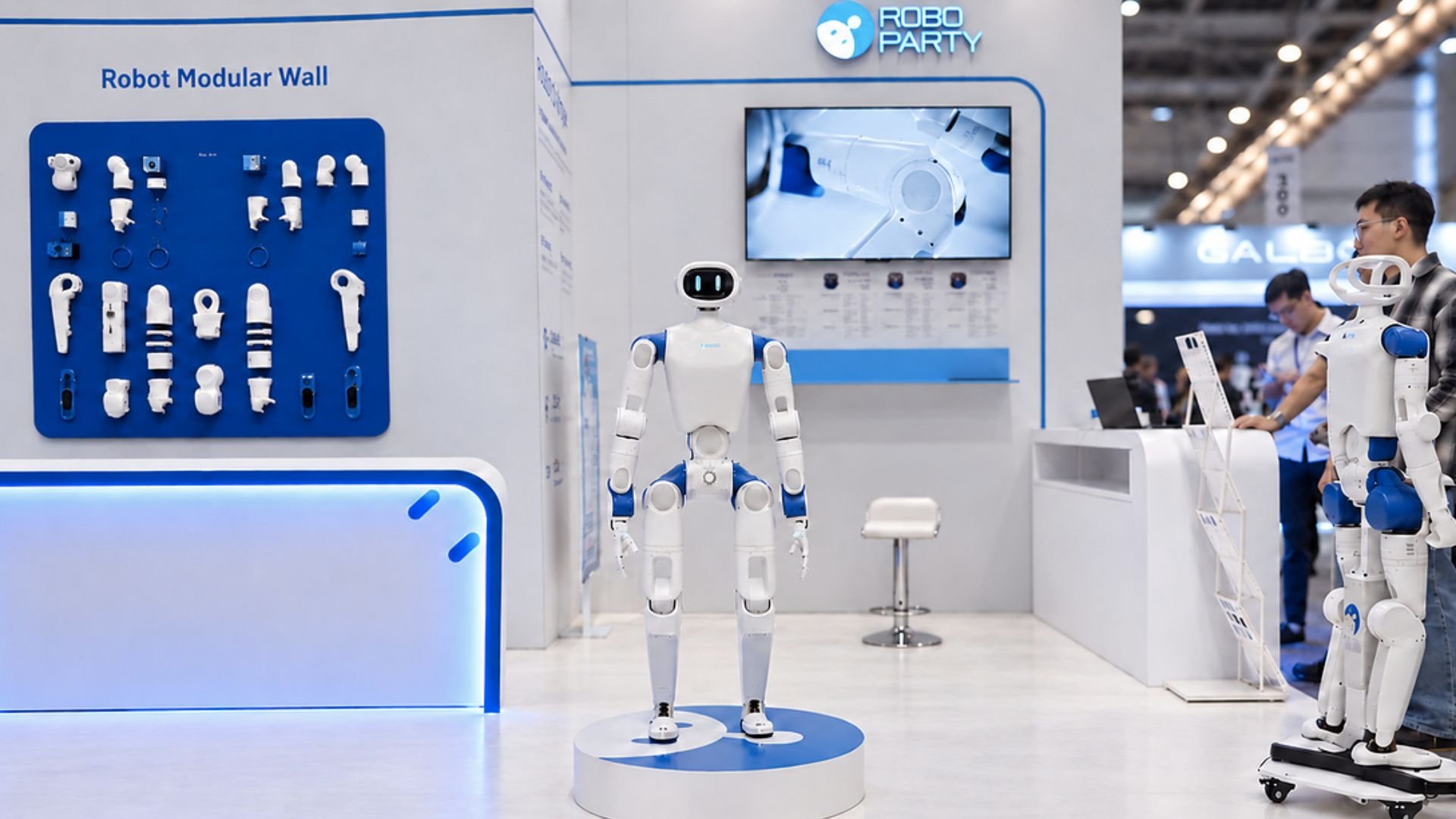
RoboParty unveils RP1 humanoid with full stack open source plans
RoboParty unveiled its RP1 humanoid, also called ROBOTO 01, at IROS 2026, demonstrating disturbance recovery and outlining plans to release hardware and software for developers. Interesting Engineering reports that the Pittsburgh based company presented the biped as a research platform that teams can modify, train and extend. A RoboParty press release distributed by Japan Wire by Kyodo News dates the unveiling to September 28, 2026.
The booth’s “Kick Me” demonstration allowed visitors to push and kick RP1, which adjusted its posture and recovered its balance, according to Interesting Engineering’s account of the company announcement. Allowing external disturbances is a more revealing control demonstration than replaying a fixed motion sequence. However, the supplied coverage provides no quantified recovery benchmark or independent assessment of the robot’s performance.
RoboParty positions RP1 as the world’s first high performance, full stack open source bipedal humanoid. That is a company claim, not an independently established distinction. More concretely, the release describes an integrated robot body, actuator modules, low level control and training software intended for joint validation.
Control stack and release plans
The company release carried by Japan Wire by Kyodo News specifies peak joint torque of up to 160 N·m, using RoboParty’s Romomo actuator modules and a real time motion control system. Peak torque is the only numerical hardware performance specification supplied; it does not establish sustained joint performance or whole robot capability.
PartyOS supports RP1’s motion and disturbance recovery, according to Interesting Engineering. The company release adds that PartyOS integrates UFO, a training framework using unsupervised reinforcement learning to discover humanoid motor skills. RoboParty says the framework covers skill transitions, disturbance recovery and fall recovery without predefined motion trajectories. Those are descriptions of the training framework, rather than published evaluation results for RP1.
The open source designation also needs a timing distinction. In the release distributed by Japan Wire by Kyodo News, RoboParty says it plans to progressively open its motion control systems, simulation environments, SDKs, training tools and PartyOS foundation. The announcement therefore does not establish that the complete RP1 stack is already available.
RP1 builds on RPO, RoboParty’s earlier open source humanoid project, which the release says launched in January 2026 and attracted more than 2,500 GitHub stars. The company plans to announce further details of RP1’s open source roadmap in October 2026, followed by broader hardware and software releases and a mass production program later in the fourth quarter.