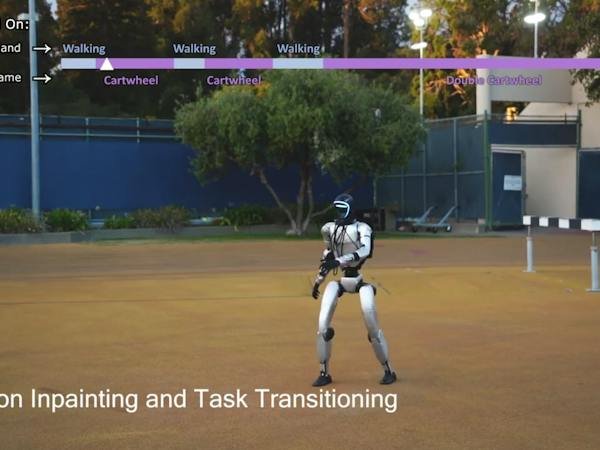
BeyondMimic teaches Unitree G1 humanoid broad motion set
Researchers from UC Berkeley and Stanford University have demonstrated BeyondMimic, a control framework that learned a broad collection of human motions and transferred 30 representative movements to a physical Unitree G1 humanoid without additional task specific training. The work remains at the research stage, but it addresses a persistent problem in humanoid control: supporting varied movement without tuning a separate controller for every skill.
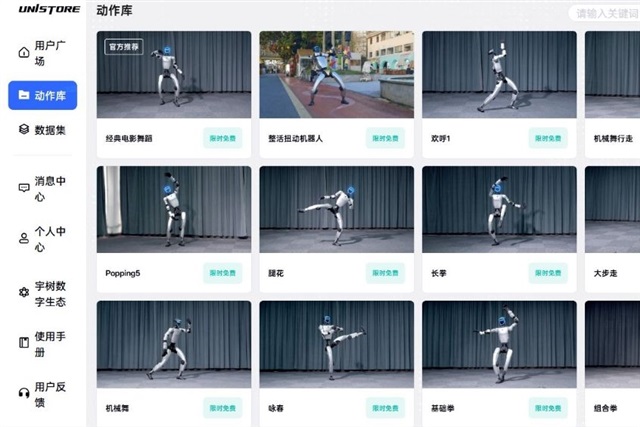
The training started with about 2.5 hours of human motion data. It included walking, running, dancing, martial arts, jumps, cartwheels and other athletic movements, according to Hackster.io. The recorded motions were adapted to the G1’s proportions and joint arrangement before reinforcement learning was used to train the control policy.
One training approach for varied movements
During reinforcement learning, BeyondMimic tracks the positions, orientations and velocities of different robot body parts. The reward system favors close reproduction of the reference motion, while penalties discourage jerky movement, body collisions and unsafe joint positions.
The framework also incorporates a variational autoencoder, which compresses robot actions into a lower dimensional representation. A diffusion model is trained on sequences combining those compressed actions with predicted robot states. Noise is introduced during training, and the model learns to reconstruct the original sequences.
This generative component allows the controller to produce connections between movements rather than simply replaying isolated recordings. The researchers applied it to joystick teleoperation and obstacle avoidance, including situations the system had not specifically encountered during training.
Physical transfer and human evaluation
The team first tested BeyondMimic in simulation, then transferred 30 representative motions to the Unitree G1. Those motions worked on the physical robot without further training tailored to each task.
A study involving 77 participants examined whether the resulting locomotion looked more natural. Participants compared BeyondMimic walking and running with movement generated by Unitree’s standard controller. BeyondMimic was judged more human like in 70.8% of the comparisons.
The naturalness result is useful but narrow. It measures human perception of walking and running, not robustness, recovery performance or success on industrial tasks. The broader technical result is the common training setup across locomotion, athletic movement, teleoperation and obstacle avoidance. The reported evaluation does not establish whether that breadth can support sustained workplace operation.
Source: Hackster.io