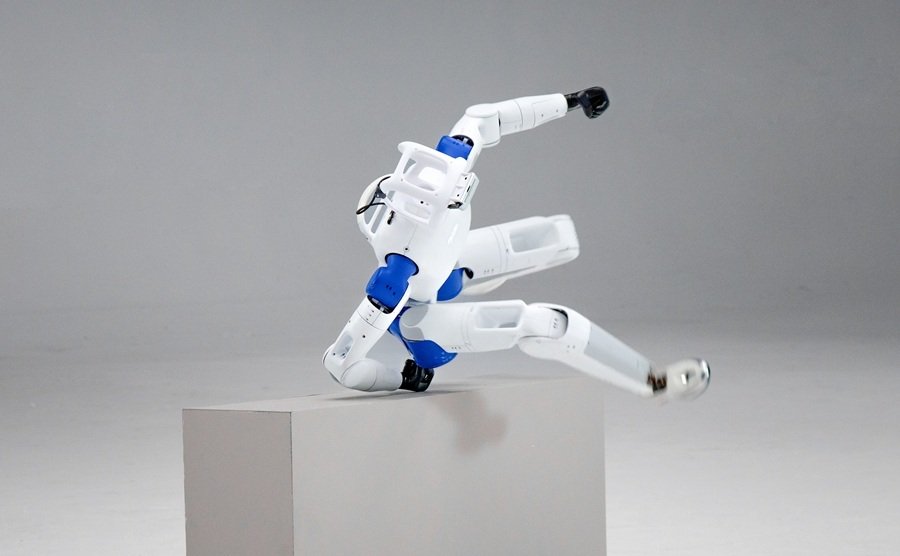
RoboParty launches RP1 humanoid with open hardware and software
RoboParty has launched the RP1 humanoid, a research platform offered in 24 and 30 actuated degree of freedom configurations, according to Auganix.org. The company describes RP1, also called ROBOTO 01, as a fully open hardware and software system, with access extending from mechanical designs and actuator resources to firmware, control algorithms and robot learning tools.
The scope of that access is the central proposition. Rather than offering only an interface for higher level applications, RoboParty says researchers can modify the underlying robot and carry their own algorithms through data collection, simulation training, physical deployment and experimental validation.
Two configurations for humanoid research
According to RoboParty, the standard RP1 stands approximately 1.3 meters tall and has 24 actuated degrees of freedom. The company positions it for gait research, balance control and transferring policies trained in simulation to physical hardware.
The Pro version has 30 actuated degrees of freedom, including a neck with two degrees of freedom and two arms with seven each. RoboParty targets that configuration at end to end policy research, human interaction and embodied AI data collection. Both versions’ joint counts exclude dexterous hands.
Interchangeable head modules and wrist end effectors allow different hardware configurations, including RoboParty’s RP Hand dexterous hand. The company says its open resources cover the robot body design and technical materials for its ROMOMO joint actuator modules, alongside documentation and research materials.
Control and learning tools
RoboParty says RP1 already supports continuous walking, recovery from external disturbances, getting up after a fall and human motion tracking. Its whole body control system coordinates the arms, torso and legs for motion tracking and posture adjustment. These supplied motor capabilities are intended to reduce the low level control work researchers must repeat before testing their own models.
The software offering includes VR teleoperation, data collection and playback, and motion retargeting. RP1 also integrates the company’s PartyOS embodied AI system, UFO unsupervised reinforcement learning framework and MimicLite motion imitation technology, according to RoboParty.
For researchers, access across those layers offers a practical debugging advantage: an inaccurate action can involve the learned model, control policy, actuator response or mechanical structure. RoboParty’s stated approach is to let teams inspect and adjust those components together rather than work solely through a fixed software interface.
RP1 continues the company’s RPO open source project, launched in January 2026. Auganix reports that RPO released mechanical and electrical design resources, training and deployment materials, and has attracted more than 2,600 GitHub stars.
Source: Auganix.org