Nvidia humanoid robot reference design debuts at COMPUTEX 2026
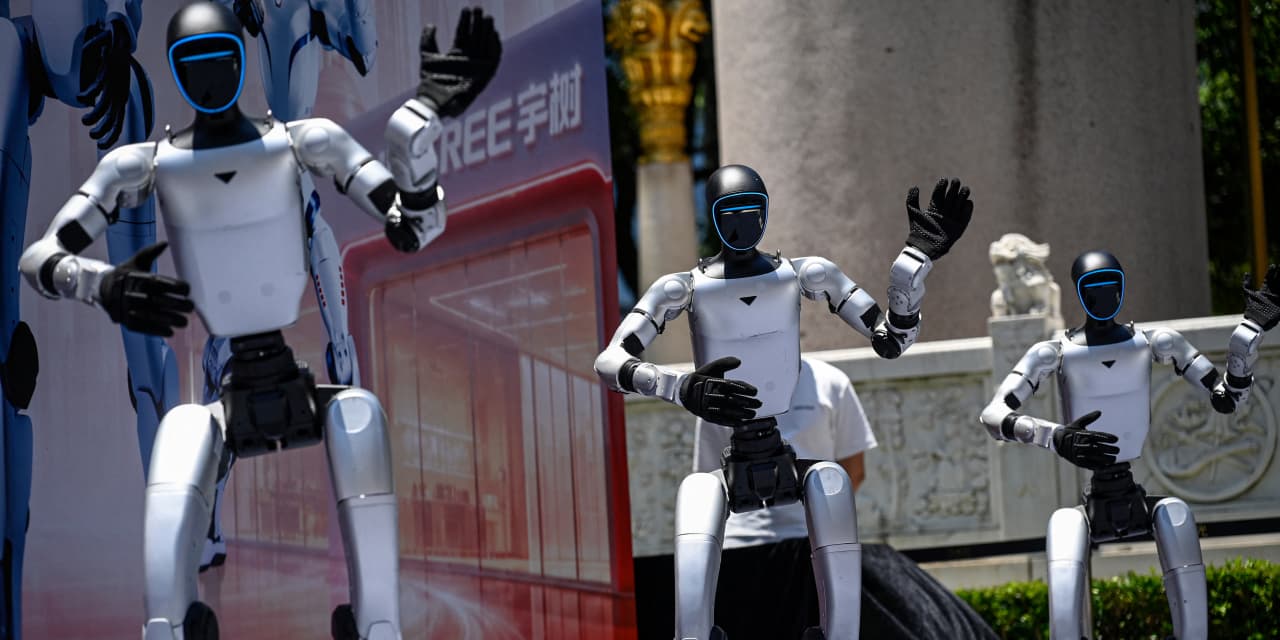
Nvidia used COMPUTEX 2026 in Taiwan to introduce its Nvidia humanoid robot reference design, an open platform intended to speed development of general-purpose humanoids. According to Barron’s, the design combines a Unitree H2 Plus humanoid robot, Sharpa five-fingered hands, and Jetson Thor onboard compute around the Isaac GR00T software stack.
How the Nvidia humanoid robot reference design is built
The announcement centers on an open reference design rather than a standalone Nvidia-built humanoid. In Nvidia’s description, the package brings together a Unitree H2 Plus body, Sharpa hands for dexterous manipulation, and Jetson Thor for onboard reasoning and control, all built on the Isaac GR00T platform.
That matters because humanoid development is still highly fragmented across mechanics, manipulation, onboard compute, and control software. Barron’s describes Isaac GR00T as Nvidia’s software for robot brains running on Jetson Thor hardware, while Sharpa is identified as an AI startup working on hands with humanlike dexterity and Unitree as a maker of AI-trained humanoid robots.
A common platform for humanoid research
Nvidia framed the release as a way to accelerate humanoid development and expand the future labor force. Jensen Huang said humanoid robots will bring physical AI to major industries and described the reference design as a single, open platform intended to help researchers make faster progress toward general-purpose physical intelligence.
For robotics teams, the practical importance is the integration model. Instead of starting with separate vendors for the body, hands, compute, and core software, the Nvidia package presents a preassembled baseline that can be used for research and prototyping. The move also extends Nvidia’s role beyond supplying processors alone by tying its software and compute products to partner hardware in one humanoid stack.
Competition and supply chain remain central
Barron’s casts the move as a direct competitive signal in a market that also includes Tesla’s Optimus effort. The article says Tesla is converting production capacity in Fremont, California, to mass-produce Optimus, even as Tesla remains an Nvidia customer for processors used in AI data centers.
The source also points to a wider field of humanoid developers. Cantor Fitzgerald analyst Andres Sheppard, as cited by Barron’s, tracks Tesla, Figure AI, Agility, Boston Dynamics, 1X Technologies, Unitree, and others. He argues that many important humanoid parts overlap with the EV supply chain, including motors, actuator power electronics, magnets, and advanced motion-control bearings.
Sheppard also said China currently produces more than 80% of the world’s humanoid robots, a lead that the United States will need to narrow. According to his view, domestic humanoid production in the U.S. could begin ramping materially over the next 12 months, suggesting that supply chain localization may become as important as model performance or demo quality.
The immediate question is whether the Nvidia humanoid robot reference design becomes a common starting point for research groups and commercial developers. If it does, the industry may shift more quickly from isolated humanoid prototypes toward shared hardware and software stacks, even as manufacturing scale, reliability, and deployment economics remain unresolved.
Source: barrons.com