Mitsubishi Electric demonstrates humanoid CNC machine tending
Mitsubishi Electric has demonstrated humanoid CNC machine tending in a system that coordinates a Galaxea Dynamics robot, a custom machine tool and an AI machining task planner. Shown at JIMTOF 2026 in Tokyo, the development system used spoken instructions to initiate a tag machining workflow, according to engineering.com. Mitsubishi Electric is conducting validation research and sees practical use around 2030.
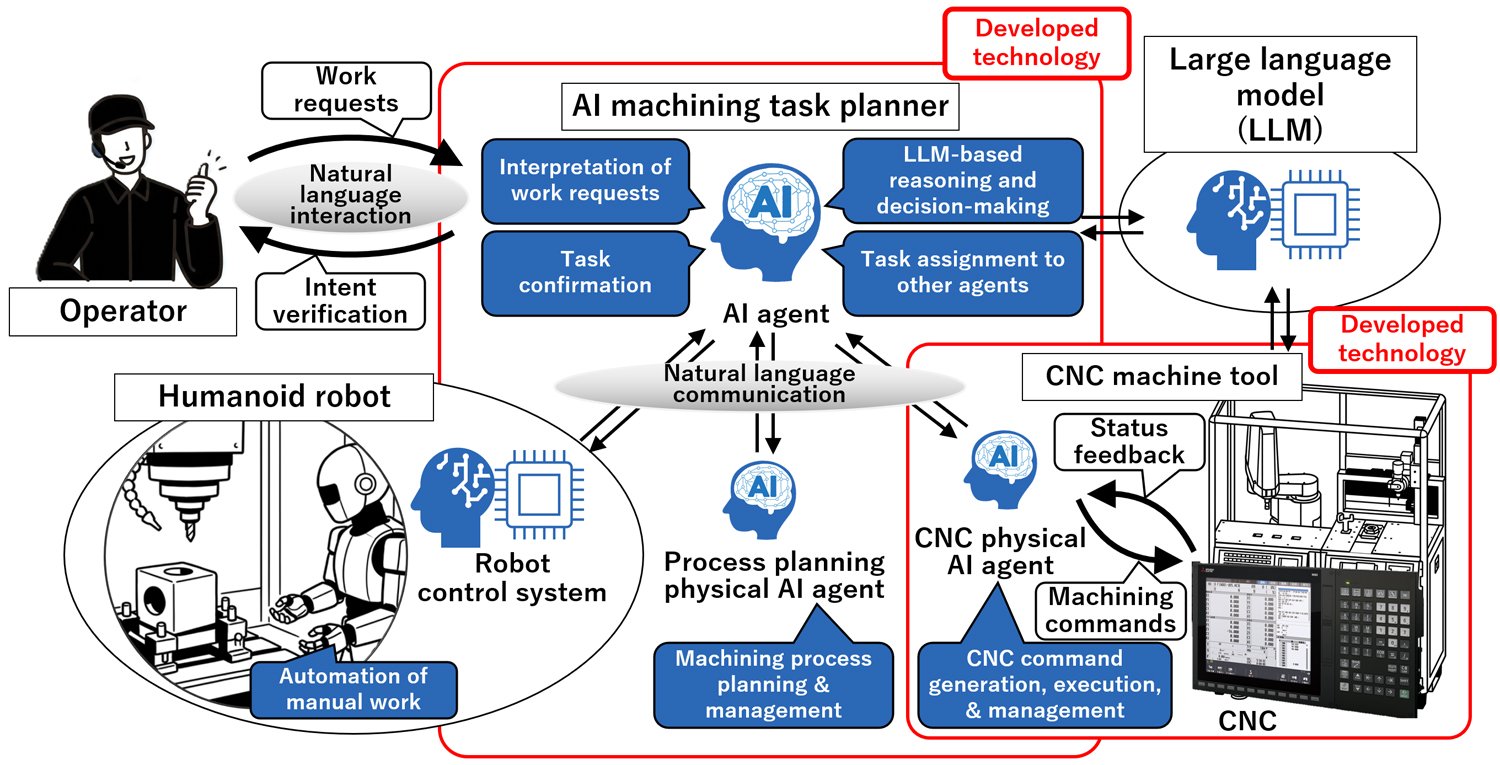
In the demonstration, an operator specified the text to be machined onto a tag by voice. AI generated the machining program, the humanoid set up the workpiece, the CNC machine machined it, and the robot removed the finished part. Mitsubishi Electric described that sequence as autonomous, while also stating that actions affecting the physical world require human approval.
A planner coordinates the robot and machine
The architecture puts coordination in an AI machining task planner rather than treating the humanoid as a standalone operator. The planner interprets instructions, generates tasks and directs both systems. It communicates with the CNC through the Model Context Protocol (MCP), and with the robot through the Robot Operating System (ROS), over Wi-Fi or a wired LAN.
The CNC can respond to planner instructions by changing machining modes and loading programs. It also supplies operational information, including machine manual information and alarm data. Both the planner and the CNC’s physical AI use Mitsubishi Electric’s proprietary Maisart technology, with a separate AI reviewing generated task plans for internal validation.
The robot’s work depends on a registered task library containing available motions, machine capabilities and supported workpieces. Changes to those parameters require library updates. Grasping and placing parts in fixtures must be configured in advance, and nonstandard machining procedures require additional natural language instructions, Mitsubishi Electric’s Tomoya Fujita told engineering.com.
Recovery and approval remain part of the workflow
Cameras and sensors check task completion before the next step. The system can retry a failed grasp, but an incorrectly positioned workpiece that cannot be placed inside the machine triggers an alarm. Mitsubishi Electric says automatic recovery for that situation is still in development.
Human approval gates cover actions including starting machining, changing parameters and changing CNC settings. The demonstration therefore combines automated task execution with explicit operator authorization, rather than unrestricted control of the cell.
Fujita identified potential uses around existing production lines designed for human workers, factories with multiple CNC machines and frequent setup changes, and operations handling relatively small parts. He said humanoids may be less suitable for heavier workpieces.
Mitsubishi Electric plans to support its current mainstream CNC series through software installation. Support for older machines through an industrial PC is under consideration as a concept. Fujita said the company hopes to begin trials at its production sites and elsewhere, initially targeting routine work around machine tools before expanding to nonroutine tasks.
Source: Engineering.com