“Deployment is the moat”: Dyna Robotics’ chief scientist on what it takes to get robots out of the lab
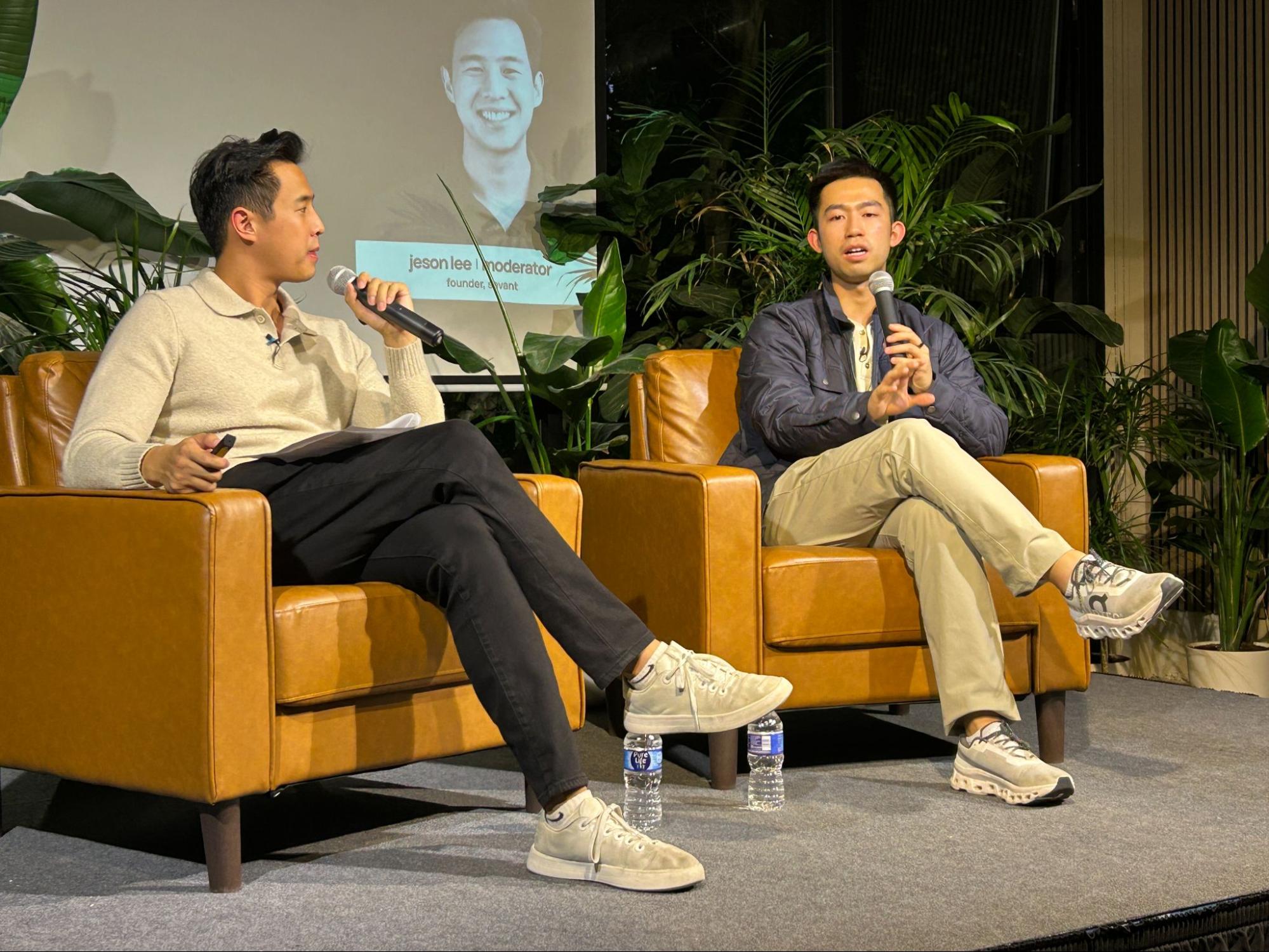
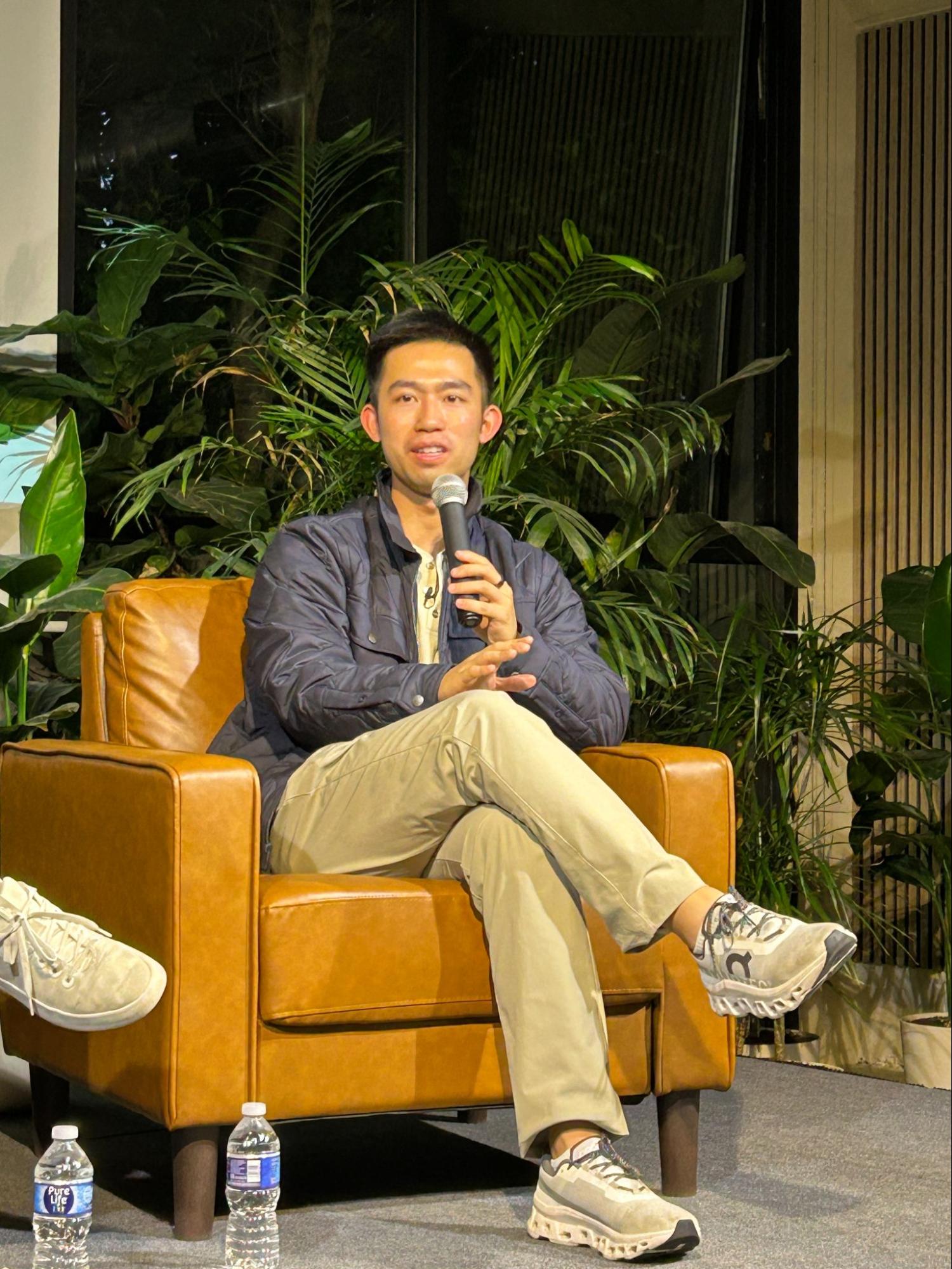
Jason Ma, co-founder and Chief Scientist of Dyna Robotics, spoke on 9 October 2026 in the Choose Good Quests series hosted by Savant VC. Jeson Lee, founder of Savant, moderated.
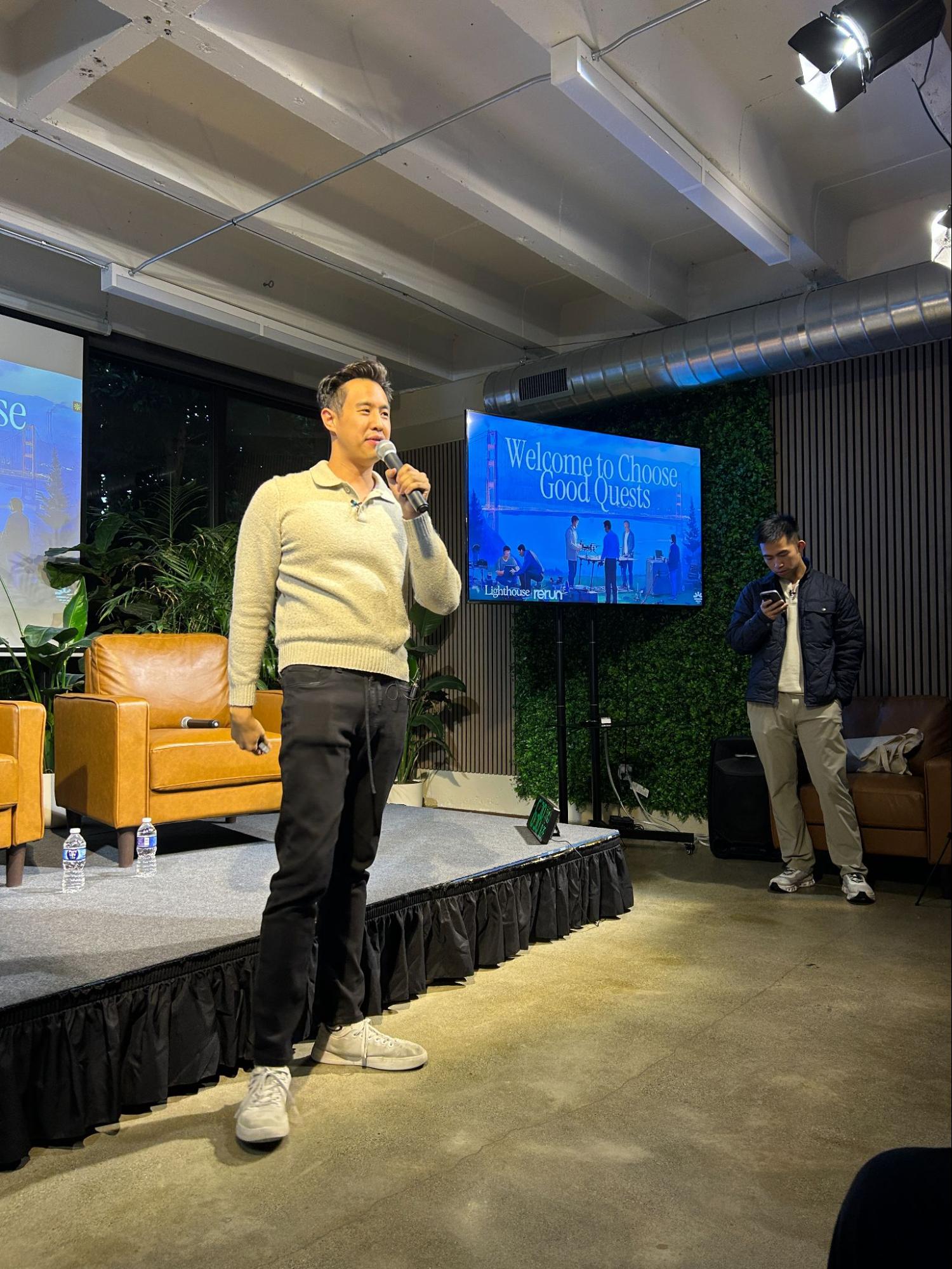
Jason Ma leads research at Dyna Robotics, a company that builds both its models and its hardware and measures progress by how the robots perform in daily operation at paying customers. Ma holds a PhD from the GRASP Lab at the University of Pennsylvania and has worked as a research scientist at Google DeepMind and at NVIDIA, where he contributed to Eureka, which was counted among the ten most important research projects of 2023. He left the research environments because the demonstrations he saw there gave little indication of how the robots would behave outside the lab, and Dyna was founded at the end of 2019, well before physical AI became a popular investment theme.
From towels to servers
Dyna started with folding napkins and towels, a task chosen because the robot can fail and try again without serious consequences, and because it offered enough learning signal to build the full technology stack, including whole-body control. The first major customer was Din Tai Fung, where a robot folds between 1,000 and 1,100 napkins per day at each restaurant, and the same unified model runs at every location with no site-specific engineering. The company also has robots in operation at Best Western, where about 1,000 towels are handled per day, and at gyms.
Experience from deployment has given Ma a clear ranking of the problems. Reaching the required performance is the first step, and sustaining it over time is the harder one, because wear and tear makes the robots non-deterministic and turns the task into a non-stationary problem. Model regression is, in his view, under-researched and will not be solved by teams that do not work on it deliberately. A 99 per cent success rate, he said, is the starting line.
From VLA to WAM
Dyna 2 moved from a vision-language-action (VLA) model to a World Action Model (WAM) trained on more than one million hours of human video. VLA models work, but they are limited in instruction following because their pretraining is not aimed at predicting future states of the world. A WAM goes from instruction to video prediction to action, and it allows generalisation to improve when video data is added even if no additional action data is available.
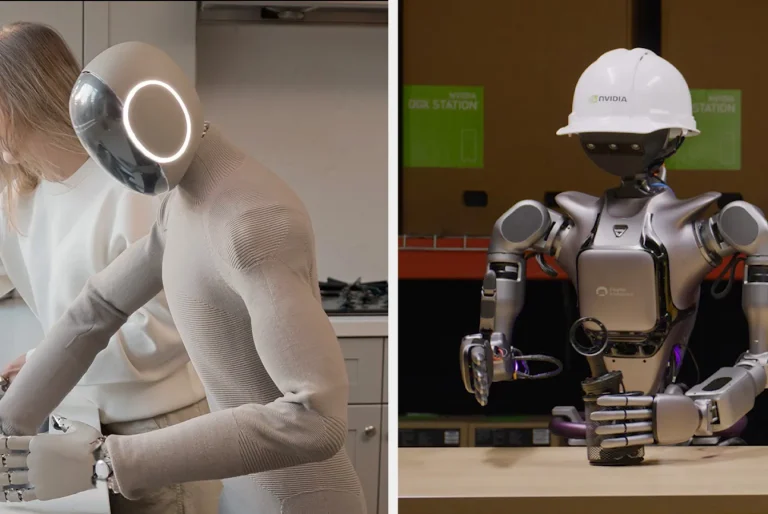
Dyna 2.1 was launched on 29 September as a framework for physical agents, together with a new embodiment called Tapu. In a one-hour demonstration the robot moves towels from a washer to a dryer, adds detergent pods and turns knobs, and it pauses folding when the dryer finishes in order to keep as many tasks running in parallel as possible. Ma compared the step to the move from autocomplete to coding agents in language models, and he described product-market fit as full automation of physical workflows rather than single-task manipulation in a fixed position.
The company builds its own hardware because off-the-shelf arms are designed for researchers, and because they are too large, too small or lack the reach to work inside a washing machine or a dryer. Most physical workflows are designed for humans, so the form factor of the robot has to match. At a new customer site a new task takes about two hours of data collection, zero-shot performance is usually good enough that a small amount of additional data brings it up to the customer’s standard, and a zero-shot T-shirt folding demonstration was given at a conference in Korea.
Roadmap and open questions
The next releases, whether they will be called Dyna 2.2 or 2.5, will have broader generalisation, wider hardware distribution and production at real scale. Dyna has a partnership with the data centre builder Lambda on robots that switch servers, which addresses a labour shortage in that industry, and the company sees logistics and hotels as further markets beyond hospitality. Ma regards Google’s Astra as complementary, and Dyna has held an internal hackathon to test Astra as a drop-in reasoning model. In his view the industry gives too much attention to models and too little to hardware and distribution, since a model without hardware and distribution cannot reach the physical world.
The challenges he described are mainly system-level. Reliability falls exponentially with task length, since 0.99 raised to the tenth power is about 90 per cent, and hardware reliability becomes harder to secure as the action space grows with seven-degree-of-freedom arms, a three-degree-of-freedom head and a torso. Ma believes that robots with a positive return on investment require work across the whole stack, and he drew a parallel to harness engineering in the language model world. Tactile sensing is for him one modality among others that is not always needed when wrist cameras avoid occlusion, and the fortune cookie demonstration was carried out without tactile sensors. Teleoperation is, in his view, necessary for every company that wants to collect data on its own robot, while the question of using it in live deployment is separate. Dyna’s approach to data is pragmatic, with an internal recipe for the data mix and no commitment to a single paradigm, and an open platform on the iPhone model is possible over time, with no fixed timeline.
His advice to young researchers was to be willing to do the unglamorous work and to work with real robots in addition to simulation, since the customer decides whether the standard has been met and the goalposts cannot be moved.
About the event
Choose Good Quests is a monthly series hosted by Savant VC, an early-stage fund for physical AI that writes first cheques. The fund runs a $3 million seed programme with rolling admission and access to a hardware lab of more than 6,000 square feet (about 560 square metres) with a CNC machine, a laser cutter and a soldering station. The sponsors were Lighthouse (immigration visa services) and Rerun (open-source infrastructure for the robotics data layer), and Zhen Xie of Ince Capital, an investor in Dyna, said that Dyna will open a new funding round soon.
Source: humanoid.guide