Welcome, Lumen S1!
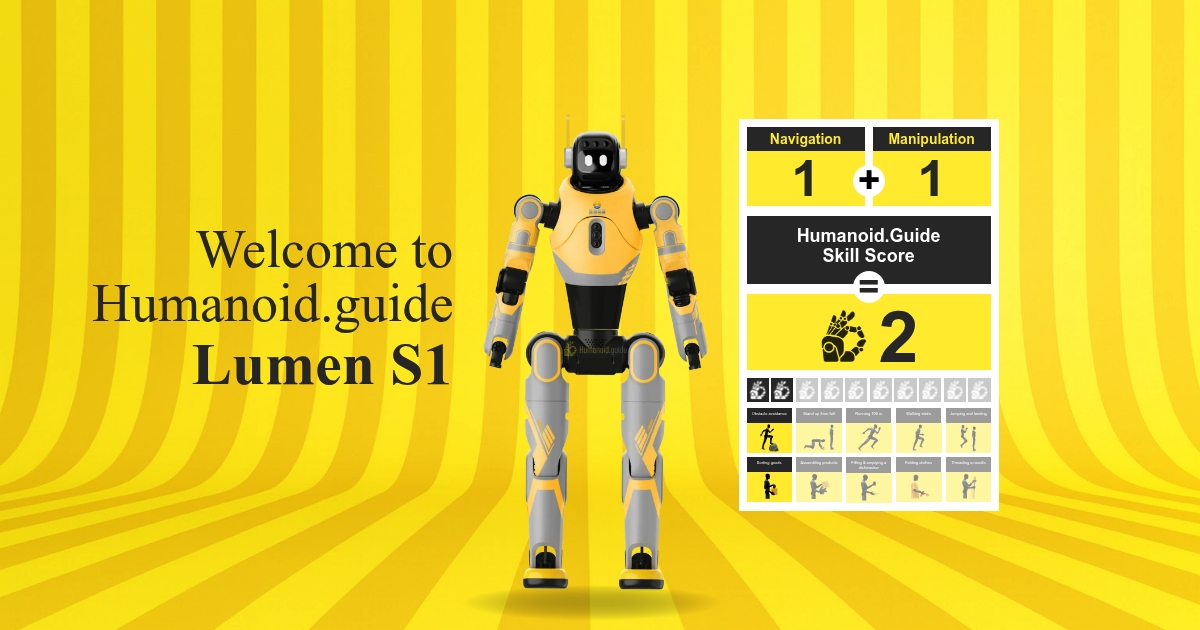
Lumen S1 is a compact humanoid robot developed by Guanggu Dongzhi, also known as HECbot, in Wuhan, China. Standing 130 cm tall and weighing 35 kg, it combines 31 body degrees of freedom with electric joint actuators and hands featuring five fingers each. Its supported physical capabilities include obstacle avoidance and sorting goods. A Humanoid.Guide Skill Score of 2 out of 10 places it in the early stage category, with Navigation and Manipulation each rated 1 out of 5. These ratings describe preliminary capability rather than mature autonomy. The hardware includes NVIDIA Jetson Orin NX computing, 16 GB of memory, and 512 GB of storage. Its sensing equipment includes LiDAR, an RGB depth camera, front stereo RGB cameras, a rear RGB camera, and an interaction camera. Listed operating specifications include approximately two hours of runtime per charge, a walking speed of 3 km/h, and a maximum speed of 4 km/h. Silver and yellow are the listed color options.
Obstacle avoidance and sorting goods provide two concrete areas for examining Lumen S1’s physical performance. For obstacle avoidance, its LiDAR and depth sensing equipment form part of the robot’s environmental sensing hardware. The Navigation rating of 1 out of 5 establishes an early stage benchmark, not a claim of comprehensive autonomous mobility. Sorting goods provides a manipulation use case for its articulated body and hands, while the Manipulation rating of 1 out of 5 similarly indicates preliminary capability. In research and education, these two functions offer defined subjects for demonstrations and evaluation. Relevant evaluation questions include how consistently the robot avoids obstacles and how reliably it completes sorting tasks under controlled conditions.
Lumen S1 is listed as in production, with a displayed price of USD 20,000 and an option to inquire about pricing. Its manufacturer, Guanggu Dongzhi, is also identified as Hubei Guanggu Dongzhi Embodied Intelligence Technology Co., Ltd., with the website hecbot.cn. Listed target markets include education and research, companionship, eldercare, entertainment, exhibitions, and marketing. These market categories describe intended deployment areas rather than proof of readiness for every associated task. Its broader significance lies in bringing a compact humanoid platform with integrated sensing and onboard computing to these markets. For prospective buyers, the distinction between intended applications and demonstrated physical capabilities is central: obstacle avoidance and sorting goods are the supported functions, alongside an overall early stage skill rating.