Welcome, Allonic Hand MK2!
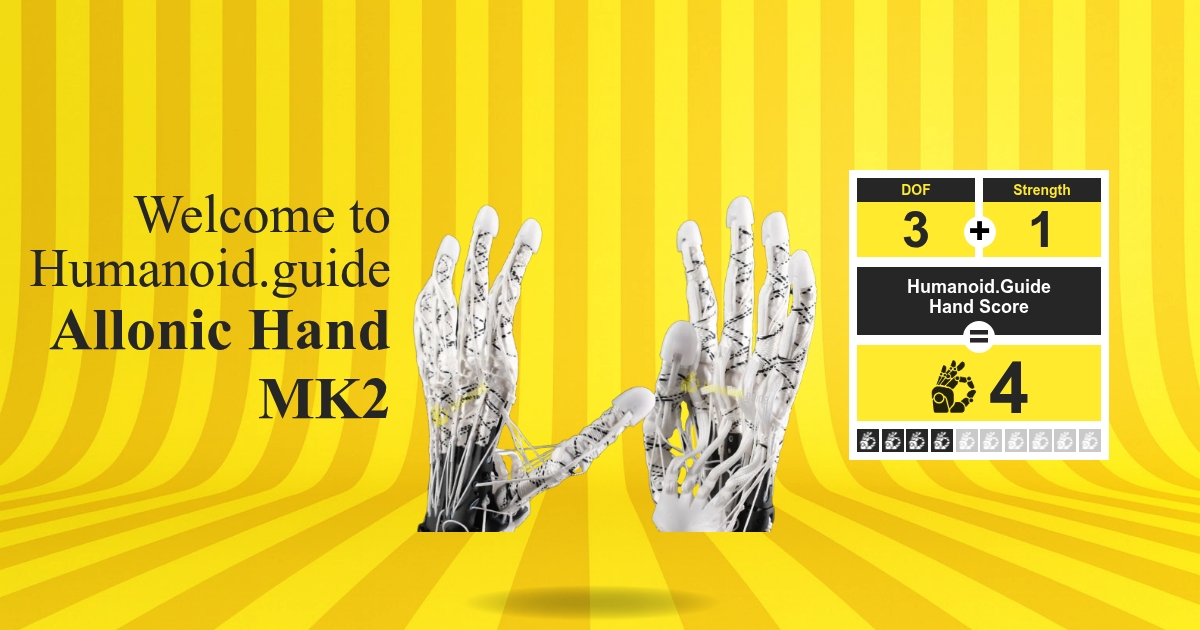
Allonic Hand MK2 is a biomimetic robotic hand built to show how advanced humanoid hardware can be made faster, cheaper, and with far less assembly work. Developed by Hungarian startup Allonic, it uses the company’s proprietary 3D Tissue Braiding process to create a monolithic composite structure in a single automated run. Braided tendons, pulley paths, and rigid support elements are integrated directly into the hand rather than added as separate components later. This architecture follows the logic of human anatomy, combining rigid internal support with woven soft structures that guide motion and compliance. The result is a hand designed for more natural movement than conventional hardware assembled from many discrete parts. In Humanoid Guide scoring, it sits in the developing range with a total score of 4, including a mid tier rating for degrees of freedom and a lower strength tier. That profile positions it as a meaningful demonstration of dexterous design and manufacturing innovation rather than a brute force manipulator aimed at heavy duty industrial handling.
A key technical idea behind the MK2 is manufacturing integration. Instead of treating tendons, routing, load paths, and outer structure as separate engineering problems, Allonic combines them into one continuous build process. That can shorten iteration cycles dramatically and make customized robotic body parts far easier to produce for research teams and emerging humanoid programs. The hand’s anatomy inspired layout also supports compliant interaction, which is valuable when developers want hardware that behaves less like a rigid machine and more like a human style manipulator. Its balanced dexterity rating suggests a platform oriented toward nuanced hand design and embodied motion studies. This makes it especially relevant for prototyping humanoid upper body systems, testing new control strategies, and exploring robotic embodiment where manufacturability and cost matter as much as raw mechanical performance.
The MK2 is currently listed as a prototype and is not available for purchase, which fits its role as a flagship technology demonstrator. Its importance extends beyond a single hand, since Allonic presents it as proof that entire robotic bodies could be woven in a single automated production flow rather than assembled from hundreds of parts. That broader thesis has attracted strong attention. In 2026, the company raised a 7.2 million dollar pre seed round with backing from angel investors connected to OpenAI and Hugging Face, marking the largest pre seed round in Hungarian history. For the humanoid sector, the hand stands out as a signal that manufacturing methods may become just as important as control software and mechanical design in determining which robotics teams can build sophisticated hardware quickly and affordably.