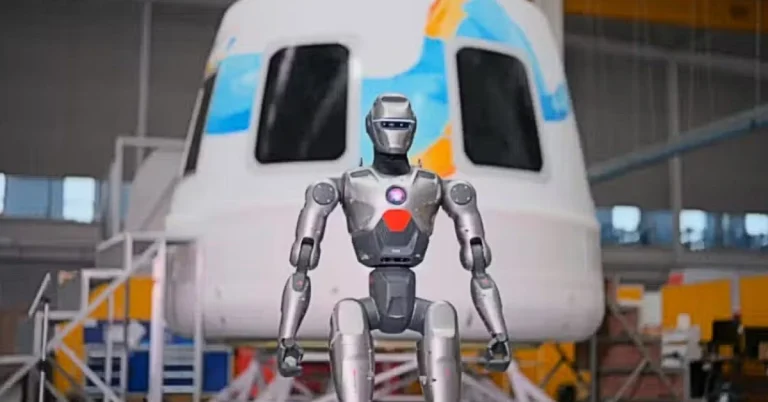
NEO Gets New Hands
Bernt Børnich teased "the most advanced robotic hand in human history". Now the new 1X NEO hands are official: 25 force-controlled degrees of freedom, fingertips that feel shear, and a target of 10,000 hands built in-house this year.
Watch the reveal · the launch film for the new hands · courtesy of 1X
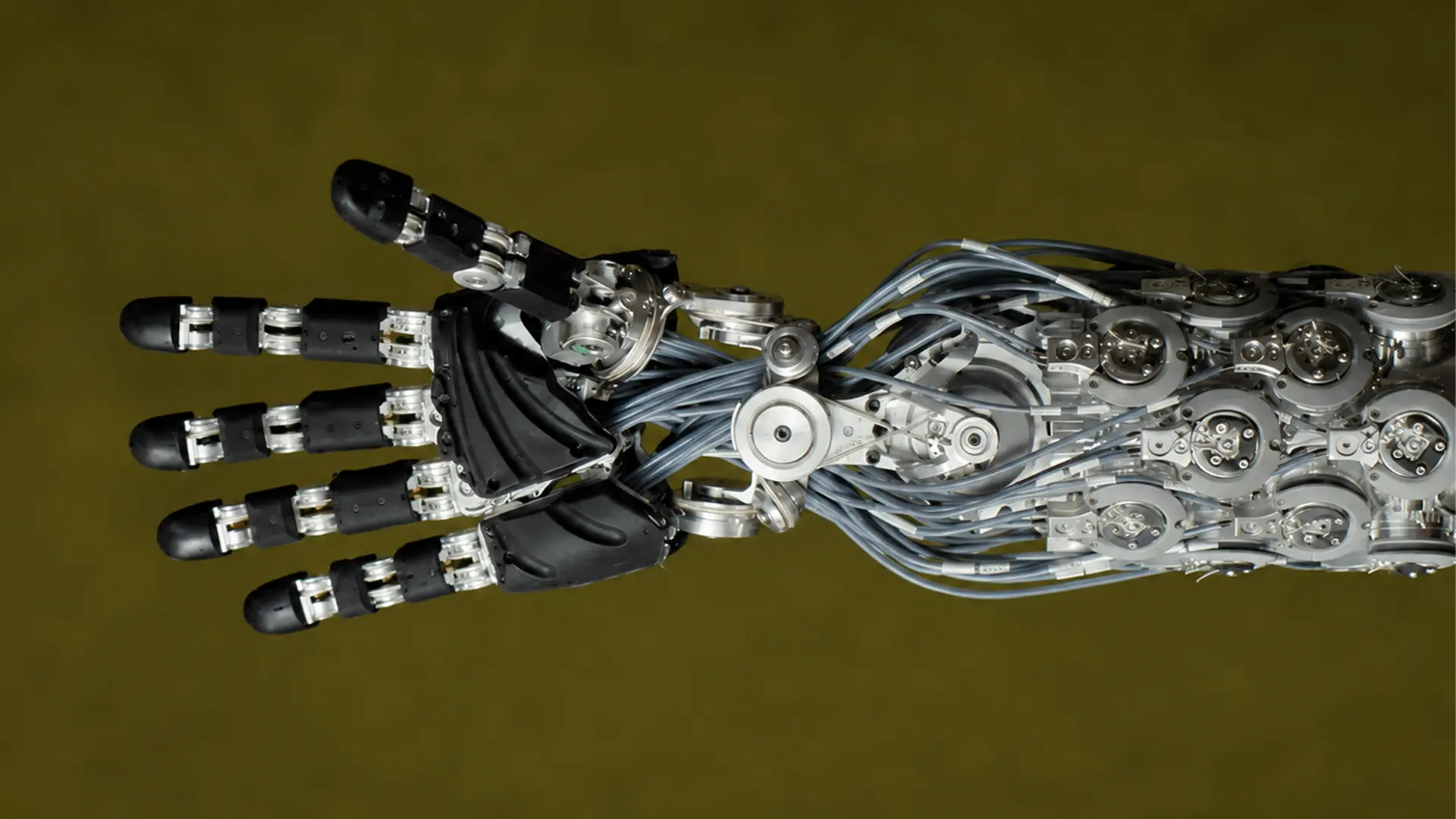
Some product teases are subtle. This was not: "Tomorrow we're unveiling the most advanced robotic hand in human history," wrote 1X founder Bernt Børnich on X, over a close-up of tendon modules that set the robotics corner of the internet counting pulleys. The unveiling is now live – and for once, the spec sheet is interesting enough to survive the hype.
The Reveal · What the New 1X NEO Hands Actually Are
1X frames the new hands as "an API to the physical world", and the numbers behind the phrase are on the launch page: 22 fully actuated degrees of freedom in the fingers and palm plus three in the wrist – all 25 force-controlled, none of them the spring-loaded passive joints that pad competitor counts. Everything is driven by the company's Tendon Drive: polymer tendons pulled by 1X's own motors at quasi-direct-drive ratios of roughly 5:1 to 15:1, which keeps every joint backdrivable – the hand can feel the world pushing back.
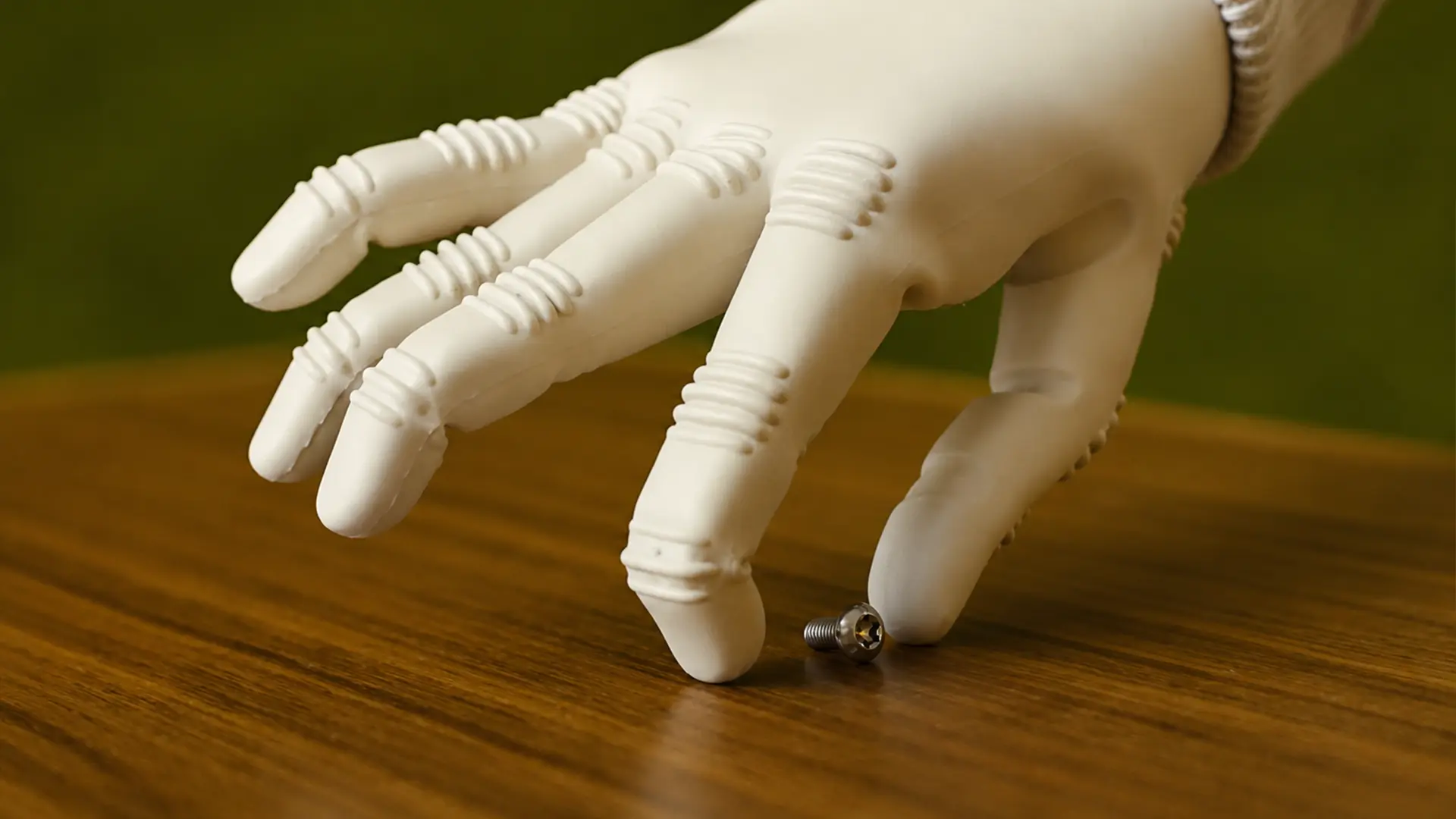
The small stuff · picking up the little things is where ±0.2 mm accuracy earns its keep · courtesy of 1X
Three things on the sheet stand out to us.
-
Force everywherePeak torques of 3.5 Nm at the thumb, 2.6 Nm at the finger knuckles and 17.75 Nm at the wrist, with up to 45 N of fingertip flexion force – and native force control on every joint, not just position control with springs.
-
Touch that includes shearThe tactile stack, moulded into the soft polymers, measures normal force, contact location and shear – enough to detect a glass starting to slip and correct the grip in real time. Shear sensing is the part most robot hands still skip.
-
Built for the dishwaterIP68 waterproof, food-safe, components tested across extreme temperatures, and wrist joints past two million cycles under load. For a home robot, that last line matters more than any dexterity demo.
Fast fingers · NEO showing off the speed of the new hand, in fourteen seconds · original video by 1X
And then the line that is easy to skim past: every unit is built end-to-end in-house – tendon materials, motors, polymers – with a stated target of 10,000 hands produced in 2026.
The full sheet, as published by 1X:
Specifications as published by 1X at launch (1x.tech) – manufacturer's own figures.
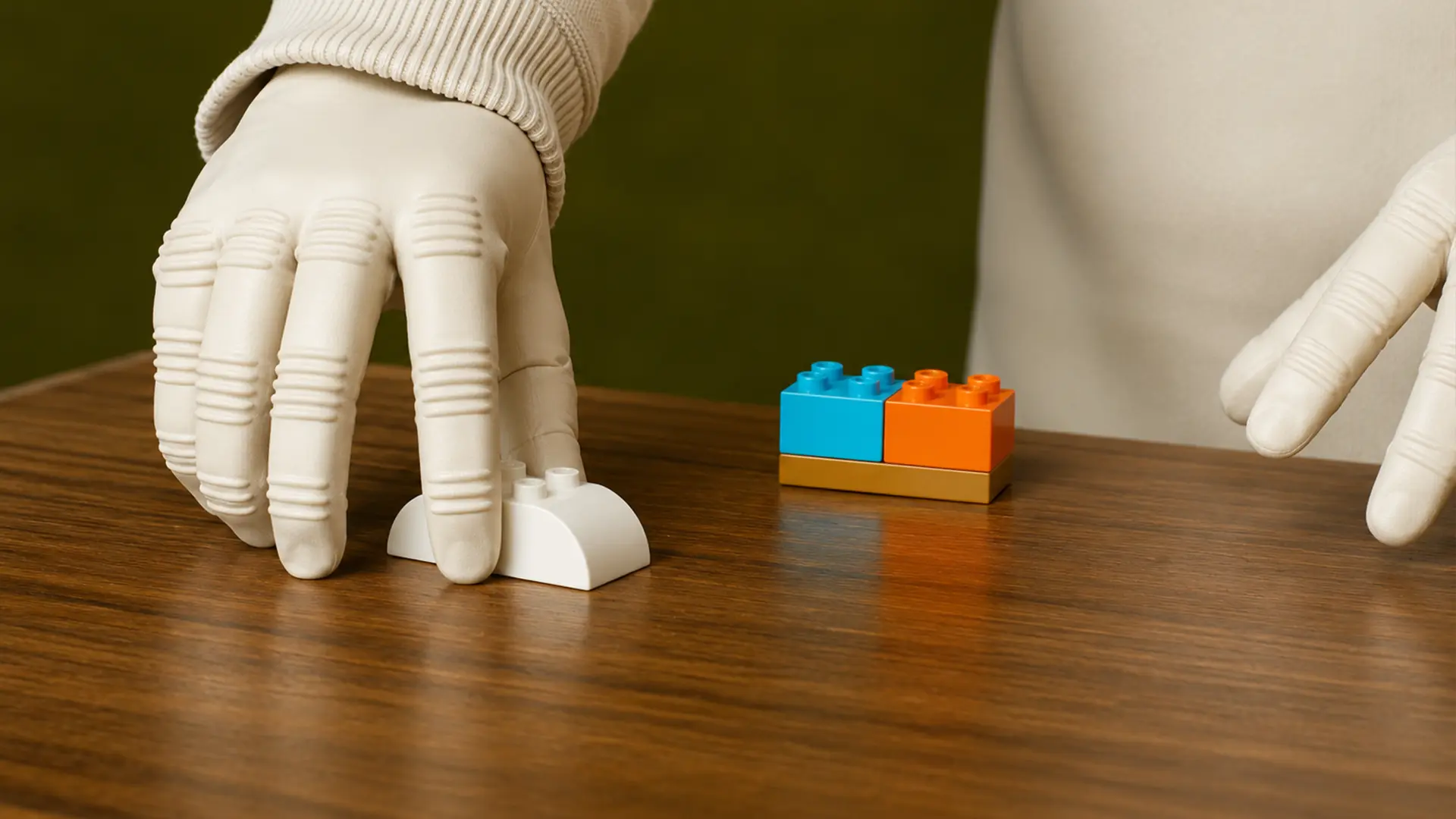
Brick by brick · Lego is the kind of party trick that quietly demands force control and touch · courtesy of 1X
"These hands are the culmination of intensive engineering focused on making humanoids truly useful."
The Foreshadowing · We Were Told, Politely
In hindsight, 1X has been trailing this reveal for weeks. In Forbes' June profile by John Koetsier, product chief Dar Sleeper demonstrated hands that were faster and more dexterous than anything in public footage – and the article noted, in plain sight, that "the hands on NEO right now that you might have seen in any existing videos are not the hands that will ship." We flagged the same signal in our own piece on NEO's hands ahead of the home launch.
Sleeper also supplied the sharpest line in the whole hand debate: most companies advertise 22 degrees of freedom, but many of those joints are passive – "usually just spring-loaded". His point, now backed by the launch page: a degree of freedom you cannot actuate and feel is a number on a datasheet, not a capability.
Neo's amazing new hands – just released! · John Koetsier's first look at the reveal, on his NEXT channel
The teaser image itself was a hint hiding in the open: the round, pulley-like modules in the close-up are tendon-drive actuator packs – 1X's signature architecture, using polymer tendons instead of rigid gearboxes, the same approach that keeps the whole robot quiet enough for a living room.
New! 2026 Humanoid
Robot Market Report
198 pages of exclusive insight from global robotics experts — uncover funding trends, technology challenges, leading manufacturers, supply chain shifts, and surveys and forecasts on future humanoid applications.

now Google DeepMind
The Hype Check · Most Advanced in Human History?
"The most advanced robotic hand in human history" is classic Børnich – a claim no spec sheet can prove and no rival can falsify. What can be done is to line the new hand up against the field, because 2026 has quietly become the year of the dexterous-hand race:
- Shadow Hand – the research benchmark for two decades, with 24 joints and a price tag to match. Legendary in the lab; never built for dishwater or volume.
- AGILINK OmniHand 3 Ultra-M – the AGIBOT spin-off's flagship with 20 active DoF and vision-based tactile fingertips, unveiled at ICRA 2026 in June with a claim of over 8,000 dexterous hands already shipped. The closest thing 1X has to a volume rival – see it in our guide.
- Wuji Hand 2 – the biomimetic, direct-drive hand that made its global debut at ICRA 2026, chasing human-like motion above all.
- Tesla Optimus – the perennial comparison: a promised 22-DoF hand for Gen 3 that, as of this writing, has not been demonstrated in public – Tesla has delayed the Gen 3 unveiling itself.
On paper, the honest read is this: no single number on the 1X sheet is unprecedented – it is the combination that is rare. Full force control on all 25 joints, shear-sensing fingertips, IP68 durability and a 10,000-unit production line do not usually appear in the same hand. Whether that adds up to "most advanced in human history" will be settled by third-party hands-on time, not by anyone's launch page – ours included.
The humanoid.guide View · Three Takes on the 1X NEO Hands
First: the DoF race is over, and 1X is trying to change the scoreboard. For years the dexterity debate has been a numbers game that rewarded creative counting. By publishing torques, force control and shear sensing instead of just a DoF figure, 1X is steering the argument toward what a hand can feel and survive – terrain where it believes it wins. Expect rivals to start publishing the same numbers within months.
Second: the hand race is really a manufacturing race. The two loudest claims of 2026 are not dexterity records – they are AGILINK's 8,000 hands shipped and 1X's 10,000 hands planned, both from vertically integrated factories. Hands are the most failure-prone, most expensive part of a humanoid; whoever industrialises them first sets the floor for everyone. That in-house Hayward line may matter more than any single joint.
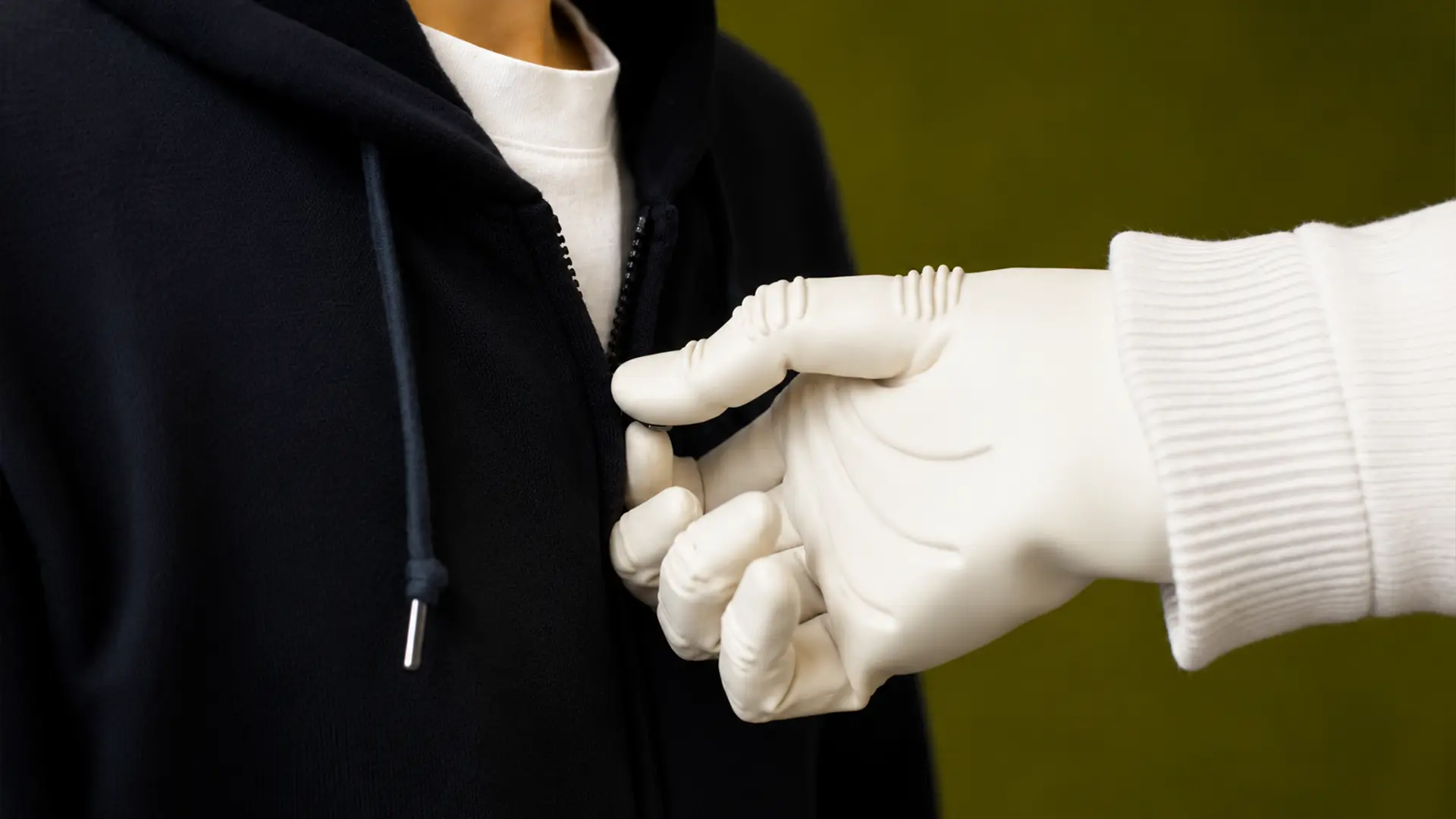
The zipper test · few household tasks punish a robot hand like a zipper – this is where slip detection earns its keep · courtesy of 1X
Third: durability is the claim to watch. Tendon-driven hands have a well-earned reputation as maintenance nightmares – tendons stretch, fray and snap. Two million wrist cycles and IP68 is exactly the answer skeptics have been asking for, and exactly the kind of claim that needs outside verification. With NEO consumer shipments slated for later this year, the real test data arrives in kitchens, not labs. We would happily be among the first to run it.
Forget the superlative – the news is force control, shear and a production line.
The hand NEO will ship with is now public. Read our earlier coverage of NEO's hands, the NEO launch and 1X's self-learning world model – or the full NEO entry in our guide.

New! 2026 Humanoid
Robot Market Report
198 pages of exclusive insight from global robotics experts — uncover funding trends, technology challenges, leading manufacturers, supply chain shifts, and surveys and forecasts on future humanoid applications.
now Google DeepMind
NEO Gets New Hands
Bernt Børnich teased "the most advanced robotic hand in human history". Now the new 1X NEO hands are official: 25 force-controlled degrees of freedom, fingertips that feel shear, and a target of 10,000 hands built in-house this year.
Watch the reveal · the launch film for the new hands · courtesy of 1X
Some product teases are subtle. This was not: "Tomorrow we're unveiling the most advanced robotic hand in human history," wrote 1X founder Bernt Børnich on X, over a close-up of tendon modules that set the robotics corner of the internet counting pulleys. The unveiling is now live – and for once, the spec sheet is interesting enough to survive the hype.
The Reveal · What the New 1X NEO Hands Actually Are
1X frames the new hands as "an API to the physical world", and the numbers behind the phrase are on the launch page: 22 fully actuated degrees of freedom in the fingers and palm plus three in the wrist – all 25 force-controlled, none of them the spring-loaded passive joints that pad competitor counts. Everything is driven by the company's Tendon Drive: polymer tendons pulled by 1X's own motors at quasi-direct-drive ratios of roughly 5:1 to 15:1, which keeps every joint backdrivable – the hand can feel the world pushing back.
The small stuff · picking up the little things is where ±0.2 mm accuracy earns its keep · courtesy of 1X
Three things on the sheet stand out to us.
-
Force everywherePeak torques of 3.5 Nm at the thumb, 2.6 Nm at the finger knuckles and 17.75 Nm at the wrist, with up to 45 N of fingertip flexion force – and native force control on every joint, not just position control with springs.
-
Touch that includes shearThe tactile stack, moulded into the soft polymers, measures normal force, contact location and shear – enough to detect a glass starting to slip and correct the grip in real time. Shear sensing is the part most robot hands still skip.
-
Built for the dishwaterIP68 waterproof, food-safe, components tested across extreme temperatures, and wrist joints past two million cycles under load. For a home robot, that last line matters more than any dexterity demo.
And then the line that is easy to skim past: every unit is built end-to-end in-house – tendon materials, motors, polymers – with a stated target of 10,000 hands produced in 2026.
The full sheet, as published by 1X:
Specifications as published by 1X at launch (1x.tech) – manufacturer's own figures.
Brick by brick · Lego is the kind of party trick that quietly demands force control and touch · courtesy of 1X
"These hands are the culmination of intensive engineering focused on making humanoids truly useful."
The Foreshadowing · We Were Told, Politely
In hindsight, 1X has been trailing this reveal for weeks. In Forbes' June profile by John Koetsier, product chief Dar Sleeper demonstrated hands that were faster and more dexterous than anything in public footage – and the article noted, in plain sight, that "the hands on NEO right now that you might have seen in any existing videos are not the hands that will ship." We flagged the same signal in our own piece on NEO's hands ahead of the home launch.
Sleeper also supplied the sharpest line in the whole hand debate: most companies advertise 22 degrees of freedom, but many of those joints are passive – "usually just spring-loaded". His point, now backed by the launch page: a degree of freedom you cannot actuate and feel is a number on a datasheet, not a capability.
Neo's amazing new hands – just released! · John Koetsier's first look at the reveal, on his NEXT channel
The teaser image itself was a hint hiding in the open: the round, pulley-like modules in the close-up are tendon-drive actuator packs – 1X's signature architecture, using polymer tendons instead of rigid gearboxes, the same approach that keeps the whole robot quiet enough for a living room.
New! 2026 Humanoid
Robot Market Report
198 pages of exclusive insight from global robotics experts — uncover funding trends, technology challenges, leading manufacturers, supply chain shifts, and surveys and forecasts on future humanoid applications.
now Google DeepMind
The Hype Check · Most Advanced in Human History?
"The most advanced robotic hand in human history" is classic Børnich – a claim no spec sheet can prove and no rival can falsify. What can be done is to line the new hand up against the field, because 2026 has quietly become the year of the dexterous-hand race:
- Shadow Hand – the research benchmark for two decades, with 24 joints and a price tag to match. Legendary in the lab; never built for dishwater or volume.
- AGILINK OmniHand 3 Ultra-M – the AGIBOT spin-off's flagship with 20 active DoF and vision-based tactile fingertips, unveiled at ICRA 2026 in June with a claim of over 8,000 dexterous hands already shipped. The closest thing 1X has to a volume rival – see it in our guide.
- Wuji Hand 2 – the biomimetic, direct-drive hand that made its global debut at ICRA 2026, chasing human-like motion above all.
- Tesla Optimus – the perennial comparison: a promised 22-DoF hand for Gen 3 that, as of this writing, has not been demonstrated in public – Tesla has delayed the Gen 3 unveiling itself.
On paper, the honest read is this: no single number on the 1X sheet is unprecedented – it is the combination that is rare. Full force control on all 25 joints, shear-sensing fingertips, IP68 durability and a 10,000-unit production line do not usually appear in the same hand. Whether that adds up to "most advanced in human history" will be settled by third-party hands-on time, not by anyone's launch page – ours included.
The humanoid.guide View · Three Takes on the 1X NEO Hands
First: the DoF race is over, and 1X is trying to change the scoreboard. For years the dexterity debate has been a numbers game that rewarded creative counting. By publishing torques, force control and shear sensing instead of just a DoF figure, 1X is steering the argument toward what a hand can feel and survive – terrain where it believes it wins. Expect rivals to start publishing the same numbers within months.
Second: the hand race is really a manufacturing race. The two loudest claims of 2026 are not dexterity records – they are AGILINK's 8,000 hands shipped and 1X's 10,000 hands planned, both from vertically integrated factories. Hands are the most failure-prone, most expensive part of a humanoid; whoever industrialises them first sets the floor for everyone. That in-house Hayward line may matter more than any single joint.
The zipper test · few household tasks punish a robot hand like a zipper – this is where slip detection earns its keep · courtesy of 1X
Third: durability is the claim to watch. Tendon-driven hands have a well-earned reputation as maintenance nightmares – tendons stretch, fray and snap. Two million wrist cycles and IP68 is exactly the answer skeptics have been asking for, and exactly the kind of claim that needs outside verification. With NEO consumer shipments slated for later this year, the real test data arrives in kitchens, not labs. We would happily be among the first to run it.
Forget the superlative – the news is force control, shear and a production line.
The hand NEO will ship with is now public. Read our earlier coverage of NEO's hands, the NEO launch and 1X's self-learning world model – or the full NEO entry in our guide.
New! 2026 Humanoid
Robot Market Report
198 pages of exclusive insight from global robotics experts — uncover funding trends, technology challenges, leading manufacturers, supply chain shifts, and surveys and forecasts on future humanoid applications.
now Google DeepMind