Booster T2 targets developers with an open humanoid platform
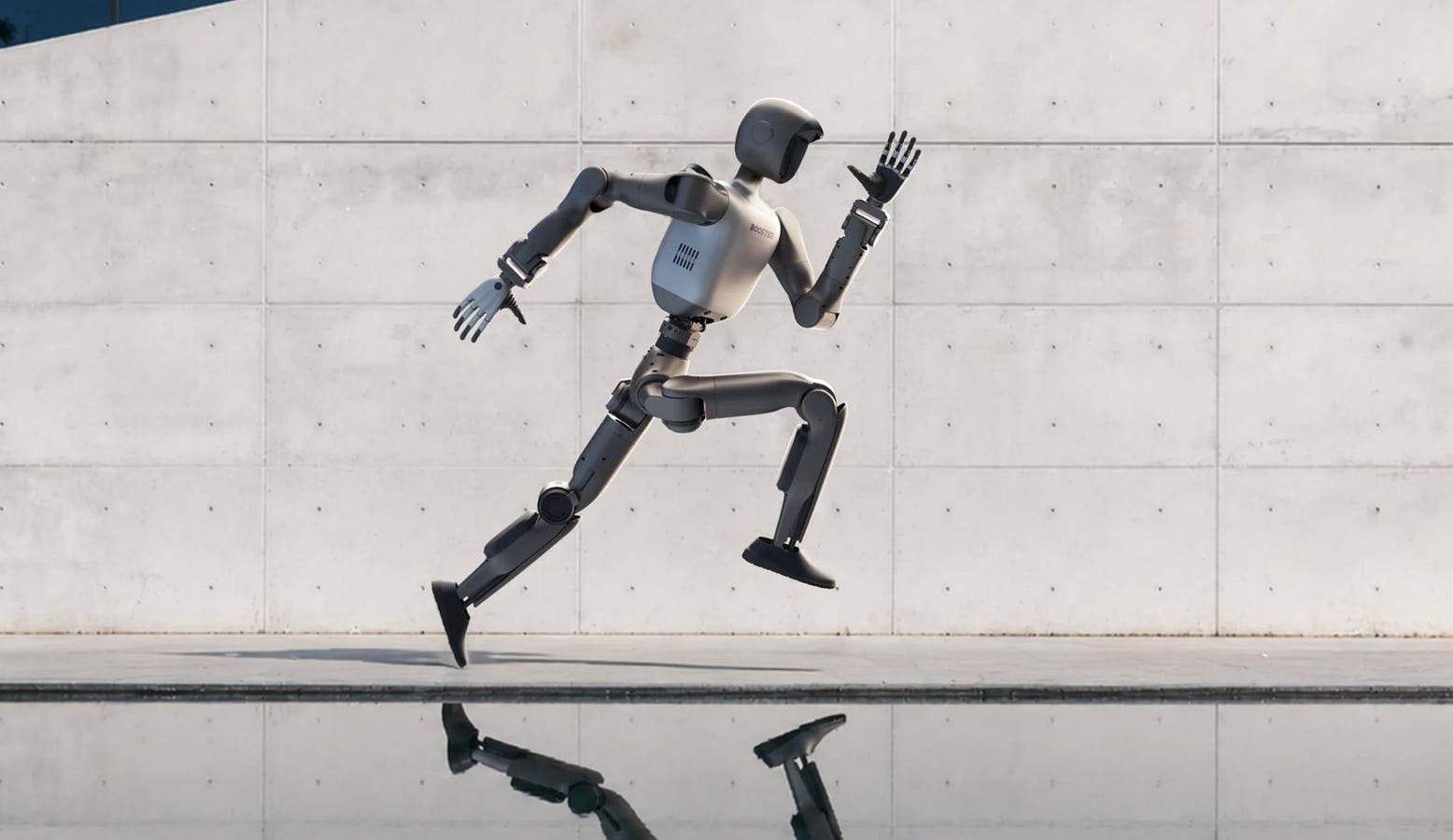
Booster Robotics is pitching its T2 humanoid as a platform for customers building their own robot intelligence, rather than a complete industrial automation system. At Web Summit in Lisbon, the Chinese company showed the robot and outlined its hardware focused strategy to Forbes, offering developers access to its APIs and software development kit.
“We produce the hardware,” Booster’s Clarence Huang told Forbes. “But we do not focus on the software.” The distinction is about who builds the application, not an absence of software: Booster also develops an operating system and development tools, and has said some investment funding will support embodied AI models and algorithms.
T2 hardware and configuration costs
According to the specifications reported by Forbes, the Booster T2 stands 1.4 meters tall, weighs about 42 kilograms and has 31 degrees of freedom. Its maximum combined arm payload is 10 kilograms. Interchangeable end effectors allow customers to fit grippers or dexterous hands from third party suppliers.
Huang said the Professional Edition includes NVIDIA’s Jetson Thor T5000, delivering up to 2,070 TFLOPS of FP4 sparse AI compute. That is a specific low precision compute rating, rather than a measure of how reliably the humanoid performs a physical task.
Booster specifies approximately two hours of battery operation. The robot can also operate while charging through a magnetic connection, according to Forbes, giving developers an option for extended experiments at a workstation without relying solely on battery endurance.
Configuration has a substantial effect on price. Forbes reported that US retailer RobotShop listed the T2 Professional starting at $40,066 without dexterous hands, compared with $132,660 for a configuration equipped with BrainCo Revo3 hands offering 21 degrees of freedom.
Customers take on the application work
Booster Studio, launched in June, combines coding, simulation, debugging and deployment to physical robots. The company says developers can use the same codebase in simulation and on hardware. Its tools also include AI assisted code generation and real time visualization of sensor data.
That approach fits research teams that want control over models and behavior. For industrial applications, it leaves the integration work with the buyer or a systems integrator: selecting software, adapting it to a task and maintaining the resulting system. Open developer tools are not unique to Booster; Forbes also points to Unitree’s SDKs and simulation environments.
Huang told Forbes that operational safety depends partly on software maturity, task complexity and the operating environment. A customer supplied control stack therefore becomes part of the safety engineering problem, alongside the hardware.
Booster says it has delivered more than 3,000 robots across more than 30 countries and regions, serving education, research, competition and development customers.
Source: Forbes