PRISM humanoid control module improves simulated walking
University of Michigan researchers report that a neural network input module called PRISM enabled simulated humanoids to finish 92.5% of 24-second walking trials without falling, compared with 51% for a conventional multilayer perceptron. According to Michigan Engineering, the module also retained an advantage when friction, mass and payload changed beyond training conditions.
The PRISM humanoid control results point to a specific architectural improvement rather than a benefit from network size alone. A conventional network enlarged to match PRISM’s parameter count, about 43% above the original baseline, completed just 52.3% of the walking trials. The humanoid locomotion results reported by the university are simulation results.
Learning interactions at the input layer
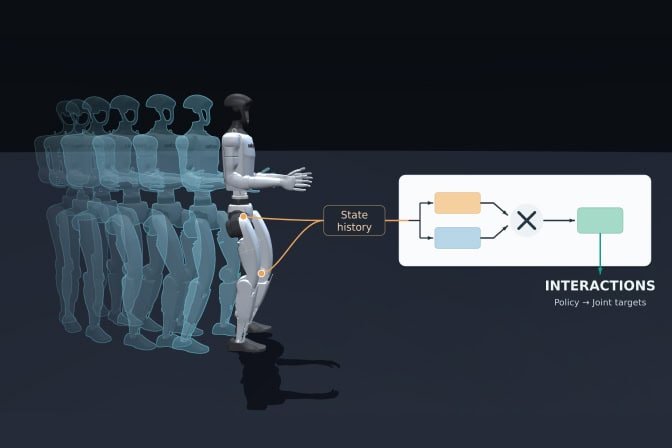
PRISM stands for Polynomial Representations for Interaction-Structured Motor Control. It learns multiplicative relationships among observations, past actions and task commands, including joint positions, velocities and desired walking speeds. Conventional multilayer perceptrons, or MLPs, learn these relationships indirectly, using network capacity to approximate interactions that PRISM represents more explicitly.
That design addresses a basic feature of motor control: movement at one joint depends on the state of others, while physical quantities such as mechanical power involve products of variables. The researchers say PRISM learns useful combinations from data without requiring engineers to specify physical equations or manually choose which variables to multiply.
“Many useful clues about physical interaction are already present in a robot’s observations, through combinations of signals such as joint positions and velocities. PRISM gives the controller a compact way to learn and use these combinations,” said Seung Hyun Lee, a Michigan doctoral student and the study’s lead author.
The module replaces the initial processing of robot state and command inputs. According to the university, it can therefore be incorporated into existing learning systems without changing their training objectives, sensing requirements or controllers.
Testing changed friction, mass and payload
Across six altered physical conditions, PRISM controlled humanoids completed 92.3% of trials on flat terrain, compared with 78.3% for a standard MLP with the same parameter count. On uneven terrain, the figures were 87.1% and 80%, respectively. These tests required neither retraining nor network modifications.
The study, supported by the National Science Foundation, was presented at the Conference on Robot Learning in Austin, Texas, on November 10, 2026. Probing the learned representations, the researchers found that quantities related to joint power, slipping and contact forces were more predictable from PRISM’s representations than from those of conventional networks.
Source: Michigan Engineering News