Welcome, JingChu!
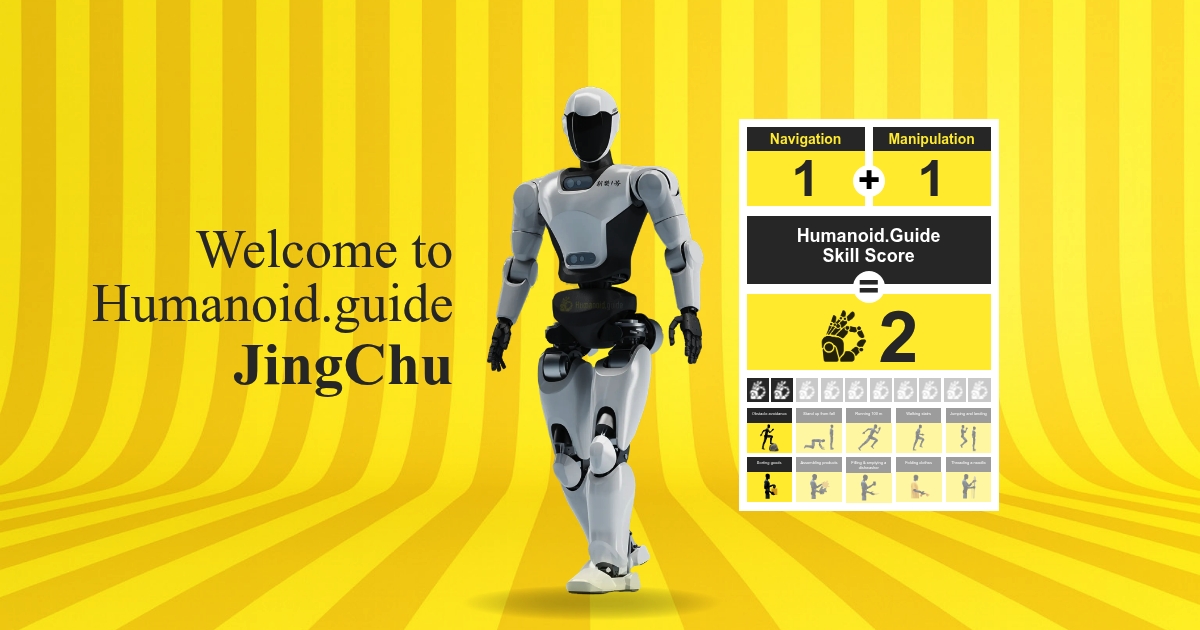
JingChu is a full size humanoid robot developed by Hubei Jingchu Humanoid Robot Co., Ltd., which operates under the JCBOT brand in Wuhan, China. Standing 170 cm tall and weighing 65 kg, it combines a bipedal body with five finger hands for education, research, and service applications. Its documented capabilities include obstacle avoidance and sorting goods. A Humanoid.Guide score of 2 out of 10 places it in the early stage category, with Navigation and Manipulation each rated 1 out of 5. The robot has 26 body degrees of freedom and uses planetary roller screw linear actuators at the knees, while other joints use rotary motor modules. Its listed maximum speed is 3 km/h, and its strength specification is 4 kg. LiDAR and depth cameras support obstacle avoidance, though its safety classification for interaction with humans is only partial. Large language model integration enables voice interaction, adding a conversational interface to a platform primarily intended for physical robotics development and demonstrations.
Obstacle avoidance and sorting goods define JingChu’s demonstrated capability profile. LiDAR and depth cameras provide environmental sensing for detecting obstacles, an important component of navigation in shared indoor spaces. For manipulation, its five finger hands provide the physical interface for sorting goods. These capabilities offer concrete topics for education and research, including how a humanoid senses nearby objects and organizes items. The onboard computing specification lists a 6 core CPU, a 32 core GPU, and 67 TOPS of AI compute, with Bluetooth 5.2 and WiFi 6 connectivity. Its low Navigation and Manipulation tier ratings remain important context: JingChu is an early stage platform, rather than a mature general purpose worker.
JingChu is listed as in production, with an advertised price of 35,000 USD and an inquiry option for prospective buyers. Its manufacturer is based in Wuhan, and the robot’s name refers to Jingchu, a historic name associated with the Hubei region. The stated target markets are education, research, and service, positioning it as a platform for institutions exploring humanoid robotics. Its broader significance lies in bringing locomotion hardware, articulated hands, environmental sensing, onboard computing, and conversational interaction into one human sized system. For prospective adopters, the distinction between that hardware breadth and its early stage skill score is central: purchasing a humanoid platform does not imply broad task autonomy or mature workplace performance.